Tuition Centre vs Self-Study: Which Path Leads to PSLE Chinese Success?
November 20, 2025
Decimal Place-Value Games: Printable Worksheets for Engaging Primary Mathematics Learning
November 24, 2025
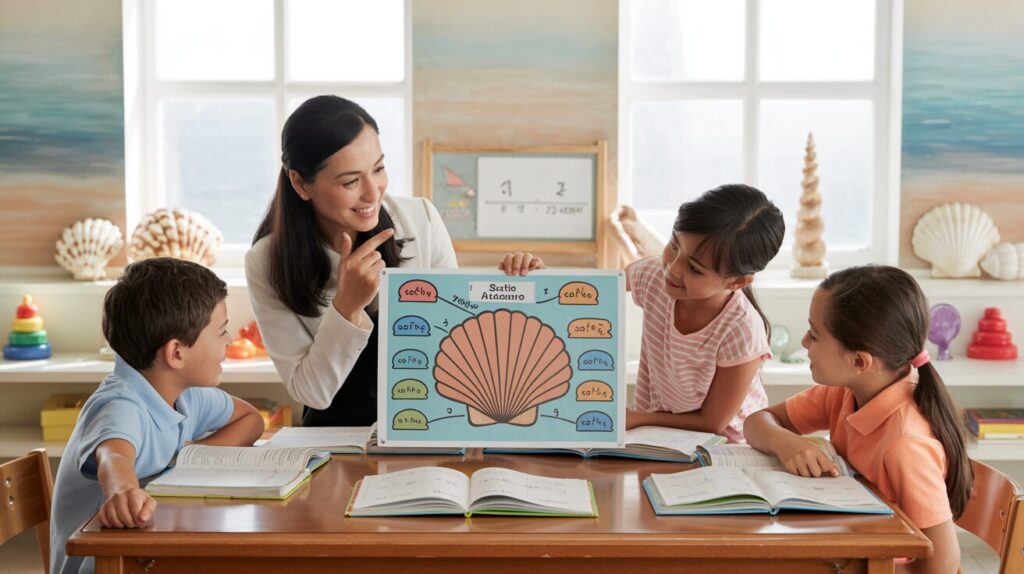
Table Of Contents
- Understanding Ratios in P5 Mathematics
- The Seashell Method for Solving Ratio Problems
- Category 1: Direct Ratio Word Problems
- Category 2: Part-Whole Ratio Problems
- Category 3: Complex Ratio Problems
- Category 4: Advanced Application Problems
- Common Mistakes to Avoid
- Preparing for PSLE Ratio Questions
- Conclusion
Ratio word problems can often feel like navigating through a mathematical maze for Primary 5 students. These questions require not just computational skills but a deeper understanding of proportional relationships. At Seashell Academy by Suntown Education Centre, we believe that every student has the potential to master these concepts when provided with the right guidance and approach.
Ratios form a cornerstone of Primary 5 Mathematics and feature prominently in the PSLE examination. Whether comparing quantities, solving for unknown values, or tackling complex multi-step problems, a strong foundation in ratio concepts opens the door to success in numerous mathematical domains.
In this comprehensive guide, we’ll walk through 12 carefully selected worked examples that cover the full spectrum of ratio word problems your child will encounter. Using our proven Seashell Method, we’ll break down each problem into manageable steps, providing clear explanations and visual representations to build both understanding and confidence. By the end of this article, your child will have gained valuable problem-solving strategies that transform challenging ratio questions into approachable opportunities to showcase their mathematical prowess.
Understanding Ratios in P5 Mathematics
At the Primary 5 level, ratio concepts evolve from simple comparisons to more complex applications. A ratio represents the relationship between quantities, typically expressed in the form a:b. For example, if there are 3 boys for every 5 girls in a class, the ratio of boys to girls is 3:5.
The Singapore Mathematics curriculum introduces ratio concepts progressively, with Primary 5 representing a critical transition point where students move from basic understanding to applying ratio concepts in increasingly sophisticated problem-solving scenarios. This foundation prepares students for the challenging PSLE Mathematics questions that often integrate ratios with other concepts like percentages, fractions, and algebraic thinking.
Before diving into our worked examples, let’s clarify some essential terminology that will appear throughout this guide:
Terms in a ratio – The numbers in a ratio (e.g., in 3:5, the terms are 3 and 5)
Equivalent ratios – Ratios that express the same relationship (e.g., 3:5 = 6:10 = 9:15)
Unit ratio – A ratio where one of the terms equals 1 (e.g., 1:4 or 5:1)
Part-to-part ratio – Comparing one subset to another subset (e.g., the ratio of boys to girls)
Part-to-whole ratio – Comparing a subset to the total (e.g., the ratio of boys to all students)
The Seashell Method for Solving Ratio Problems
At Seashell Academy by Suntown Education Centre, we’ve developed a structured approach to help students navigate ratio word problems with confidence. Our Seashell Method combines cognitive mapping with emotional support to transform mathematical challenges into achievable steps:
S – Study the problem carefully to identify what is given and what needs to be found
E – Express the relationships using appropriate ratio notation
A – Analyze the units and ensure consistency throughout
S – Search for the total value or a known quantity to establish a reference point
H – Harness the power of unitary method or models when appropriate
E – Execute calculations methodically
L – Look back to verify that your answer makes sense
L – Learn from the problem by reflecting on the strategy used
This method not only structures the problem-solving process but also builds confidence as students see how complex problems can be broken down into manageable steps. We’ll apply this method throughout our worked examples to demonstrate its effectiveness across various problem types.
Category 1: Direct Ratio Word Problems
Direct ratio problems represent the foundation of ratio understanding. These problems involve straightforward applications of ratio concepts to find unknown quantities when the relationship between items is clearly defined.
Example 1: Finding Total Quantity
Problem: The ratio of apples to oranges in a fruit basket is 3:5. If there are 24 apples, how many fruits are there in total?
Solution using the Seashell Method:
Study: We know the ratio of apples to oranges is 3:5, and there are 24 apples. We need to find the total number of fruits (apples + oranges).
Express: Let’s denote the ratio as apples:oranges = 3:5
Analyze: Both quantities are measured in the same unit (number of fruits).
Search: We know there are 24 apples, which corresponds to the first term in our ratio (3).
Harness: If 3 parts = 24 apples, then 1 part = 24 ÷ 3 = 8 fruits.
Execute:
If 1 part = 8 fruits, then 5 parts (oranges) = 8 × 5 = 40 oranges.
Total fruits = Apples + Oranges = 24 + 40 = 64 fruits
Look back: Let’s verify. The ratio of apples to oranges should be 3:5.
24:40 = 24÷8:40÷8 = 3:5 ✓
Learn: We found the value of one part, then used it to calculate the other part and the total.
Example 2: Finding One Part When Total is Given
Problem: The ratio of boys to girls in a class is 4:7. If there are 44 students in total, how many boys are there?
Solution using the Seashell Method:
Study: The ratio of boys to girls is 4:7, and there are 44 students in total. We need to find the number of boys.
Express: Boys:Girls = 4:7
Analyze: Both quantities are measured in the same unit (number of students).
Search: Total number of students = 44, which represents 4 + 7 = 11 parts.
Harness: If 11 parts = 44 students, then 1 part = 44 ÷ 11 = 4 students.
Execute:
Number of boys = 4 parts = 4 × 4 = 16 boys
Look back: Let’s verify. Number of girls should be 7 parts = 7 × 4 = 28 girls.
Total students = 16 + 28 = 44 ✓
Ratio of boys to girls = 16:28 = 16÷4:28÷4 = 4:7 ✓
Learn: When given the total quantity and a ratio, we first find what one part represents by dividing the total by the sum of the ratio terms.
Example 3: Comparing Quantities
Problem: Ahmad and Mei Lin collected stamps. The ratio of Ahmad’s stamps to Mei Lin’s stamps was 5:8. If Ahmad had 30 stamps, how many more stamps did Mei Lin have than Ahmad?
Solution using the Seashell Method:
Study: The ratio of Ahmad’s stamps to Mei Lin’s stamps is 5:8. Ahmad has 30 stamps. We need to find how many more stamps Mei Lin had.
Express: Ahmad:Mei Lin = 5:8
Analyze: Both quantities are measured in the same unit (number of stamps).
Search: Ahmad has 30 stamps, which corresponds to 5 parts.
Harness: If 5 parts = 30 stamps, then 1 part = 30 ÷ 5 = 6 stamps.
Execute:
Mei Lin’s stamps = 8 parts = 8 × 6 = 48 stamps
Difference = Mei Lin’s stamps – Ahmad’s stamps = 48 – 30 = 18 stamps
Look back: Verifying the ratio: 30:48 = 30÷6:48÷6 = 5:8 ✓
Learn: When comparing quantities in a ratio problem, we find the value of one part first, then calculate each quantity and determine the difference.
Category 2: Part-Whole Ratio Problems
Part-whole ratio problems require students to understand how individual parts relate to the total. These problems often involve expressing ratios in terms of fractions of the whole.
Example 4: Finding Individual Parts
Problem: In a bag of 60 marbles, the ratio of red marbles to blue marbles to green marbles is 2:3:5. How many green marbles are there?
Solution using the Seashell Method:
Study: The ratio of red:blue:green marbles is 2:3:5, and there are 60 marbles in total. We need to find the number of green marbles.
Express: Red:Blue:Green = 2:3:5
Analyze: All quantities are measured in the same unit (number of marbles).
Search: Total number of marbles = 60, which represents 2 + 3 + 5 = 10 parts.
Harness: If 10 parts = 60 marbles, then 1 part = 60 ÷ 10 = 6 marbles.
Execute:
Number of green marbles = 5 parts = 5 × 6 = 30 marbles
Look back: Number of red marbles = 2 × 6 = 12
Number of blue marbles = 3 × 6 = 18
Total = 12 + 18 + 30 = 60 marbles ✓
Learn: With multiple terms in a ratio, we still follow the same process of finding what one part represents, then multiplying by the specific term we’re looking for.
Example 5: Finding the Whole
Problem: The ratio of the number of fiction books to non-fiction books in a library is 3:2. If there are 126 fiction books, how many books are there altogether?
Solution using the Seashell Method:
Study: The ratio of fiction to non-fiction books is 3:2, and there are 126 fiction books. We need to find the total number of books.
Express: Fiction:Non-fiction = 3:2
Analyze: Both quantities are measured in the same unit (number of books).
Search: Fiction books = 126, which corresponds to 3 parts.
Harness: If 3 parts = 126 books, then 1 part = 126 ÷ 3 = 42 books.
Execute:
Non-fiction books = 2 parts = 2 × 42 = 84 books
Total books = Fiction + Non-fiction = 126 + 84 = 210 books
Look back: Verifying the ratio: 126:84 = 126÷42:84÷42 = 3:2 ✓
Learn: To find the whole, we determine the value of one part and then calculate the sum of all parts.
Example 6: Working with Fractions
Problem: In a fruit basket, the ratio of apples to oranges to pears is 4:3:5. What fraction of the fruits are pears?
Solution using the Seashell Method:
Study: The ratio of apples:oranges:pears is 4:3:5. We need to find what fraction of the fruits are pears.
Express: Apples:Oranges:Pears = 4:3:5
Analyze: We’re looking for a fraction, so we need to determine how the pears relate to the total.
Search: The total number of parts is 4 + 3 + 5 = 12 parts.
Harness: Pears represent 5 parts out of 12 total parts.
Execute:
Fraction of pears = 5/12
Look back: Let’s verify by considering a concrete example. If we have 12 fruits in total, we would have 4 apples, 3 oranges, and 5 pears. The fraction of pears would be 5/12.
Learn: To find a fraction in a ratio problem, we express the part as the numerator and the total number of parts as the denominator.
Category 3: Complex Ratio Problems
Complex ratio problems involve changes to the original ratio or multiple steps. These problems require careful analysis and systematic application of ratio concepts.
Example 7: Changing Ratios
Problem: The ratio of red beads to blue beads in a box is 3:4. After adding 15 red beads and 5 blue beads, the ratio becomes 1:1. How many red beads were there originally?
Solution using the Seashell Method:
Study: Initially, the ratio of red:blue beads is 3:4. After adding 15 red beads and 5 blue beads, the ratio becomes 1:1. We need to find the original number of red beads.
Express: Let’s say there were originally 3x red beads and 4x blue beads, where x is the number of units.
Analyze: After the addition, we have (3x + 15) red beads and (4x + 5) blue beads, and these quantities are now equal.
Search: We can set up an equation: 3x + 15 = 4x + 5
Harness: Let’s solve for x:
3x + 15 = 4x + 5
15 – 5 = 4x – 3x
10 = x
Execute:
Original number of red beads = 3x = 3 × 10 = 30 beads
Look back: Let’s verify:
Original number of blue beads = 4x = 4 × 10 = 40 beads
After adding: Red beads = 30 + 15 = 45, Blue beads = 40 + 5 = 45
New ratio = 45:45 = 1:1 ✓
Learn: When ratios change, we can set up equations using variables to represent the original quantities and solve for the unknown.
Example 8: Consecutive Changes
Problem: The ratio of boys to girls in a class is 4:5. After 6 more boys join the class, the ratio becomes 5:4. How many students were there originally?
Solution using the Seashell Method:
Study: Initially, the ratio of boys:girls is 4:5. After 6 more boys join, the ratio becomes 5:4. We need to find the original total number of students.
Express: Let’s say there were originally 4x boys and 5x girls, where x is the number of units.
Analyze: After 6 more boys join, there are (4x + 6) boys and 5x girls, with a new ratio of 5:4.
Search: We can set up an equation based on the new ratio:
(4x + 6)/5x = 5/4
Harness: Let’s solve for x:
(4x + 6)/5x = 5/4
4(4x + 6) = 5 × 5x
16x + 24 = 25x
24 = 25x – 16x
24 = 9x
x = 24/9 = 8/3
Execute:
Original number of boys = 4x = 4 × 8/3 = 32/3
Since we can’t have a fractional number of students, let’s multiply by 3:
If x = 8, then:
Original number of boys = 4 × 8 = 32
Original number of girls = 5 × 8 = 40
Original total number of students = 32 + 40 = 72
Look back: Let’s verify:
After adding 6 boys: Boys = 32 + 6 = 38, Girls = 40
New ratio = 38:40 = 38÷2:40÷2 = 19:20 (not 5:4)
Let’s recalculate. If x = 8/3:
Original number of boys = 4 × 8/3 = 32/3
Original number of girls = 5 × 8/3 = 40/3
After adding 6 boys: Boys = 32/3 + 6 = 32/3 + 18/3 = 50/3, Girls = 40/3
New ratio = 50/3:40/3 = 50:40 = 5:4 ✓
Therefore, the original total number of students = 32/3 + 40/3 = 72/3 = 24 students
Learn: Complex ratio problems involving consecutive changes often require algebraic equations and careful verification of our answers.
Example 9: Multi-Step Ratio Problems
Problem: In a bag containing red, blue, and green marbles, the ratio of red to blue marbles is 3:4, and the ratio of blue to green marbles is 2:1. If there are 48 marbles in total, how many red marbles are there?
Solution using the Seashell Method:
Study: We have two ratios: red:blue = 3:4 and blue:green = 2:1. There are 48 marbles in total. We need to find the number of red marbles.
Express: We need to find a common ratio that relates all three colors.
Analyze: Since blue appears in both ratios, we can use it as a reference.
If red:blue = 3:4, then red = 3/4 × blue.
If blue:green = 2:1, then green = 1/2 × blue.
Search: Let’s say there are 4y blue marbles. Then:
Red marbles = 3/4 × 4y = 3y
Blue marbles = 4y
Green marbles = 1/2 × 4y = 2y
Total marbles = 3y + 4y + 2y = 9y = 48
Harness: Solving for y:
9y = 48
y = 48/9 = 16/3
Execute:
Number of red marbles = 3y = 3 × 16/3 = 16 marbles
Look back: Let’s verify:
Blue marbles = 4y = 4 × 16/3 = 64/3 marbles
Green marbles = 2y = 2 × 16/3 = 32/3 marbles
Total = 16 + 64/3 + 32/3 = 16 + 96/3 = 16 + 32 = 48 marbles ✓
Ratio of red to blue = 16:(64/3) = 16:21.33… (not 3:4)
Let’s recalculate. If blue marbles = 4y, we need:
red:blue = 3:4
blue:green = 2:1
This gives us:
red:blue:green = 3:4:2
Total parts = 3 + 4 + 2 = 9
If 9 parts = 48 marbles, then 1 part = 48 ÷ 9 = 16/3 marbles
Red marbles = 3 × 16/3 = 16 marbles
Learn: When working with multiple ratios, we need to establish a common relationship among all quantities before solving for specific values.
Category 4: Advanced Application Problems
These problems integrate ratio concepts with other mathematical ideas or real-world scenarios, requiring students to apply their knowledge in context.
Example 10: Ratio with Age Problems
Problem: The ratio of Mary’s age to her mother’s age is 2:7. In 8 years’ time, the ratio will become 3:8. How old is Mary now?
Solution using the Seashell Method:
Study: Currently, Mary’s age to her mother’s age is 2:7. In 8 years, the ratio will be 3:8. We need to find Mary’s current age.
Express: Let Mary’s current age be 2x and her mother’s current age be 7x.
Analyze: In 8 years, Mary will be (2x + 8) years old, and her mother will be (7x + 8) years old. The new ratio will be 3:8.
Search: We can set up an equation:
(2x + 8)/(7x + 8) = 3/8
Harness: Let’s solve for x:
8(2x + 8) = 3(7x + 8)
16x + 64 = 21x + 24
64 – 24 = 21x – 16x
40 = 5x
x = 8
Execute:
Mary’s current age = 2x = 2 × 8 = 16 years
Look back: Let’s verify:
Mother’s current age = 7x = 7 × 8 = 56 years
Current ratio = 16:56 = 2:7 ✓
In 8 years: Mary = 16 + 8 = 24, Mother = 56 + 8 = 64
Future ratio = 24:64 = 3:8 ✓
Learn: Age problems with ratios involve both the current and future states, requiring us to account for equal time progression for all parties involved.
Example 11: Ratio with Money
Problem: Ali, Ben, and Charlie shared $450 in the ratio 2:3:4. How much more did Charlie receive than Ali?
Solution using the Seashell Method:
Study: Ali, Ben, and Charlie shared $450 in the ratio 2:3:4. We need to find how much more Charlie received than Ali.
Express: Ali:Ben:Charlie = 2:3:4
Analyze: The total ratio is 2 + 3 + 4 = 9 parts, and the total amount is $450.
Search: If 9 parts = $450, then 1 part = $450 ÷ 9 = $50.
Harness: Ali’s share = 2 parts = 2 × $50 = $100
Charlie’s share = 4 parts = 4 × $50 = $200
Execute:
Difference = Charlie’s share – Ali’s share = $200 – $100 = $100
Look back: Ben’s share = 3 × $50 = $150
Total = $100 + $150 + $200 = $450 ✓
Learn: Ratio problems involving money follow the same principles as other ratio problems, but we need to be mindful of the units (dollars and cents).
Example 12: Ratio with Mixture Problems
Problem: Solution A contains water and salt in the ratio 9:1. Solution B contains water and salt in the ratio 4:1. If 300 ml of Solution A is mixed with 200 ml of Solution B, what is the ratio of water to salt in the resulting mixture?
Solution using the Seashell Method:
Study: Solution A has water:salt = 9:1, and Solution B has water:salt = 4:1. We mix 300 ml of A with 200 ml of B. We need to find the water:salt ratio in the mixture.
Express: Let’s determine the actual amounts of water and salt in each solution.
Analyze:
In Solution A (300 ml):
Water:Salt = 9:1, which means Water = 9/10 of the solution, Salt = 1/10 of the solution.
Amount of water in A = 9/10 × 300 ml = 270 ml
Amount of salt in A = 1/10 × 300 ml = 30 ml
In Solution B (200 ml):
Water:Salt = 4:1, which means Water = 4/5 of the solution, Salt = 1/5 of the solution.
Amount of water in B = 4/5 × 200 ml = 160 ml
Amount of salt in B = 1/5 × 200 ml = 40 ml
Search: We need to find the total amounts of water and salt in the mixture.
Harness:
Total water = 270 ml + 160 ml = 430 ml
Total salt = 30 ml + 40 ml = 70 ml
Execute:
Ratio of water to salt in the mixture = 430:70 = 43:7
Look back: Total volume of mixture = 300 ml + 200 ml = 500 ml
Water + Salt = 430 ml + 70 ml = 500 ml ✓
Learn: Mixture problems require us to track the individual components through the mixing process, then establish the new ratio based on the total quantities of each component.
Common Mistakes to Avoid
Even with a solid understanding of ratio concepts, students can fall into common traps. Here are some mistakes to watch out for:
1. Misinterpreting the ratio: Always clarify whether the ratio represents part-to-part or part-to-whole relationships.
2. Forgetting to convert to equivalent units: When working with different units (e.g., kg and g), ensure all quantities are expressed in the same unit before applying ratio principles.
3. Not verifying answers: Always check that your solution satisfies the original ratio and makes logical sense.
4. Overlooking the context: Ratios must be interpreted within the context of the problem. For example, in certain problems, the number of people must be a whole number.
5. Rushing the calculation: Take time to organize your thoughts and work methodically through each step of the problem.
At Seashell Academy by Suntown Education Centre, we teach students to avoid these pitfalls by applying our structured problem-solving method consistently.
Preparing for PSLE Ratio Questions
As students prepare for the PSLE Mathematics examination, it’s important to develop strategies for tackling ratio questions effectively:
1. Master the fundamentals: Ensure a solid understanding of basic ratio concepts before attempting complex problems.
2. Practice a variety of question types: Expose yourself to different variations of ratio problems to build flexibility in your problem-solving approach.
3. Develop a systematic approach: The Seashell Method provides a framework that can be applied to any ratio problem, helping you organize your thinking and avoid missing crucial steps.
4. Draw models when helpful: Visual representations can clarify complex relationships in ratio problems.
5. Build computational fluency: Practice calculations involving fractions, decimals, and percentages to enhance your ability to work with ratios efficiently.
At our Mathematics Programme, we incorporate these strategies into our curriculum, ensuring students develop both conceptual understanding and procedural fluency in ratio problems.
Conclusion
Ratio word problems may seem daunting at first, but with a systematic approach and plenty of practice, they become manageable and even enjoyable challenges. The 12 worked examples we’ve explored cover the full spectrum of ratio problems that Primary 5 students might encounter, from basic direct ratio calculations to complex multi-step scenarios.
At Seashell Academy by Suntown Education Centre, we believe that every student can master these concepts when provided with clear explanations, structured methods, and supportive guidance. Our Seashell Method empowers students to approach ratio problems with confidence, breaking down complex questions into manageable steps.
Remember that success in ratio word problems—and mathematics in general—comes from understanding the underlying concepts rather than memorizing procedures. By developing a strong foundation in ratios at the Primary 5 level, students prepare themselves not only for PSLE success but also for continued mathematical growth in secondary school and beyond.
If your child needs additional support with ratio concepts or other mathematical topics, our experienced educators at Seashell Academy are ready to provide personalized guidance through our Mathematics Programme. We combine academic excellence with emotional support to nurture not just capable students, but confident, resilient learners who approach challenges with enthusiasm.
Want your child to master ratio problems and build confidence in mathematics?
Discover how our proven Seashell Method can transform your child’s mathematical journey!
Contact Us Today