DIY Lung Model: A Hands-On Activity to Understand the Respiratory System
December 17, 2025
Food Webs: Marine Ecosystem Diorama Project Guide for Primary School Students
December 20, 2025
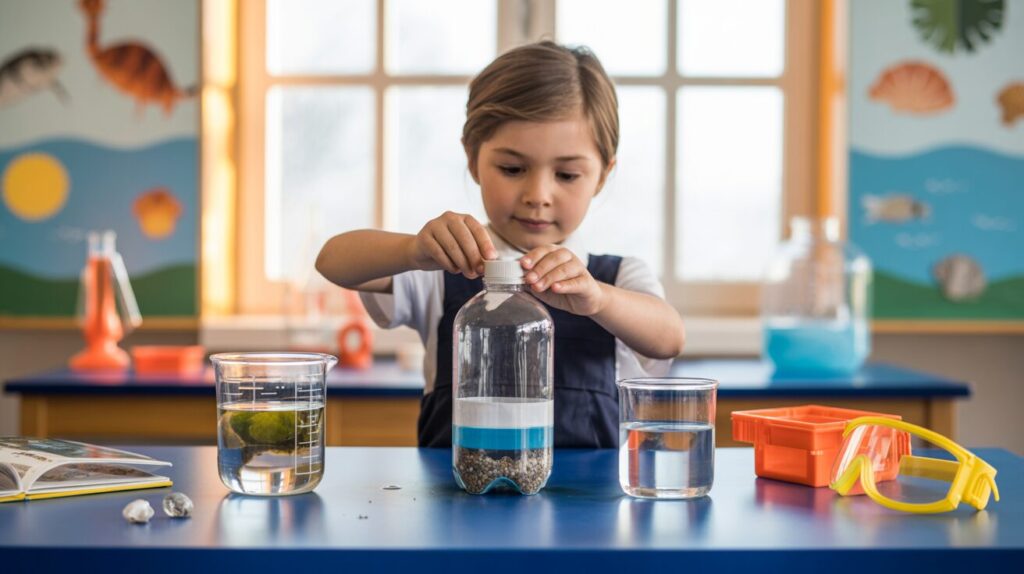
Table Of Contents
- Introduction to Water Pollution Experiments
- Why Water Filtration Experiments Matter
- The Science Behind Water Filtration
- Materials Needed for Your Homemade Filter
- Step-by-Step Filter Construction Procedure
- Conducting the Filtration Experiment
- Making Scientific Observations
- Experiment Variations and Extensions
- Connecting to Real-World Applications
- Conclusion
Water is our planet’s most precious resource, yet pollution threatens this vital element that sustains all life. At Seashell Academy by Suntown Education Centre, we believe that understanding environmental concepts through hands-on experiments not only strengthens scientific knowledge but also nurtures a deeper connection with our natural world. Our homemade water filter experiment provides students with an engaging way to visualize water pollution and explore practical solutions to environmental challenges.
This experiment transforms abstract concepts of water purification into tangible learning experiences. By constructing their own water filters using everyday materials, students can observe firsthand how contaminants are removed through physical processes similar to those used in nature and modern treatment facilities. The activity perfectly embodies our Seashell Method—combining academic learning with practical application while fostering critical thinking skills that extend far beyond the classroom.
Whether you’re a parent looking for an educational weekend activity or a student curious about environmental science, this guide will walk you through creating an effective homemade water filter. You’ll discover not just how to build the filter, but also understand the scientific principles at work and their real-world significance in addressing global water challenges.
DIY Water Filtration Experiment
A hands-on learning experience exploring water pollution and purification
Why It Matters
Water pollution affects 2 billion people worldwide, with contaminated water causing nearly 485,000 deaths annually.
Demonstrates scientific concepts like sedimentation and filtration
Develops critical thinking through observation and analysis
Builds environmental awareness and problem-solving skills
What You’ll Need
Plastic bottle
Cotton balls
Fine sand
Gravel/rocks
Charcoal (optional)
Collection jar
How Your Filter Works
Mechanical Filtration
Large particles are physically trapped between filter materials
Sedimentation
Gravity pulls heavier particles downward, causing them to settle
Adsorption
Contaminants adhere to surface of charcoal particles (if included)
Graduated Filtration
Multiple layers with decreasing particle size trap progressively smaller contaminants
Filter Construction Guide
Prepare Container
Cut bottom third of plastic bottle. Turn top portion upside down to form a funnel shape. Remove cap.
Add Filter Layers
Place cotton balls at the neck of the bottle. Add layers in this order (bottom to top): fine sand (2cm), coarse sand (2cm), activated charcoal if using (2cm), gravel (3cm).
Test Your Filter
Create “polluted” water with soil, food coloring, and oil. Pour slowly through filter and observe changes in water clarity as it flows through each layer.
Experiment Extensions
- Compare different filter designs with varied materials
- Test against various pollutants (salt, vinegar, microplastics)
- Observe filter effectiveness changing over repeated use
- Connect to municipal water treatment systems
Key Observations
Document water appearance before, during, and after filtration
Note flow rate changes through different materials
Analyze which pollutants were removed vs. which remained
Beyond the Experiment
This hands-on activity transforms abstract concepts into tangible learning experiences, connecting classroom knowledge with real-world environmental challenges while developing critical thinking skills.
Why Water Filtration Experiments Matter
Water pollution is a pressing global issue that affects ecosystems, wildlife, and human communities worldwide. According to the World Health Organization, approximately 2 billion people drink water contaminated with feces, leading to diseases that claim nearly 485,000 lives annually. These sobering statistics highlight why understanding water purification is not merely an academic exercise but a matter of real-world significance.
At Seashell Academy by Suntown Education Centre, we integrate such impactful topics into our Programme Philosophy, believing that education should connect classroom knowledge with pressing global challenges. Our water filtration experiment serves multiple educational purposes that align perfectly with this approach:
First, it demonstrates scientific concepts like sedimentation, filtration, and adsorption in action, making abstract principles tangible and observable. Second, it develops critical thinking as students predict, observe, and analyze results—skills that form the foundation of scientific inquiry. Third, it cultivates environmental awareness by highlighting both the vulnerability of our water resources and the ingenuity humans have developed to protect them.
Perhaps most importantly, this experiment shows students that they can be part of the solution to environmental problems. By understanding how filtration works, they gain insight into larger water treatment systems and may be inspired to pursue further learning in environmental science or engineering—fields where innovative solutions to pollution are desperately needed.
The Science Behind Water Filtration
Before constructing our filter, it’s essential to understand the scientific principles that make water filtration possible. Natural water purification in ecosystems happens through several physical and biological processes that our homemade filter will partially replicate.
Physical Filtration Processes
The first mechanism in our filter is mechanical filtration, where larger particles are physically trapped as water passes through materials of different densities. This mimics how water naturally filters through layers of soil, sand, and rock in the environment. Larger contaminants get caught in the spaces between filter materials, preventing them from passing through with the water.
Sedimentation is another crucial process, where gravity pulls heavier particles downward, causing them to settle at the bottom. In our experiment, students will observe this happening as denser materials in muddy water sink to the bottom of containers during the filtration process.
Chemical Processes
While our homemade filter primarily demonstrates physical filtration, it’s worth noting that activated charcoal (if included in your filter design) works through adsorption—a chemical process where contaminant molecules adhere to the surface of the charcoal particles. Commercial water filters and treatment plants often use activated carbon filters to remove chemicals, odors, and some dissolved substances that physical filtration alone cannot capture.
Understanding these mechanisms connects directly to our Mathematics Programme, where students learn concepts like density, volume, and rates of flow that apply directly to understanding how and why filtration works. This cross-disciplinary approach exemplifies how Seashell Academy integrates learning across subjects for deeper comprehension.
Materials Needed for Your Homemade Filter
Creating an effective homemade water filter requires simple, readily available materials that mimic the layers found in natural filtration systems. Before beginning the experiment, gather the following items:
For the filter container:
- A clean, empty plastic bottle (2-liter soda bottle works well)
- Scissors or craft knife (for adult use only)
- Measuring cup
- Clear collection container (glass jar or beaker)
For the filtration materials (from bottom to top):
- Cotton balls or coffee filter (to prevent small particles from escaping)
- Fine sand (approximately 2 cm layer)
- Coarse sand or small pebbles (approximately 2 cm layer)
- Gravel or small rocks (approximately 3 cm layer)
- Activated charcoal pieces (optional, approximately 2 cm layer)
For testing the filter:
- Muddy water (mix soil, small debris, and water)
- Vegetable oil (a few drops to represent chemical pollutants)
- Food coloring (to represent dissolved contaminants)
- Observation notebook and pencil
- Magnifying glass (optional)
These materials have been carefully selected to demonstrate different aspects of water filtration while remaining safe for classroom use. Through our P5 Chinese Programme and other language courses, students can also learn to describe this scientific process bilingually, enhancing both their scientific vocabulary and language skills simultaneously.
Step-by-Step Filter Construction Procedure
Building an effective water filter requires careful assembly of the filtration layers. Follow these instructions to construct your homemade water filter:
Preparing the Filter Container
Begin by carefully cutting the bottom third of the plastic bottle using scissors or a craft knife. This should be done by an adult for younger students. Turn the top portion upside down so it forms a funnel shape, and remove the bottle cap. This inverted section will become your filter container, while the bottom portion can serve as a collection basin if you don’t have a separate container.
Place the cotton balls or coffee filter at the neck of the bottle (where the cap would normally be). This layer prevents the fine sand from washing through and creates your first filtration barrier. Press it in gently but firmly to ensure it stays in place when water flows through.
Adding Filtration Layers
Now you’ll add the filtration materials in layers, starting with the finest materials closest to the bottom:
First, add a 2 cm layer of fine sand on top of the cotton balls. Pack it down gently by tapping the sides of the bottle. This layer will trap very small particles and begin the clarification process. Next, add a 2 cm layer of coarse sand or small pebbles above the fine sand. This creates a gradient of filtration sizes that prevents clogging.
If you’re using activated charcoal, add a 2 cm layer now. This optional component helps remove some dissolved impurities and odors through adsorption. Finally, add a 3 cm layer of gravel or small rocks at the top. This layer helps distribute the water flow evenly and catches the largest particles.
Each layer should be relatively level before adding the next material. The completed filter should have distinct layers visible from the outside of the bottle, creating a visual learning tool as well as a functional filter.
Setting Up the Filtering Station
Place your constructed filter funnel into a clear collection container or the cut-off bottom portion of the bottle. Make sure it’s stable and won’t tip over when water is added. If possible, set up the experiment where it can remain undisturbed throughout the observation period, ideally near natural light for better visibility of the filtering process.
This methodical construction process not only builds a functional filter but also helps students develop patience and precision—qualities we nurture through our P4 Chinese Programme and other courses at Seashell Academy by Suntown Education Centre.
Conducting the Filtration Experiment
With your homemade filter constructed, you’re ready to begin testing its effectiveness against different types of water pollution. This experimental phase is where the true learning happens, as students observe the filtration process in action and document their findings.
Preparing the “Polluted” Water
Create your test water by adding several tablespoons of soil to approximately 500ml of tap water in a separate container. Mix thoroughly to create visibly muddy water. To simulate different types of pollution, you can add a few drops of vegetable oil (representing chemical pollutants like petroleum products) and several drops of food coloring (representing dissolved contaminants that might be harder to filter).
Before filtering, take a small sample of this polluted water in a clear container as your “before” reference. This will help students visually compare the effectiveness of their filter. You might want to take a photograph or have students draw what they observe at this stage.
Filtering Process
Slowly pour the polluted water into your filter, being careful not to disturb the top layer of gravel too much. Pour steadily but not too quickly—allowing time for the water to percolate through each layer. Depending on your filter construction, this process might take several minutes.
As the water passes through each layer, observe how its appearance changes. Students should watch carefully as the water moves through the different filtration materials, noting which contaminants seem to be removed at each stage. The cotton balls or coffee filter might begin to discolor, and the fine sand might trap visible particles.
Once the filtering is complete, examine the water that has collected in your container. Compare it to your “before” sample. While the homemade filter won’t produce perfectly clean drinking water, there should be a noticeable difference in clarity between the original polluted water and the filtered result.
This hands-on investigation exemplifies the inquiry-based learning approach we champion at Seashell Academy by Suntown Education Centre, where students are encouraged to observe, question, and draw conclusions based on evidence—skills that transfer to our P6 Chinese Programme and other academic subjects.
Making Scientific Observations
Scientific observation is a cornerstone of the experimental process, and developing strong observational skills is a key component of the Seashell Method we employ at Seashell Academy by Suntown Education Centre. During the filtration experiment, guide students to make detailed observations using all their senses (except taste—the filtered water is NOT safe to drink!).
What to Record
Encourage students to document their observations in a structured manner. They should record the appearance of the water at different stages: before filtration, during the filtration process, and after filtration is complete. Note the color, clarity, and presence of visible particles. For older students, you might introduce terms like “turbidity” to describe water cloudiness.
Have students observe and record how quickly the water moves through different layers of the filter. Does it slow down at certain points? Does the flow rate change as more water is filtered? These observations connect to concepts of permeability and porosity that are fundamental in earth science.
If possible, use a magnifying glass to examine the filtered water more closely. Are there still tiny particles visible? Did the food coloring get removed, or is the water still tinted? What happened to the oil droplets—are they visible in the filtered water or did they get trapped in the filter?
Analyzing Results
Once observations are complete, guide students through analyzing their results. Which pollutants were most effectively removed by the filter? Which were more challenging to filter out? Why might this be the case? This analysis helps students understand that different contaminants require different removal methods—an important concept in water treatment science.
Students should also examine the filter itself after the experiment. Which layers trapped the most visible contaminants? This examination helps reinforce understanding of how each layer contributed to the overall filtration process.
Through careful observation and analysis, students develop critical thinking skills that are applicable across all subjects. This methodical approach to learning is central to our educational philosophy at Seashell Academy, where we prepare students not just for exams, but for a lifetime of scientific inquiry and environmental awareness.
Experiment Variations and Extensions
Once students have mastered the basic water filtration experiment, there are numerous ways to extend the learning experience and deepen their understanding of water purification concepts. These extensions encourage creative thinking and experimental design—skills we nurture in all our programs at Seashell Academy by Suntown Education Centre.
Comparing Different Filter Designs
Challenge students to design multiple filters with different materials or layer arrangements, then test them against the same polluted water sample. For example, one filter might include activated charcoal while another doesn’t, or the layers might be arranged in a different order. Students can measure and compare the clarity of water from each filter and discuss which design was most effective and why.
This comparative approach introduces concepts of experimental variables and controls, foundational elements of scientific methodology that students will encounter repeatedly throughout their academic careers and in standardized examinations like PSLE Science.
Testing Against Different Pollutants
Another valuable extension is testing your filter against different types of simulated pollution. Besides the muddy water with oil and food coloring, you might try filtering water with dissolved salt (representing industrial waste), vinegar (representing acid rain), or small plastic pieces (representing microplastic pollution). Students can discover that while the physical filter works well for some contaminants, it has limitations for others—particularly dissolved substances.
This realization leads to meaningful discussions about the complexities of water treatment in the real world and the different technologies required for comprehensive purification. These discussions build critical thinking skills that extend beyond science into social studies and even economics when considering the cost and accessibility of clean water globally.
Long-term Observation Project
For an extended learning experience, students can create a more permanent filter setup and observe how its effectiveness changes over time with repeated use. After filtering several batches of polluted water, does the filter become less effective? Do certain layers become saturated or clogged? This longitudinal study helps students understand the maintenance requirements of filtration systems and introduces the concept of filter lifespan—important considerations in engineering and environmental management.
These extension activities exemplify our approach to education at Seashell Academy, where we encourage students to take ownership of their learning by exploring beyond the basic curriculum. Such self-directed investigation fosters the resilience and intellectual curiosity that distinguish our students as lifelong learners.
Connecting to Real-World Applications
At Seashell Academy by Suntown Education Centre, we believe that learning becomes truly meaningful when students understand how classroom experiments connect to real-world challenges and solutions. The homemade water filter experiment offers numerous opportunities to make these connections explicit.
Municipal Water Treatment Systems
After completing the experiment, discuss how the homemade filter demonstrates principles similar to those used in Singapore’s water treatment facilities, but on a much smaller scale. Municipal systems use sedimentation basins, sand filters, and activated carbon filters—all processes that students have observed in their experiment. This connection helps students appreciate the engineering that delivers clean water to their homes and the importance of water conservation in our resource-limited island nation.
For older students, you might discuss NEWater, Singapore’s reclaimed water system, and how advanced filtration technologies like reverse osmosis and ultraviolet disinfection take water purification beyond what physical filtration alone can achieve. This opens conversations about innovation and sustainability that are central to Singapore’s water security strategy.
Global Water Access Challenges
The experiment also offers a window into global water challenges. Discuss how in many parts of the world, people lack access to clean drinking water and sophisticated treatment facilities. Simple filtration systems, not unlike the one students have built (though more refined), are sometimes used in emergency situations or in communities without infrastructure for clean water.
This discussion naturally extends into considerations of global citizenship and environmental justice—themes that align with our holistic approach to education. Students begin to see how science connects to social issues and how their knowledge might someday contribute to solving pressing global problems.
Career Connections
For students showing particular interest in the experiment, highlight careers related to water quality and environmental protection. Environmental engineers, hydrologists, water quality scientists, and conservation specialists all work with the principles demonstrated in this simple experiment. By connecting classroom activities to potential career paths, we help students envision how their academic interests might evolve into meaningful professional pursuits.
These real-world connections transform what might otherwise be a simple science activity into a meaningful exploration of environmental stewardship—a value we actively cultivate at Seashell Academy through our integrated curriculum approach across Chinese, Mathematics, and Science subjects.
Conclusion
The homemade water filter experiment offers far more than a demonstration of physical science principles—it provides a tangible connection to environmental stewardship, engineering concepts, and global water challenges. As students observe murky water becoming clearer through their own carefully constructed filters, they gain firsthand insight into both the fragility of our water resources and the ingenuity humans have developed to protect this precious resource.
At Seashell Academy by Suntown Education Centre, we believe that experiments like this exemplify our educational philosophy. By combining hands-on discovery with thoughtful reflection, we help students develop not only scientific knowledge but also the critical thinking skills to apply that knowledge meaningfully. The water filtration experiment demonstrates how complex concepts become accessible through direct experience, a principle that guides our teaching across all subjects from Chinese language to Mathematics.
Most importantly, activities like the homemade water filter help students see themselves as capable problem-solvers in a world facing serious environmental challenges. When a student successfully filters water, they experience firsthand how human innovation can address environmental problems. This sense of agency and possibility is perhaps the most valuable outcome of the experiment—more enduring than memorized facts and more transformative than test scores.
We encourage parents and students to extend this learning beyond the classroom by discussing water conservation at home, visiting local water treatment facilities, or researching water access challenges in different parts of the world. By connecting classroom experiments to ongoing conversations and actions, we nurture not just academic excellence but also the environmental consciousness and compassion that our world so urgently needs.
Would you like to see how Seashell Academy by Suntown Education Centre integrates hands-on science experiments like this into our comprehensive curriculum? Our experienced educators are passionate about nurturing curious, confident learners who understand how classroom concepts connect to real-world applications.
Learn more about our innovative teaching methods or schedule a visit to see our learning environment firsthand. Our small class sizes ensure that each student receives the personalized attention they need to thrive academically while developing a genuine love for learning.
Contact us today to discover how the Seashell Method can transform your child’s educational journey!