Best Science Assessment Books for Primary Students: A Complete Singapore Parent’s Guide
December 28, 2025
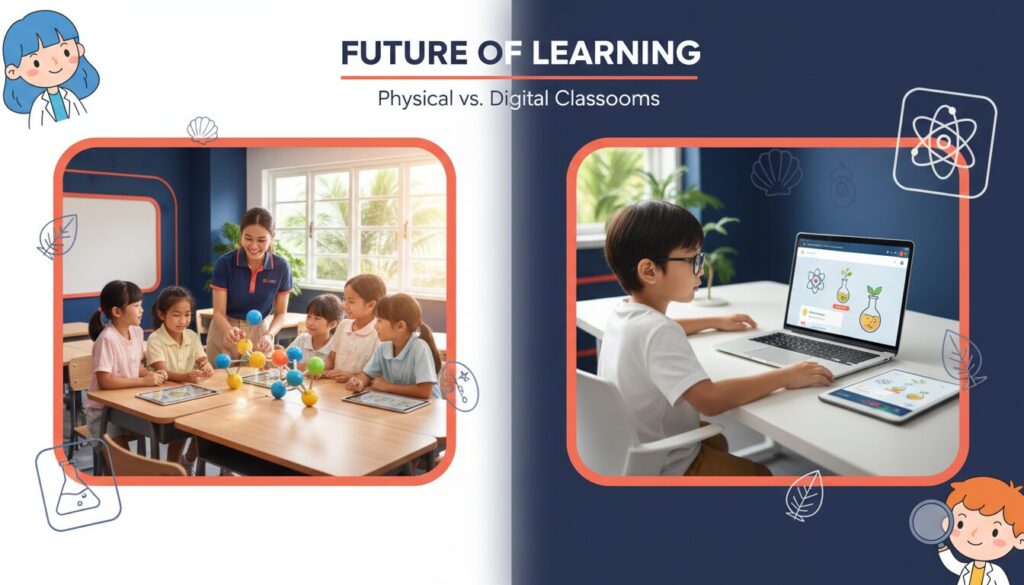
Table Of Contents
- Understanding Your Options: What Each Learning Mode Offers
- Learning Effectiveness: Where Deep Understanding Happens
- Student Engagement and Focus: The Attention Factor
- Personalization and Individual Support
- Social Development and Collaborative Learning
- Practical Considerations: Time, Cost, and Convenience
- Science-Specific Learning Needs
- The Hybrid Approach: Can You Have Both?
- Making the Right Decision for Your Child
As a parent navigating Singapore’s competitive education landscape, you’ve likely encountered this dilemma: should you enroll your child in a traditional tuition centre or opt for the convenience of online science classes? It’s a question that keeps many parents awake at night, especially as both options promise academic improvement but deliver vastly different experiences.
The rise of online learning platforms during recent years has transformed how we think about supplementary education. What was once a necessity has now become a permanent fixture in the educational ecosystem. Yet, traditional tuition centres continue to thrive, particularly for subjects like Science that benefit from hands-on exploration and immediate feedback. This isn’t simply a matter of old versus new—it’s about understanding which learning environment helps your child truly flourish.
The decision becomes even more critical when you consider that Science education goes beyond memorizing facts and definitions. It requires developing scientific thinking, understanding abstract concepts through concrete examples, and building confidence to tackle increasingly complex problems as students progress from lower to upper primary levels. The learning environment you choose plays a crucial role in whether your child develops genuine understanding or simply learns to reproduce answers.
In this comprehensive guide, we’ll explore both options through the lens of what actually matters: learning effectiveness, student engagement, personalized support, and long-term educational outcomes. By the end, you’ll have a clear framework for making this important decision based on your child’s unique needs and learning style.
Tuition Centre vs Online Classes
Making the Right Choice for Your Child’s Science Education
🎯 Quick Comparison
🏫 Tuition Centres
- Best for: Hands-on learners
- Strength: Immediate feedback
- Engagement: High through peer interaction
- Focus: Distraction-free environment
- Social: Collaborative learning
💻 Online Classes
- Best for: Self-disciplined students
- Strength: Flexibility & convenience
- Engagement: Digital tools & simulations
- Focus: Requires home discipline
- Social: Limited peer interaction
🔑 5 Key Factors to Consider
Learning Effectiveness
Science needs hands-on exploration. Physical centres excel with experiments and tactile learning, while online offers simulations that can’t fully replace real-world manipulation.
Student Engagement
Dedicated learning spaces minimize distractions. Home environments, despite convenience, present focus challenges for primary students still developing self-regulation.
Personalized Support
Small class sizes allow educators to observe body language and work processes, catching misconceptions before they solidify—something limited in digital environments.
Social Development
Collaborative problem-solving mirrors real scientific work. Physical centres naturally foster teamwork, communication, and peer learning that’s harder to replicate online.
Practical Considerations
Balance time savings from online classes against health concerns from increased screen time. Consider value over price—effective learning is the true measure.
✅ Choose Tuition Centre If…
- Needs hands-on exploration
- Benefits from peer interaction
- Requires structured environment
- In foundational learning stages
- Struggles with self-direction
✅ Choose Online If…
- Shows strong self-discipline
- Has schedule constraints
- Works well independently
- Needs supplementary practice
- Comfortable with digital tools
💡 The Bottom Line
The best choice depends on your child’s unique learning style, developmental stage, and needs. For Science education—especially in primary levels—hands-on exploration with immediate feedback often produces deeper understanding and lasting confidence.
🌟 Consider trying both approaches to see what resonates with your child. Their engagement, enthusiasm, and actual learning gains will guide you to the right decision.
Understanding Your Options: What Each Learning Mode Offers
Before diving into comparisons, let’s clarify what we mean by each option. Traditional tuition centres provide physical classroom environments where students attend scheduled sessions with an instructor and peers. These sessions typically run weekly, with structured curricula aligned to MOE syllabuses, offering consistent routines and face-to-face interaction.
Online science classes, on the other hand, deliver instruction through digital platforms. These range from live video sessions with real-time interaction to pre-recorded lessons students can watch on demand. Some platforms offer one-on-one tutoring, while others provide group classes similar to physical settings, just conducted virtually. The flexibility varies considerably depending on the provider and format chosen.
Both approaches aim to supplement school learning, reinforce concepts, and prepare students for examinations. However, the mechanisms through which they achieve these goals differ significantly. Understanding these differences helps you evaluate which aligns better with how your child learns most effectively.
Learning Effectiveness: Where Deep Understanding Happens
When it comes to actual learning outcomes, the effectiveness of either option depends heavily on implementation quality rather than the medium itself. However, certain characteristics of each format naturally lend themselves to different aspects of Science education.
Hands-On Learning and Experiential Understanding
Science is fundamentally an exploratory subject. Young learners grasp concepts like magnetism, electrical circuits, or plant growth most effectively when they can manipulate materials and observe phenomena directly. Traditional tuition centres excel here because they can incorporate physical demonstrations, simple experiments, and tactile learning aids that transform abstract concepts into concrete experiences. When a Primary 4 student sees a circuit light up after connecting it correctly, that moment of discovery creates neural pathways that passive observation simply cannot replicate.
Online platforms attempt to bridge this gap through virtual labs, simulations, and video demonstrations. While technology has advanced considerably, there remains a qualitative difference between watching a screen and handling actual materials. For younger primary students especially, this experiential component significantly impacts concept retention and the development of scientific curiosity.
Immediate Feedback and Misconception Correction
One of the most critical factors in effective learning is the speed at which misconceptions get corrected. In a physical tuition centre, experienced educators can observe student body language, facial expressions, and work processes to identify confusion before it solidifies into persistent misunderstanding. At Seashell Academy, our approach emphasizes real-time observation and intervention, allowing educators to address conceptual gaps the moment they appear.
Online environments, particularly asynchronous ones, create lag time between when students develop misconceptions and when these get addressed. Even in live online classes, the instructor’s ability to read the room and gauge individual understanding is significantly limited. This delay can be particularly problematic in Science, where concepts build sequentially and early misunderstandings compound over time.
Student Engagement and Focus: The Attention Factor
Maintaining a child’s attention during supplementary classes after a full school day presents challenges regardless of format. However, the environmental factors differ substantially between physical and online settings.
In a tuition centre environment, the dedicated learning space naturally signals to children that it’s time to focus. The absence of home distractions—siblings playing, comfortable beds nearby, or the temptation of toys—creates a psychological boundary that supports concentration. Additionally, the presence of peers creates a subtle accountability that helps students maintain focus even when material becomes challenging.
Online classes require students to maintain discipline in environments filled with distractions. Even with parental supervision, the home setting doesn’t carry the same focused energy as a dedicated learning space. For primary school students still developing self-regulation skills, this environmental difference significantly impacts engagement quality. The convenience of attending class from home becomes a double-edged sword when that same comfort undermines the learning mindset.
Interactive Engagement Strategies
Effective Science education incorporates gamification, group activities, and hands-on challenges that transform learning into discovery. Physical tuition centres can implement these strategies more naturally—students can work in pairs to build models, compete in quick-fire quiz teams, or collaboratively solve problems using manipulatives and visual aids.
Online platforms attempt similar engagement through digital tools, breakout rooms, and virtual rewards systems. While some students respond well to these digital engagement strategies, they lack the kinesthetic and social elements that make learning memorable for many children. The question becomes whether your child is among those who thrive with digital interaction or among those who need physical, multi-sensory engagement to stay invested.
Personalization and Individual Support
Every child learns differently, and truly effective supplementary education adapts to individual needs rather than forcing students into one-size-fits-all approaches.
Quality tuition centres, particularly those with small class sizes, offer substantial personalization. Educators can observe individual students’ work processes, identify specific struggle points, and adjust explanations or provide additional examples tailored to that child’s learning style. At Seashell Academy, our small class structure ensures that each student receives attention proportional to their needs, with personalized learning plans that acknowledge different starting points and learning paces.
Online platforms promise personalization through adaptive algorithms and one-on-one sessions. Algorithmic personalization can be effective for practice and reinforcement, adjusting question difficulty based on student performance. However, it lacks the nuanced understanding that experienced educators bring—recognizing when a student needs encouragement versus challenge, or when confusion stems from language comprehension rather than conceptual gaps.
One-on-one online tutoring provides the most personalized online option, but it eliminates peer learning benefits and often comes at premium pricing. Group online classes, meanwhile, face the same personalization challenges as large physical classes, compounded by the limited observational capacity of the digital medium.
Social Development and Collaborative Learning
Education serves purposes beyond content mastery. The social dimensions of learning—collaboration, communication, healthy competition, and peer support—contribute significantly to child development and make the learning experience richer.
Physical tuition centres naturally foster these social elements. Students build friendships with peers who share similar academic goals, learn to articulate their thinking when explaining concepts to classmates, and develop resilience through navigating group dynamics. These soft skills prove invaluable as children progress through their educational journey and eventually into professional environments.
For Science specifically, collaborative problem-solving mirrors how scientific work actually happens. When students work together to design an experiment, hypothesize outcomes, or troubleshoot why their model isn’t working, they’re developing critical thinking and teamwork skills alongside content knowledge. This collaborative discovery process is difficult to replicate in online environments where interaction feels more transactional and less organic.
Online classes do offer interaction through chat functions, virtual group work, and discussion forums. However, these interactions tend to be more constrained and less spontaneous than in-person exchanges. The casual learning that happens before class starts, during transitions, or in post-class questions to peers gets lost in virtual formats.
Practical Considerations: Time, Cost, and Convenience
Beyond learning outcomes, practical realities influence decision-making for busy families balancing multiple commitments.
Time and Transportation
Online classes eliminate travel time, an attractive feature for families juggling multiple children’s schedules or living far from quality tuition centres. A student can finish homework at 7 PM and immediately join an online class without the 30-minute commute that physical attendance requires. This time efficiency can reduce family stress and provide more flexibility in daily scheduling.
However, this convenience comes with hidden costs. The lack of transition time between home activities and learning can make it harder for children to shift into focused study mode. The physical journey to a tuition centre, while time-consuming, serves as a mental transition that prepares students to engage seriously with learning.
Investment and Value
Pricing varies widely in both categories, making direct comparison challenging. Generally, online classes offer lower price points due to reduced overhead costs, though premium platforms with live instruction and small groups approach physical tuition centre pricing.
When evaluating cost, consider value rather than just price. A slightly more expensive tuition centre that delivers significantly better learning outcomes, stronger engagement, and holistic development may represent better value than a cheaper online option that your child struggles to focus on or doesn’t enjoy. Educational investment should be measured in learning gains and skill development, not just hourly rates.
Health and Safety Considerations
Online learning gained prominence partly due to health concerns, and it remains a safer option during illness outbreaks. Children can continue learning without exposure risks, and those with minor illnesses can attend class without infecting others.
However, excessive screen time presents its own health concerns. Primary school children already spend substantial time on devices for school, homework, and recreation. Adding more screen hours through online tuition contributes to eye strain, sedentary behavior, and potential sleep disruption. Physical tuition centres provide a screen-free learning alternative that balances children’s overall daily technology exposure.
Science-Specific Learning Needs
Science education presents unique requirements that make the learning environment choice particularly consequential.
The Singapore Science syllabus emphasizes inquiry-based learning, where students develop hypotheses, conduct investigations, and draw evidence-based conclusions. This investigative approach requires environments where questioning is encouraged, materials are accessible, and failure is treated as a learning opportunity rather than something to avoid. Physical learning spaces naturally support this exploratory mindset.
Concept visualization presents another Science-specific challenge. Understanding processes like the water cycle, food chains, or systems of the human body requires moving between abstract principles and concrete representations. Quality tuition centres use multiple visualization tools—physical models, diagrams, animations, and real specimens—to build understanding from various angles. While online platforms can certainly show videos and simulations, the educator’s ability to dynamically switch between representation modes based on student confusion is more limited.
Additionally, Science examination success in Singapore requires strong problem-solving skills and the ability to apply concepts to novel scenarios. This higher-order thinking develops through guided practice with an experienced educator who can scaffold thinking processes, ask probing questions, and help students recognize patterns across different question types. This cognitive apprenticeship happens most effectively in environments allowing rich interaction and immediate responsive teaching.
The Hybrid Approach: Can You Have Both?
Rather than viewing this as an either-or decision, some families successfully combine both formats to leverage their respective strengths.
A common hybrid model uses physical tuition centres for primary instruction and concept building, supplemented by online resources for additional practice, revision, or specific topic reinforcement. This approach allows children to benefit from the engagement and hands-on learning of physical classes while using online platforms for flexible, self-paced practice that doesn’t require instructor presence.
Another hybrid approach involves attending physical tuition during regular weeks but switching to online options during school holidays, travel periods, or when schedule conflicts arise. This maintains the consistency of quality instruction while accommodating life’s inevitable disruptions.
The key to successful hybrid learning is ensuring the approaches complement rather than confuse. Different teaching methodologies or conflicting strategies between providers can leave children uncertain about which approach to use. Selecting complementary resources that align in philosophy and methodology prevents this fragmentation.
Making the Right Decision for Your Child
Ultimately, the best choice depends on your child’s unique profile, your family circumstances, and your educational priorities.
Consider physical tuition centres if your child:
- Benefits from structured, distraction-free learning environments
- Learns best through hands-on exploration and kinesthetic activities
- Thrives on social interaction and peer learning
- Needs close monitoring to stay focused and engaged
- Is in lower primary levels where foundational concept building is critical
- Struggles with self-directed learning or requires external accountability
Consider online classes if your child:
- Demonstrates strong self-discipline and intrinsic motivation
- Has significant schedule constraints or transportation challenges
- Responds well to digital learning tools and formats
- Needs supplementary practice rather than foundational concept building
- Works well independently with minimal supervision
- Has specific health or safety considerations that make physical attendance challenging
Beyond these general guidelines, reflect on your educational philosophy. Are you primarily seeking examination results, or are you equally invested in developing curiosity, confidence, and love for learning? Approaches like the Seashell Method recognize that sustainable academic success emerges from holistic development—combining subject mastery with emotional well-being, confidence-building, and genuine understanding that extends beyond examination halls.
If your child is currently struggling with Science, consider that the struggle might stem from pedagogical approach rather than capability. Some children who seem “weak” in Science simply haven’t experienced teaching that matches their learning style. Before assuming online convenience will solve the problem, evaluate whether more personalized, hands-on instruction might address the root cause more effectively.
For parents considering Science enrichment for Primary 4, Primary 5, or Primary 6 students, remember that these years involve increasingly complex concepts and examination pressure. The learning environment you choose should not only teach content but also build the resilience and problem-solving confidence needed for long-term success.
Take time to trial both options if possible. Most quality tuition centres offer trial sessions, and online platforms typically provide free introductory classes. Observe your child’s engagement, ask about their experience, and monitor whether understanding actually improves rather than just accepting that they attended class. Your child’s feedback and demonstrated learning provide the most valuable data for this decision.
The choice between tuition centres and online science classes isn’t about which format is objectively superior—it’s about which environment allows your child to flourish academically while developing confidence and genuine understanding. Online learning offers undeniable convenience and flexibility, making it an attractive option for busy families. However, for subjects like Science that benefit from hands-on exploration, immediate feedback, and collaborative discovery, traditional tuition centres often provide richer learning experiences, particularly for primary school students still developing foundational skills.
The most successful educational approach balances academic rigor with emotional support, challenges students appropriately without causing burnout, and builds not just knowledge but genuine capability. As you make this decision, prioritize learning environments that treat your child as a whole person—nurturing curiosity, building confidence, and developing skills that extend far beyond any single examination.
Whether you choose physical tuition, online classes, or a hybrid approach, the key is ensuring alignment between the learning environment, your child’s needs, and your family’s educational values. When these elements align, supplementary education becomes not a source of stress but a genuine support system that helps your child reach their potential while maintaining their love for learning.
Discover the Seashell Academy Difference
See how our nurturing approach combines hands-on Science learning with personalized support in small classes led by experienced MOE-trained educators. We don’t just prepare students for exams—we build confident, curious learners who genuinely love Science.