4 Essential Story Structures to Ace PSLE Chinese Narrative Writing
November 4, 2025
Mastering Chinese Vocabulary: The Spaced Repetition Method for Primary School Success
November 6, 2025
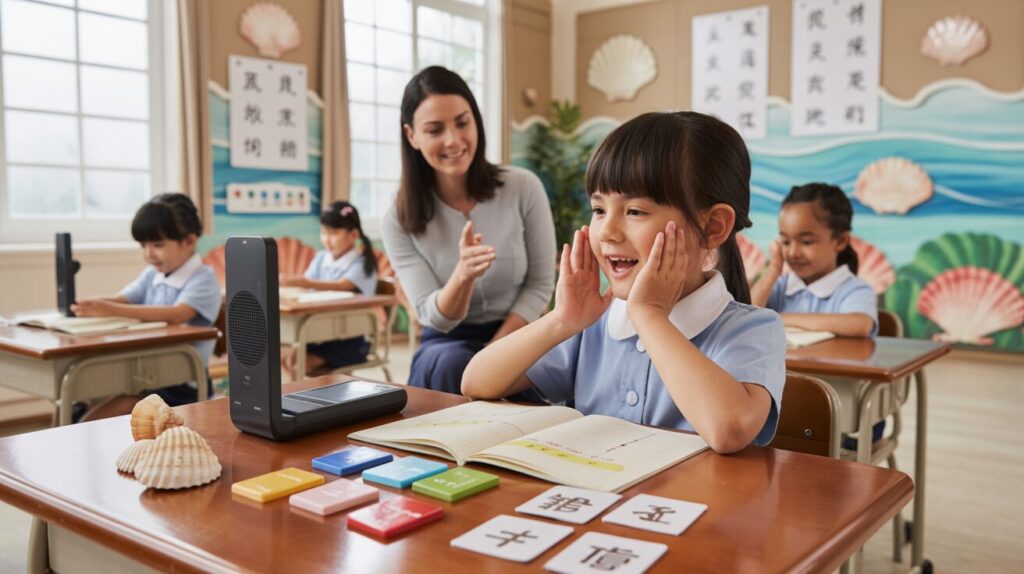
Table Of Contents
- Understanding Chinese Tones: The Foundation of Clear Speech
- Effective Tone Drills for Primary School Students
- Using Recorders to Perfect Your Child’s Pronunciation
- Common Tone Challenges and How to Overcome Them
- Establishing an Effective Practice Routine
- Assessment Techniques for Monitoring Progress
- Preparing for Chinese Oral Examinations
- Conclusion: Building Confidence in Chinese Speaking
Mastering Chinese pronunciation is often considered one of the most challenging aspects of learning the language, particularly for primary school students in Singapore. The four tones of Mandarin Chinese can be especially daunting, creating barriers to confidence and fluency. At Seashell Academy by Suntown Education Centre, we understand that proper pronunciation is not just about academic achievement—it’s the foundation for effective communication and genuine appreciation of Chinese language and culture.
In this comprehensive guide, we’ll explore proven tone drill techniques and recorder usage strategies that transform pronunciation challenges into opportunities for growth. Drawing from our Seashell Method that nurtures both academic excellence and emotional well-being, we’ll show you how regular, structured practice with the right guidance can help your child develop natural-sounding tones and clear articulation. Whether your child is preparing for PSLE Chinese oral examinations or simply building fundamental language skills, these approaches will foster both competence and confidence.
Master Chinese Pronunciation
Essential Tone Drills & Recording Techniques
The 4 Essential Chinese Tones
-
1First Tone (高平)
High level pitch→
-
2Second Tone (上升)
Rising pitch↗
-
3Third Tone (低降低升)
Falling then rising↘↗
-
4Fourth Tone (降调)
Falling pitch↘
Minimal Pair Examples
Practice these pairs that differ only in tone:
Effective Recording Techniques
- Listen to a model: Study native speaker pronunciations
- Practice silently: Rehearse before recording
- Record small segments: Focus on 3-5 sentences at a time
- Compare with the model: Note differences in tone and rhythm
- Record again: Implement improvements immediately
Tone Drill Exercises
Draw tone patterns in the air while pronouncing words to create multi-sensory learning.
Practice with: “四是四,十是十,十四是十四,四十是四十”
Gradually build longer sentences while maintaining tonal accuracy.
Common Tone Challenges & Solutions
Third Tone Confusion
Exaggerate the dip in third tones during practice to internalize the movement pattern.
Tone Sandhi
Practice whole phrases rather than memorizing abstract rules (e.g., 你好 – nǐ hǎo).
Maintaining Tones in Sentences
Use progressive sentence building to maintain tonal accuracy in longer utterances.
Ideal Practice Schedule
Regular schedule
Rotate exercises
When mentally fresh
Remember
Pronunciation improvement happens gradually. Celebrate small victories and maintain consistent practice.
Understanding Chinese Tones: The Foundation of Clear Speech
Before diving into specific practice techniques, it’s essential to understand what makes Chinese tones so crucial. Unlike English, Mandarin Chinese is a tonal language where the pitch pattern of a syllable determines its meaning. The same syllable pronounced with different tones can represent entirely different words—creating both challenges and fascinating linguistic patterns for learners.
The Four Tones of Mandarin Chinese
Mandarin Chinese features four primary tones plus a neutral tone. Each has a distinct pitch pattern that must be mastered for clear communication:
First Tone (高平 – gāo píng): A high, level tone that remains steady throughout the syllable. The pitch is consistently high, like singing a sustained high note. Example: 妈 (mā) meaning “mother.”
Second Tone (上升 – shàng shēng): A rising tone that starts at a medium pitch and rises to a high pitch, similar to the intonation when asking a question in English. Example: 麻 (má) meaning “hemp.”
Third Tone (低降低升 – dī jiàng dī shēng): A complex tone that first dips down and then rises. It starts at a medium pitch, falls to a low pitch, and then rises again. In practice, the rising part is often subtle or omitted. Example: 马 (mǎ) meaning “horse.”
Fourth Tone (降调 – jiàng diào): A falling tone that starts high and drops sharply, like giving a command in English. Example: 骂 (mà) meaning “to scold.”
Neutral Tone (轻声 – qīng shēng): A light tone without emphasis, shorter in duration than the other tones. Its pitch depends on the tone that precedes it. Example: 吗 (ma) in 你好吗? (nǐ hǎo ma?) meaning “How are you?”
At Seashell Academy by Suntown Education Centre, we’ve observed that students who grasp these fundamental differences early develop greater confidence in their Chinese speaking abilities. Rather than teaching tones as abstract concepts, we integrate them into meaningful context through our Programme Philosophy that emphasizes real-life application.
Effective Tone Drills for Primary School Students
Tone drills form the backbone of pronunciation improvement. The key is making these exercises engaging and appropriate for primary school students while ensuring they build lasting skills. Here are proven techniques we implement in our P4 Chinese Programme and adapt for different learning levels:
Minimal Pair Exercises
Minimal pairs are words that differ only in tone but are otherwise identical in sound. Practicing these pairs highlights the importance of tonal precision and trains the ear to distinguish subtle differences.
For example, have your child practice these common minimal pairs:
– 买 (mǎi, to buy) vs. 卖 (mài, to sell)
– 老师 (lǎoshī, teacher) vs. 老是 (lǎoshì, always)
– 星期 (xīngqī, week) vs. 星期一 (xīngqī yī, Monday)
– 意思 (yìsi, meaning) vs. 一四 (yī sì, one four)
Through our gamified interactive lessons, we transform these drills into engaging activities where students can earn points for correctly identifying tones, making the learning process both effective and enjoyable.
Tone Pattern Visualization
Visual learners benefit greatly from seeing tone patterns represented graphically. At Seashell Academy, we use colored tone marks, hand gestures, and visual aids that show the pitch movements:
– First tone: Drawing a horizontal line in the air (→)
– Second tone: Drawing an upward diagonal line (↗)
– Third tone: Drawing a V shape (↘↗)
– Fourth tone: Drawing a downward diagonal line (↘)
We encourage students to trace these patterns in the air while pronouncing words, creating a multi-sensory learning experience that strengthens tone memory and production. This mind-mapping approach helps students internalize tone patterns rather than memorizing them mechanically.
Tongue Twisters (绕口令 – Ràokǒulìng)
Chinese tongue twisters specifically designed to practice particular tones provide both challenge and enjoyment. Start with simpler ones and gradually increase difficulty. For instance:
四是四,十是十,十四是十四,四十是四十 (Sì shì sì, shí shì shí, shí sì shì shí sì, sì shí shì sì shí)
This popular tongue twister helps practice the fourth tone and similar-sounding numbers. Our P5 Chinese Programme incorporates these challenges in a supportive environment where mistakes become learning opportunities rather than sources of discouragement.
Using Recorders to Perfect Your Child’s Pronunciation
Recording and playback technology offers powerful tools for pronunciation improvement. Modern smartphones and tablets make this accessible to all students, creating opportunities for self-assessment and targeted practice.
Selecting the Right Recording Tools
While professional recording equipment isn’t necessary, certain features make some recording tools more effective for language learning:
Smartphone Apps: Apps like “Voice Memos” (iOS) or “Voice Recorder” (Android) provide sufficient quality for basic practice. For more features, consider language-specific apps that allow for comparison with native speaker recordings.
Digital Voice Recorders: These dedicated devices often have superior microphones and noise cancellation, making them ideal for classroom or group settings where background noise might be an issue.
Computer Software: Programs like Audacity (free) allow for more detailed analysis of speech patterns, including visualization of pitch contours—particularly helpful for older primary students developing more nuanced awareness of their pronunciation.
Effective Recording Techniques
Simply recording practice sessions isn’t enough—structure is essential for improvement. We recommend this process:
1. Listen to a model: Before recording, have your child listen to a native speaker pronouncing the target words or phrases. This could be a teacher, online resource, or parent if fluent.
2. Practice silently: Encourage a few practice attempts without recording to build confidence.
3. Record in small segments: Rather than long passages, focus on recording 3-5 sentences at a time for more targeted feedback.
4. Compare with the model: Play both recordings, noting differences in tone, rhythm, and clarity.
5. Record again: After identifying areas for improvement, make another recording immediately to implement changes while they’re fresh.
In our P6 Chinese Programme, we guide students through this process regularly, helping them develop the critical listening skills necessary for self-correction—an essential ability for the PSLE oral examination.
Creating a Pronunciation Journal
We encourage students to maintain a digital pronunciation journal where they save recordings over time. This creates a tangible record of progress that can be tremendously motivating when students experience challenges. Every few weeks, have your child listen to earlier recordings to recognize their improvement.
This approach aligns with our belief at Seashell Academy by Suntown Education Centre that sustainable growth requires both structured practice and emotional reinforcement. Seeing (and hearing) progress builds confidence that fuels further learning.
Common Tone Challenges and How to Overcome Them
Through our experience teaching Chinese to primary school students in Singapore, we’ve identified several recurring pronunciation challenges and developed targeted strategies to address them.
Third Tone Confusion
Many students struggle with the third tone’s dipping pattern, often producing it as a second tone (rising) or fourth tone (falling).
Solution: Practice exaggerating the dip in the third tone when learning new words. We teach students to stretch the syllable longer than normal and emphasize the dipping motion. With time and practice, this can be refined to a more natural-sounding third tone.
For example, when practicing the word “好” (hǎo), have your child dramatically lower their pitch in the middle before slightly rising at the end. Once the movement is mastered, they can produce it more subtly and naturally.
Tone Sandhi (变调 – Biàndiào)
Tone sandhi refers to the way tones change when certain tones appear together. The most common example is when two third tones appear consecutively—the first changes to a second tone. This natural phenomenon confuses many learners.
Solution: Rather than teaching tone sandhi as abstract rules, we focus on whole phrases and common word combinations. Through repeated practice of complete phrases like “你好” (nǐ hǎo), students internalize the proper tone modifications without overthinking the technical rules.
Maintaining Tones in Longer Sentences
Many students can produce correct tones in isolated words but lose tonal accuracy when speaking in complete sentences.
Solution: We practice “tone chains” where students maintain focus on tones while gradually increasing sentence length:
Start with: 我 (wǒ)
Then add: 我喜欢 (wǒ xǐhuan)
Expand to: 我喜欢学习 (wǒ xǐhuan xuéxí)
Complete with: 我喜欢学习中文 (wǒ xǐhuan xuéxí zhōngwén)
This progressive approach helps students maintain tonal accuracy while managing the cognitive load of producing longer utterances—a key skill for the PSLE Chinese oral examination.
Establishing an Effective Practice Routine
Consistent practice is more effective than intensive but irregular sessions. At Seashell Academy by Suntown Education Centre, we advocate for a balanced approach that prevents burnout while ensuring steady progress.
The Ideal Practice Schedule
For primary school students, we recommend:
Duration: 10-15 minutes of focused pronunciation practice daily is more effective than an hour once a week.
Timing: Practice when your child is mentally fresh, not tired after a full day of school. Many families find mornings or early evenings most productive.
Consistency: Establish a regular schedule that becomes part of your child’s routine, creating a habit rather than feeling like an additional burden.
Variety: Rotate between different types of exercises (minimal pairs, tone chains, tongue twisters, recording activities) to maintain engagement and develop well-rounded skills.
Making Practice Engaging
At Seashell Academy, we transform what could be repetitive drills into engaging activities that sustain interest:
Tone Games: Create tone identification games where students earn points for correctly identifying tones in words they hear.
Pronunciation Challenges: Set up friendly family competitions where everyone attempts challenging pronunciations.
Real-world Application: Practice ordering in Chinese at restaurants or having simple conversations with Mandarin speakers in the community.
Digital Resources: Incorporate age-appropriate Chinese language apps and videos that focus on pronunciation in entertaining formats.
These approaches reflect our Mathematics Programme philosophy as well—making learning interactive and relevant rather than abstract and disconnected from real life.
Assessment Techniques for Monitoring Progress
Tracking pronunciation development helps maintain motivation and identifies areas needing additional attention. Effective assessment combines formal evaluation with ongoing feedback.
Self-Assessment Strategies
Empower your child to evaluate their own pronunciation with these techniques:
Recording Comparisons: Have your child compare their recordings with native speakers, noting specific differences in tone and pronunciation.
Tone Marking Practice: After listening to words or phrases, ask your child to mark the tones they hear, then verify accuracy.
Confidence Ratings: Encourage your child to rate their confidence in pronouncing specific sounds or tone patterns on a scale of 1-5, creating awareness of areas needing focus.
Feedback Techniques for Parents and Teachers
Effective feedback motivates rather than discourages. At Seashell Academy by Suntown Education Centre, we use these approaches:
The Sandwich Method: Begin with positive reinforcement, provide specific correction, and end with encouragement.
For example: “Your second tone sounds very natural! The fourth tone in ‘是’ could drop more sharply—try speaking more forcefully on that syllable. Your overall rhythm is improving tremendously!”
Focused Correction: Rather than correcting every error, focus on one specific aspect at a time (e.g., third tone accuracy or specific sound combinations).
Progress Charts: Create visual representations of improvement, tracking mastery of specific tones or challenging sounds over time.
These assessment techniques reflect our holistic approach to education that emphasizes building confidence alongside academic mastery. We recognize that emotional support is just as critical as technical correction in developing strong Chinese speaking skills.
Preparing for Chinese Oral Examinations
For primary school students in Singapore, Chinese oral examinations form a significant component of their language assessment. At Seashell Academy, we prepare students not just for examination success but for genuine communicative confidence.
Understanding Oral Examination Requirements
Typically, primary school Chinese oral examinations assess:
Reading Aloud (朗读 – lǎngdú): Students read a passage demonstrating clear pronunciation, appropriate pacing, and natural intonation.
Picture Description (看图说话 – kàn tú shuō huà): Students describe images using appropriate vocabulary and grammatical structures.
Conversation (会话 – huìhuà): Students engage in dialogue with examiners, demonstrating both comprehension and speaking ability.
Across all components, tonal accuracy and clear articulation significantly impact scoring. Our structured preparation targets these specific requirements while building transferable communication skills.
Strategic Preparation Techniques
Beyond regular pronunciation practice, these strategies help students perform confidently in examination settings:
Simulated Examinations: Regular practice under exam-like conditions reduces anxiety and builds familiarity with the format.
Recording Analysis: Record practice sessions in the exact format of the examination, then analyze them using the same criteria examiners will use.
Focus on Transitions: Practice transitional phrases that connect ideas smoothly, creating a natural flow rather than disconnected statements.
Stress Management: Teach deep breathing and positive self-talk techniques to manage examination nerves that often affect pronunciation.
At Seashell Academy by Suntown Education Centre, our experienced MOE-trained educators guide students through these preparation techniques in small classes that allow for personalized coaching and ample speaking practice.
Conclusion: Building Confidence in Chinese Speaking
Mastering Chinese pronunciation through effective tone drills and recording practices is a journey that requires patience, consistency, and the right guidance. At Seashell Academy by Suntown Education Centre, we’ve witnessed countless students transform their Chinese speaking abilities through the structured yet nurturing approaches outlined in this guide.
The key to success lies not just in the technical aspects of tone production but in developing a positive relationship with the learning process. When students view pronunciation challenges as opportunities rather than obstacles, they develop resilience that serves them well beyond language learning. Our Seashell Method recognizes that combining academic rigor with emotional support creates the ideal environment for growth.
Remember that pronunciation improvement happens gradually. Celebrate small victories, maintain consistent practice, and provide encouraging feedback. With time, your child will develop not just the ability to produce accurate tones but genuine confidence in communicating in Mandarin Chinese—a skill that will serve them throughout their educational journey and beyond.
Whether your child is working toward PSLE success or building fundamental language skills for the future, the techniques in this guide provide a roadmap for meaningful progress. Like a pearl forming within a protective shell, your child’s Chinese language abilities will develop beautifully with the right environment and nurturing approach.
Nurture Your Child’s Chinese Language Journey with Seashell Academy
Looking for expert guidance to help your child master Chinese pronunciation and prepare confidently for oral examinations? Seashell Academy by Suntown Education Centre offers specialized Chinese language programs for Primary 1-6 students with small class sizes and experienced MOE-trained educators.
Our unique Seashell Method combines academic excellence with emotional well-being, helping students develop not just language skills but genuine confidence and love for learning Chinese.
Contact us today to learn more about our Chinese programs and how we can support your child’s language development journey!