Chinese Cloze Passage Traps: Expert Guide to Spot and Solve Challenging Questions
November 9, 2025
5 Free Podcasts to Practise and Improve Your Chinese Listening Skills
November 13, 2025
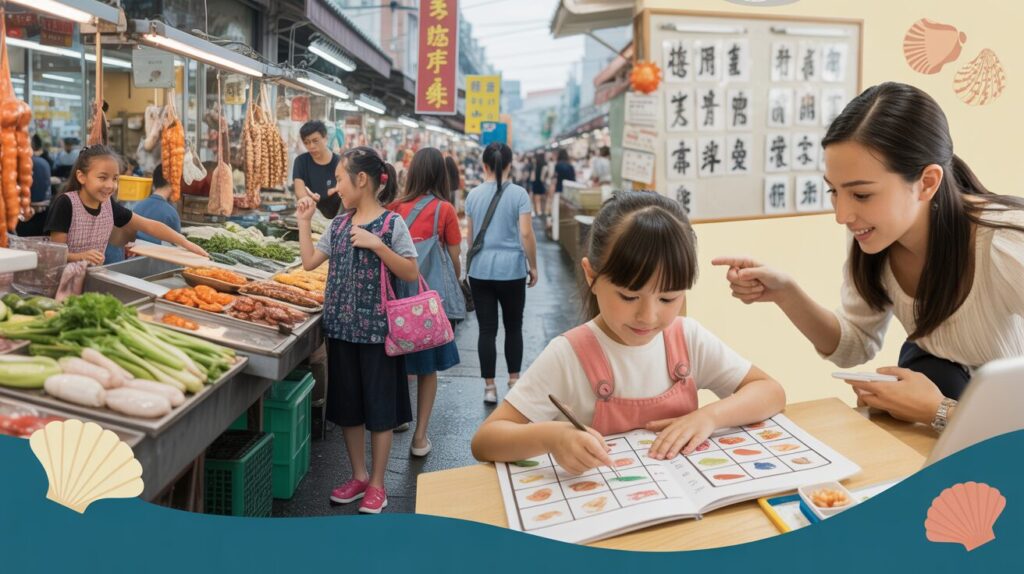
Table Of Contents
- The Importance of Pictorial Description in Chinese Exams
- Why Wet Market Scenes Frequently Appear in Exams
- Essential Vocabulary for Describing a Wet Market
- The Ideal Structure for Describing Pictorial Scenes
- 5 Effective Techniques to Enhance Descriptions
- Common Mistakes to Avoid
- Practice Tips and Activities for Home
- Sample Description of a Wet Market Scene
Picture this: Your child sits in the examination room, facing a colorful image of a bustling wet market. The examiner asks them to describe what they see in Mandarin. Will they confidently weave a rich tapestry of words that brings the scene to life, or will they struggle to find the right expressions?
Pictorial description is a crucial component of Chinese oral examinations in Singapore, and wet market scenes are particularly common due to their cultural significance and visual richness. At Seashell Academy by Suntown Education Centre, we understand that mastering this skill requires more than memorizing vocabulary—it demands a structured approach, creative thinking, and regular practice.
This comprehensive guide will equip your child with the essential tools to excel in describing wet market scenes. From specialized vocabulary and sentence structures to effective techniques and common pitfalls, we’ll cover everything they need to transform a simple picture into an impressive oral response that showcases their Chinese language proficiency.
The Importance of Pictorial Description in Chinese Exams
Pictorial description (看图说话, kàn tú shuō huà) forms a significant portion of Chinese oral examinations across primary school levels. This assessment component evaluates several critical language skills simultaneously:
First, it tests vocabulary breadth and depth—can students accurately name objects, actions, and scenarios they observe? Second, it assesses grammar and sentence construction—can they form coherent, grammatically correct sentences? Third, it evaluates fluency and pronunciation—can they speak smoothly with proper tones? Finally, it measures creative thinking—can they infer context and emotions beyond what’s explicitly shown?
For Primary 4 to Primary 6 students, the complexity of pictorial descriptions increases significantly. Examiners expect more sophisticated vocabulary, varied sentence structures, and deeper observations that demonstrate critical thinking. This progression aligns with the increasing demands of the P4 Chinese Programme, P5 Chinese Programme, and ultimately the P6 Chinese Programme leading up to the PSLE.
Why Wet Market Scenes Frequently Appear in Exams
Wet markets hold special cultural significance in Singapore and across Asia. These vibrant marketplaces represent traditional commerce, cultural heritage, and community gathering spaces. For examination purposes, wet markets offer several advantageous features:
They present visually rich environments with numerous elements to describe—vendors, customers, various foods, interactions, and activities. They incorporate diverse vocabulary domains including food, numbers, transactions, and human interactions. Wet markets also showcase cultural practices that students should be familiar with as part of their cultural literacy.
At Seashell Academy, we believe that teaching children to describe wet markets goes beyond exam preparation—it connects them to important cultural traditions and everyday experiences that form part of Singapore’s heritage, aligning with our programme philosophy of making learning relevant to real life.
Essential Vocabulary for Describing a Wet Market
Setting and Environment
Building a rich description begins with setting the scene. Here are key terms to describe the wet market environment:
湿巴刹 (shī bā shā) – wet market
摊位 (tān wèi) – stall
小贩 (xiǎo fàn) – vendor/hawker
顾客 (gù kè) – customer
人山人海 (rén shān rén hǎi) – crowded with people (idiom)
热闹非凡 (rè nào fēi fán) – extremely lively/bustling
讨价还价 (tǎo jià huán jià) – to bargain/haggle over price
Food and Goods
Wet markets offer an abundance of items to describe. Students should be familiar with these common categories and examples:
新鲜蔬菜 (xīn xiān shū cài) – fresh vegetables
时令水果 (shí lìng shuǐ guǒ) – seasonal fruits
海鲜 (hǎi xiān) – seafood
鱼 (yú) – fish
虾 (xiā) – prawns/shrimp
螃蟹 (páng xiè) – crab
肉类 (ròu lèi) – meat products
鸡肉 (jī ròu) – chicken meat
猪肉 (zhū ròu) – pork
牛肉 (niú ròu) – beef
Actions and Activities
A dynamic wet market scene contains various actions that bring the description to life:
挑选 (tiāo xuǎn) – to select/choose
称重 (chēng zhòng) – to weigh
包装 (bāo zhuāng) – to package
付款 (fù kuǎn) – to pay
排队 (pái duì) – to queue/line up
吆喝 (yāo he) – to call out/hawk goods
推销 (tuī xiāo) – to promote/market goods
Descriptive Adjectives
These adjectives help create vivid imagery:
喧闹的 (xuān nào de) – noisy/bustling
拥挤的 (yōng jǐ de) – crowded/congested
繁忙的 (fán máng de) – busy
五颜六色的 (wǔ yán liù sè de) – colorful/multicolored
新鲜的 (xīn xiān de) – fresh
便宜的 (pián yi de) – inexpensive/cheap
The Ideal Structure for Describing Pictorial Scenes
At Seashell Academy, we teach students to approach pictorial descriptions with a clear, logical structure. This method helps organize thoughts and ensures comprehensive coverage of the image. Our recommended structure follows these four steps:
1. Introduce the Overall Scene (总述)
Begin with a general statement about what the picture shows. For example:
“这幅图片描述的是一个繁忙的湿巴刹的情景。” (This picture depicts a scene of a busy wet market.)
“图中展示的是周末早上湿巴刹热闹的景象。” (The picture shows the lively scene of a wet market on a weekend morning.)
2. Describe the Main Elements (主体描述)
Move from general to specific by identifying and describing the main elements in the picture. Use location markers to organize your description:
“在市场中央,许多顾客正在各个摊位前挑选商品。” (In the center of the market, many customers are selecting goods at various stalls.)
“左边有一个卖蔬菜的摊位,小贩正在称重青菜。” (On the left, there is a vegetable stall where the vendor is weighing greens.)
3. Focus on Specific Details and Actions (细节与动作)
Highlight interesting activities, interactions, or unique elements that add depth to your description:
“有一位老奶奶正在跟卖鱼的小贩讨价还价,脸上露出微笑。” (An elderly lady is bargaining with the fish vendor, with a smile on her face.)
“一个小男孩正帮妈妈提着装满水果的袋子,看起来很重。” (A little boy is helping his mother carry a bag full of fruits, which looks very heavy.)
4. Conclude with Atmosphere or Personal Reflection (总结或感想)
End your description with a statement about the atmosphere or a brief personal reflection:
“这个湿巴刹充满了生活气息,展现了人们日常购物的场景。” (This wet market is full of vitality, showcasing scenes of people’s daily shopping.)
“从这幅图可以看出,湿巴刹不仅是购买食材的地方,也是社区交流的重要场所。” (From this picture, we can see that wet markets are not only places to buy ingredients but also important venues for community interaction.)
5 Effective Techniques to Enhance Descriptions
At Seashell Academy by Suntown Education Centre, we encourage students to elevate their descriptions beyond basic vocabulary through these proven techniques:
1. Use the “Five Senses” Approach
While the picture is visual, incorporating imagined sensory experiences creates immersive descriptions:
视觉 (Sight): “各种蔬菜水果五颜六色,非常好看。” (Various vegetables and fruits are colorful and attractive.)
听觉 (Sound): “小贩们大声吆喝,市场里充满了讨价还价的声音。” (Vendors call out loudly, and the market is filled with the sounds of bargaining.)
嗅觉 (Smell): “空气中弥漫着新鲜水果和海鲜的香味。” (The air is filled with the aroma of fresh fruits and seafood.)
触觉 (Touch): “顾客轻轻捏着水果,检查是否成熟。” (Customers gently squeeze the fruits to check if they are ripe.)
味觉 (Taste): “有些摊位提供试吃,让顾客品尝水果的甜美。” (Some stalls offer samples, allowing customers to taste the sweetness of the fruits.)
2. Incorporate Idiomatic Expressions (成语)
Using appropriate idioms demonstrates language proficiency and cultural understanding:
琳琅满目 (lín láng mǎn mù) – a dazzling array of goods
Example: “摊位上的商品琳琅满目,应有尽有。” (The stalls display a dazzling array of goods, offering everything one could want.)
川流不息 (chuān liú bù xī) – an endless stream (of people)
Example: “市场里的人流川流不息,非常热闹。” (There’s an endless stream of people in the market, making it very lively.)
3. Use Varied Sentence Structures
Alternating between different sentence patterns adds sophistication to the description:
并列句 (Parallel structure): “有人在买菜,有人在挑水果,还有人在讨价还价。” (Some are buying vegetables, some are selecting fruits, and others are bargaining.)
因果句 (Cause-effect): “因为周末人特别多,所以顾客需要排队等候。” (Because it’s the weekend, there are many people, so customers need to queue and wait.)
转折句 (Contrast): “虽然市场很拥挤,但是人们脸上都带着笑容。” (Although the market is crowded, people’s faces all bear smiles.)
4. Make Cultural Connections
Relating the scene to cultural practices demonstrates deeper understanding:
“许多人在农历新年前来湿巴刹采购,准备团圆饭的食材。” (Many people come to the wet market before Chinese New Year to purchase ingredients for reunion dinners.)
“这种传统市场反映了新加坡多元文化的特点,各族群的人们在这里交流互动。” (This traditional market reflects Singapore’s multicultural characteristics, where people of different ethnic groups interact.)
5. Add Emotional Elements
Incorporating emotions and human interactions enriches descriptions:
“卖鱼的阿姨对熟客露出亲切的笑容,还额外给了一些葱姜。” (The fish vendor lady smiles warmly at her regular customers and gives some extra scallions and ginger.)
“一个小女孩好奇地望着水缸里游动的活鱼,眼睛里充满了惊奇。” (A little girl curiously watches the live fish swimming in the tank, her eyes filled with amazement.)
Common Mistakes to Avoid
When describing pictorial scenes, students often fall into these traps:
1. Overlooking the Background
Many students focus solely on the main objects or people, missing important contextual elements. Remember to describe the overall environment, including time of day, weather (if shown), and setting details.
2. Listing Without Connecting
Weak descriptions often read like lists: “There is a vendor. There are vegetables. There are customers.” Instead, use connecting words and varied sentence structures to create flow: “在熙熙攘攘的市场里,顾客们围在蔬菜摊位前,而小贩则忙着招呼每一位顾客。” (In the bustling market, customers gather around vegetable stalls, while vendors are busy attending to each customer.)
3. Using Limited Vocabulary
Repeating basic terms like “有” (there is/are) and “看见” (see) creates monotonous descriptions. Expand your vocabulary with more precise verbs and descriptive adjectives, such as “展示” (display), “涌动” (surge), or “繁忙的” (busy).
4. Missing Human Interactions
The most interesting elements of wet market scenes are often the human interactions. Don’t just describe objects—focus on what people are doing, their expressions, and their interactions with others.
5. Inaccurate Language Use
Using incorrect measure words or mixing up similar-sounding vocabulary can change your meaning entirely. For example, using “买” (to buy) when you mean “卖” (to sell), or forgetting appropriate measure words like “一条鱼” (a fish) versus “一个鱼” (incorrect).
Practice Tips and Activities for Home
At Seashell Academy, we believe that learning continues beyond the classroom. Here are practical ways parents can help children improve their pictorial description skills at home:
Visit a Real Wet Market
Experience is the best teacher. Take your child to a local wet market and engage in these activities:
Play the “I Spy” game in Chinese, identifying different items and their descriptions
Ask your child to count the different types of vegetables or fruits they can name in Chinese
Observe vendor-customer interactions and discuss them in Chinese afterward
This real-world application aligns perfectly with the Seashell Method, which emphasizes connecting classroom learning with practical experiences.
Use Online Resources
The digital world offers abundant resources:
Watch videos of Asian wet markets on platforms like YouTube, then have your child describe what they saw
Find pictures of wet markets online and practice timed descriptions (2-3 minutes per picture)
Use flashcard apps to build wet market-related vocabulary
Create Mind Maps
Visual organization helps with vocabulary recall:
Draw a central bubble labeled “湿巴刹” (wet market)
Create branches for different categories: people, foods, actions, descriptions
Add vocabulary to each branch, using different colors for different word types
This mind-mapping approach mirrors the techniques used in our Mathematics Programme and other subjects at Seashell Academy, reinforcing consistent learning strategies across disciplines.
Record and Review
Technology can provide valuable feedback:
Have your child record their descriptions of wet market pictures
Listen together and identify areas for improvement
Track progress by comparing recordings over time
This reflective practice builds confidence and awareness of language use—key components of our holistic learning approach.
Sample Description of a Wet Market Scene
Here’s a model description that demonstrates the techniques and structures discussed above:
这幅图片描绘的是一个繁忙的湿巴刹场景。清晨的阳光照射进市场,给整个场景增添了生机。
市场中央人山人海,顾客们穿梭于各个摊位之间。左边有一排卖蔬菜水果的摊位,琳琅满目的新鲜产品让人眼花缭乱。一位戴着草帽的阿姨正在细心挑选青菜,用手轻轻捏着叶子检查新鲜度。旁边的小贩正忙着为顾客称重,并熟练地包装好购买的蔬菜。
右边是海鲜区,几个大水缸里养着活蹦乱跳的鱼和螃蟹。一位中年男子正指着一条大鱼,与卖鱼的小贩讨价还价。虽然他们在激烈地商量价格,但脸上都带着友好的笑容,这是湿巴刹常见的有趣互动。
市场后方有卖肉的摊位,只见一位熟练的肉贩正在切肉,动作又快又准。一些顾客排队等候,他们手里拿着购物袋,耐心地等待着自己的turn。
整个市场热闹非凡,空气中弥漫着新鲜食材的香味,混合着人们讨价还价的声音和小贩吆喝的叫卖声。这样的传统湿巴刹不仅是人们购买日常食材的地方,也是邻里交流的重要场所,展现了新加坡独特的社区文化。
Translation:
This picture depicts a busy wet market scene. The morning sunlight shines into the market, adding vitality to the entire scene.
The center of the market is crowded with people, with customers moving between various stalls. On the left, there is a row of stalls selling vegetables and fruits, with a dazzling array of fresh products that is overwhelming to the eyes. A lady wearing a straw hat is carefully selecting vegetables, gently pinching the leaves to check freshness. The vendor nearby is busy weighing items for customers and skillfully packaging the purchased vegetables.
On the right is the seafood section, with several large tanks containing lively fish and crabs. A middle-aged man is pointing at a large fish, bargaining with the fish vendor. Although they are intensely negotiating the price, they both have friendly smiles on their faces, which is a common interesting interaction in wet markets.
At the back of the market are meat stalls, where a skilled butcher is seen cutting meat with movements that are both fast and precise. Some customers are queuing, holding shopping bags in their hands, patiently waiting for their turn.
The entire market is extremely lively, with the air filled with the aroma of fresh ingredients, mixed with the sounds of people bargaining and vendors calling out to sell their goods. Such traditional wet markets are not only places for people to buy daily ingredients but also important venues for neighborhood interactions, showcasing Singapore’s unique community culture.
Conclusion: Beyond the Examination
Mastering the art of describing a wet market scene is more than an examination skill—it’s an opportunity for your child to connect with cultural traditions, develop observational abilities, and build confidence in their Chinese language expression.
At Seashell Academy by Suntown Education Centre, we nurture these skills through our holistic approach to Chinese language learning. Like a pearl developing within a protective shell, we provide the structured environment, guidance, and practice opportunities your child needs to grow their language abilities naturally and confidently.
Our experienced MOE-trained educators understand that each child learns differently. Through our unique Seashell Method, we combine academic excellence with emotional well-being, using mind-mapping approaches and interactive lessons that make learning Chinese engaging rather than overwhelming.
Remember that consistent practice with the right techniques yields steady improvement. Whether your child is currently struggling with pictorial descriptions or aiming to refine already strong skills, the structured approach and vocabulary provided in this guide will help them build confidence and competence in this important examination component.
Want Your Child to Excel in Chinese Oral Examinations?
At Seashell Academy by Suntown Education Centre, we specialize in building strong foundations in Chinese language through our proven methodology and experienced educators.
Book a consultation today to discover how our P4, P5, and P6 Chinese programmes can help your child develop confidence and fluency in Chinese oral examinations.