Energy Conversion Project: How to Build a Rubber Band Car – Complete Tutorial
December 14, 2025
Building a Simple Electric Circuit: A Complete Guide with Safety Tips for Primary Students
December 16, 2025
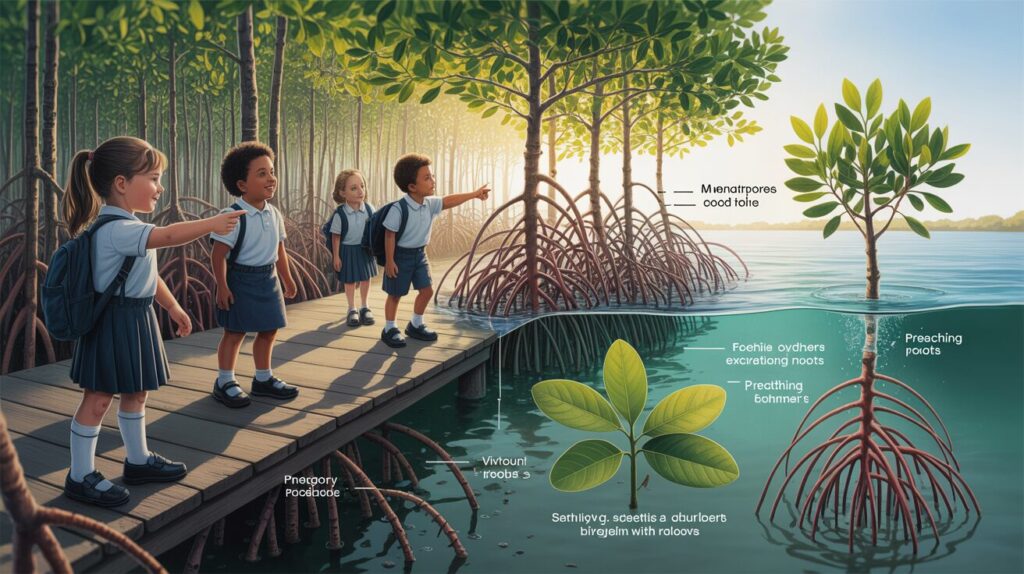
Table Of Contents
- Introduction to Mangrove Ecosystems
- What Are Mangroves?
- Challenges of the Mangrove Environment
- Root Adaptations: Standing Strong in Shifting Sands
- Salt Management Adaptations: Thriving in Saline Conditions
- Reproductive Adaptations: Ensuring the Next Generation
- Leaf Adaptations: Maximizing Survival
- Singapore’s Mangrove Ecosystems: A Natural Laboratory
- Conservation and Importance of Mangroves
- Classroom Activities: Exploring Mangrove Adaptations
- Conclusion: Nature’s Ingenious Solutions
The coastal fringes of tropical and subtropical regions around the world are home to one of nature’s most resilient plant communities—mangroves. These remarkable plants have evolved a suite of adaptations that allow them to thrive where few other plants could survive: in the challenging transition zone between land and sea. For young science enthusiasts, mangrove ecosystems offer a fascinating glimpse into how plants can adapt to extreme environments.
In Singapore, our mangrove forests at Sungei Buloh Wetland Reserve, Pasir Ris Park, and Pulau Ubin provide excellent opportunities for Primary school students to witness these adaptations firsthand. Just as our students at Seashell Academy by Suntown Education Centre learn to adapt to different learning challenges, mangrove plants have developed specialized features to overcome the difficulties of their habitat.
In this comprehensive illustrated guide, we’ll explore the ingenious adaptations that enable mangrove plants to survive in waterlogged, oxygen-poor, salt-rich environments. From their distinctive root systems to specialized methods of reproduction, these adaptations demonstrate nature’s remarkable ability to find solutions to environmental challenges—an important science concept for Primary 3-6 students studying plant adaptations in their Science curriculum.
What Are Mangroves?
Mangroves are not a single species but rather a diverse group of trees and shrubs that share the ability to live in coastal intertidal zones. These special plants form unique ecosystems called mangrove forests or mangals. Unlike most plants that would perish in salty, waterlogged conditions, mangroves have evolved to not just survive but thrive in these challenging environments.
There are approximately 80 different species of mangrove plants worldwide, with about 35 species found in Southeast Asia. Singapore, despite its small size, is home to around 35 true mangrove species—a testament to the rich biodiversity of our island nation.
Some common mangrove species found in Singapore include:
- Avicennia marina (Grey Mangrove or Api-api Putih)
- Rhizophora mucronata (Red Mangrove or Bakau Hitam)
- Sonneratia alba (Mangrove Apple or Perepat)
- Bruguiera cylindrica (Tumu)
- Nypa fruticans (Mangrove Palm or Nipah)
Each species has its own set of adaptations, though they share common strategies for coping with their challenging environment. Just as we at Seashell Academy believe that every child has unique learning needs while sharing common educational goals, mangrove species have developed their own specialized adaptations while addressing similar environmental challenges.
Challenges of the Mangrove Environment
Before we explore the adaptations of mangrove plants, it’s important to understand the challenges they face. This helps us appreciate why their adaptations are so remarkable—similar to how understanding a student’s learning challenges helps us develop appropriate teaching strategies at Seashell Academy.
Waterlogged, Oxygen-Poor Soil
Mangroves grow in muddy, waterlogged soils where water movement is slow. These conditions create an anaerobic (oxygen-poor) environment that would suffocate the roots of most plants. Without oxygen, normal root respiration becomes impossible.
High Salinity
With roots bathed in seawater, mangroves must contend with salt concentrations that would kill ordinary plants. Saltwater creates osmotic pressure that makes it difficult for plants to extract water from their environment and can cause toxic buildup of salt in plant tissues.
Unstable Substrate
The soft mud of mangrove habitats offers poor anchorage for plants. Combined with tidal movements and potential wave action, this creates a physically unstable environment that plants must adapt to.
Tidal Flooding
Twice daily, tides inundate mangrove environments, submerging parts of the plants. This creates challenges for gas exchange and reproduction.
These challenging conditions have driven mangroves to evolve some of the most fascinating adaptations in the plant kingdom, which we’ll explore in detail in the following sections.
Root Adaptations: Standing Strong in Shifting Sands
Perhaps the most visible adaptations of mangroves are their specialized root systems. These remarkable structures solve multiple problems simultaneously: they provide stability in soft mud, access oxygen in waterlogged soils, and in some species, help manage salt levels.
Prop Roots (Rhizophora species)
Rhizophora mangroves display distinctive arching prop roots that extend from the trunk and lower branches down into the mud. These stilt-like structures create a stable base that anchors the tree firmly in the soft substrate. When teaching about prop roots at Seashell Academy, we often compare them to the legs of a table spreading outward to provide stability—a practical example that helps Primary students understand this adaptation.
Beyond providing support, these roots have small pores called lenticels that allow oxygen to enter the plant’s tissue during low tide. The oxygen is then stored in specialized tissue and transported to underground roots, allowing them to breathe even when submerged.
Pneumatophores (Avicennia and Sonneratia species)
One of the most fascinating adaptations is the development of pneumatophores—vertical breathing roots that project upward from the mud like small snorkels or straws. These pencil-like projections can range from 10 to 30 cm in height and are covered with lenticels that absorb oxygen during low tide.
At Seashell Academy’s learning approach, we emphasize visual learning, often comparing pneumatophores to snorkels that allow mangroves to “breathe” in oxygen-poor environments. This comparison helps students grasp how these specialized structures function as a respiratory adaptation.
Knee Roots (Bruguiera species)
Bruguiera mangroves develop knee roots—horizontal underground roots that periodically emerge from and reenter the mud, creating knee-like structures. These knobs contain lenticels for gas exchange, functioning similarly to pneumatophores but with a different structure.
Buttress Roots (Various species)
Some mangrove species develop buttress roots—expansions at the base of the trunk that spread outward like the flying buttresses of a cathedral. These provide additional stability in soft mud while also increasing the surface area for oxygen absorption.
Salt Management Adaptations: Thriving in Saline Conditions
Living in saltwater poses a significant challenge for plants. Mangroves have evolved several remarkable strategies to manage salt, which we explore in detail with our P4 Chinese Programme, P5 Chinese Programme, and P6 Chinese Programme students when studying nature vocabulary and environmental topics.
Salt Excluders: Keeping Salt Out
Some mangroves, including Rhizophora species, function as salt excluders—they prevent most salt from entering their tissues in the first place. Their roots contain specialized membranes that act as ultrafiltration systems, filtering out salt ions as water is drawn into the root system. This is similar to how water filtration systems work, a concept that helps students connect scientific principles to everyday life.
Salt Secreters: Removing Excess Salt
Other species, like Avicennia, allow salt to enter their system but then secrete it through specialized salt glands on their leaves. If you visit a mangrove forest and look closely at Avicennia leaves, you might notice tiny salt crystals on their surface—evidence of this remarkable adaptation in action. At Seashell Academy, we encourage this type of observational learning during field trips to help students develop scientific inquiry skills.
Under a microscope, these salt glands appear as small, specialized structures that actively pump salt ions out of the plant tissue. The secreted salt can sometimes be visible as a fine white crust on the upper surface of the leaves, especially during dry periods.
Salt Accumulators: Storing Salt Safely
Some mangroves, including certain Sonneratia species, accumulate salt in older leaves or special compartments within cells. When these leaves age and fall off, they take the accumulated salt with them—an elegant solution for disposing of excess salt.
This adaptive strategy is particularly interesting for our Mathematics Programme students when studying patterns and cycles, as it demonstrates a cyclical process in nature that can be observed and quantified.
Succulent Leaves: Diluting Salt
Many mangrove species have developed thick, fleshy leaves with specialized cells for water storage. These succulent leaves help dilute the salt concentration within the plant tissues. By storing more water, the relative concentration of salt is reduced—a simple but effective strategy for salt management.
Reproductive Adaptations: Ensuring the Next Generation
Reproduction in the challenging mangrove environment presents unique problems: seeds that fall into waterlogged, salty mud or get washed away by tides might not survive. Mangroves have evolved fascinating reproductive adaptations to overcome these challenges.
Vivipary: Growing Before Leaving
Perhaps the most remarkable reproductive adaptation in mangroves is vivipary—the development of embryos into seedlings while still attached to the parent plant. Instead of producing dormant seeds like most plants, species like Rhizophora develop propagules—elongated, dart-like structures that are actually germinated seedlings.
These propagules can grow up to 50 cm long while still attached to the parent tree, developing their own chlorophyll and photosynthesizing. When mature, they drop from the parent tree, and their arrow-like shape helps them stick into the mud when they fall at low tide. If they fall during high tide, they can float horizontally in water for extended periods—sometimes up to a year—until finding suitable habitat.
At Seashell Academy, we use this amazing adaptation to demonstrate to students how natural selection has crafted ingenious solutions to environmental challenges—a perfect example of how our holistic education approach connects scientific concepts to real-world examples.
Cryptovivipary: Hidden Growth
Some mangrove species like Avicennia exhibit cryptovivipary, where the embryo grows within the seed coat but doesn’t break through while attached to the parent plant. These seeds germinate rapidly after dropping from the parent tree, giving them a head start in establishing themselves in the challenging mangrove environment.
Buoyant Seeds and Fruits: Designed for Dispersal
Mangrove propagules and seeds are often buoyant, allowing them to be dispersed by water currents. This hydrochory (water-based seed dispersal) enables mangroves to colonize new areas and expand their range. The seeds can remain viable even after floating in seawater for extended periods, sometimes traveling hundreds of kilometers before establishing in a new location.
Leaf Adaptations: Maximizing Survival
Mangrove leaves have evolved several adaptations to cope with their challenging environment, demonstrating nature’s ingenious problem-solving abilities—much like how we encourage creative problem-solving in our students at Seashell Academy.
Thick Cuticles: Conserving Water
Though surrounded by water, mangroves face the paradoxical challenge of physiological drought due to the high salt content of their environment. To conserve fresh water, many mangrove species have developed leaves with thick, waxy cuticles that reduce water loss through evaporation.
If you touch a mangrove leaf, you’ll notice it feels thicker and more leathery than the leaves of typical garden plants—a tactile learning experience we encourage during our hands-on science lessons.
Sunken Stomata: Controlled Gas Exchange
The stomata (tiny pores for gas exchange) of many mangrove species are sunken into small pits on the leaf surface. This arrangement creates small humid chambers that reduce water loss while still allowing the necessary exchange of oxygen and carbon dioxide for photosynthesis.
Leaf Orientation: Avoiding Excess Heat
Many mangrove species position their leaves at steep angles to the sun, especially during the hottest part of the day. This reduces direct exposure to intense sunlight, lowering leaf temperature and decreasing water loss—a simple but effective adaptation.
Deciduous Salt Management
Some mangrove species use their leaves as disposable salt dumps. They concentrate excess salt in certain leaves, which then turn yellow and fall off, effectively removing the salt from the plant. This demonstrates a sacrificial approach to salt management that fascinates Primary students studying plant adaptations.
Singapore’s Mangrove Ecosystems: A Natural Laboratory
Singapore offers excellent opportunities for students to observe mangrove adaptations firsthand. Despite our urban development, several significant mangrove areas remain protected and accessible for educational visits.
Sungei Buloh Wetland Reserve
Singapore’s first ASEAN Heritage Park, Sungei Buloh Wetland Reserve, contains extensive mangrove forests where students can observe different mangrove species and their adaptations along well-maintained boardwalks. The visitor center offers educational displays that explain the ecosystem in detail.
Pasir Ris Park Mangrove Boardwalk
The 1.5-kilometer mangrove boardwalk at Pasir Ris Park provides an accessible way to observe mangrove adaptations up close. Information boards along the path highlight key features of the ecosystem, making it an excellent location for educational field trips.
Pulau Ubin’s Chek Jawa
The Chek Jawa Wetlands on Pulau Ubin feature a rich mangrove ecosystem that can be explored via boardwalks. This site showcases the transition between different coastal habitats and the adaptations of plants in each zone.
At Seashell Academy, we incorporate field trips to these locations into our science curriculum, allowing students to connect classroom learning with real-world observations—a key aspect of our holistic educational philosophy that emphasizes learning beyond textbooks.
Conservation and Importance of Mangroves
Understanding the adaptations of mangrove plants helps us appreciate their ecological importance and the need for conservation efforts—values we instill in our students at Seashell Academy.
Ecological Benefits
Mangroves provide numerous ecosystem services that benefit both nature and human communities:
- Coastal Protection: Mangrove roots bind soil and buffer shorelines against erosion and storm damage.
- Carbon Storage: Mangrove ecosystems sequester carbon at rates up to four times higher than tropical rainforests, helping mitigate climate change.
- Nursery Habitats: Many commercially important fish and crustacean species use mangroves as nursery grounds for their young.
- Water Filtration: Mangrove systems filter pollutants and sediments, improving water quality in coastal areas.
- Biodiversity Support: These ecosystems provide habitat for numerous species, from microorganisms to birds and mammals.
Conservation Challenges
Despite their importance, mangrove ecosystems face significant threats worldwide, including:
- Coastal development and urban expansion
- Conversion to aquaculture ponds, particularly for shrimp farming
- Pollution from agricultural and industrial runoff
- Overharvesting for timber and charcoal production
- Sea-level rise due to climate change
Singapore’s Conservation Efforts
Singapore has made significant efforts to protect its remaining mangrove forests and has undertaken restoration projects at sites like Pulau Semakau and Pulau Ubin. The National Parks Board regularly conducts mangrove replanting activities, some of which are open to school participation—offering educational opportunities for students to contribute to conservation efforts.
Classroom Activities: Exploring Mangrove Adaptations
At Seashell Academy, we believe in making learning engaging and hands-on. Here are some activities that teachers and parents can use to help Primary students explore mangrove adaptations:
Mangrove Propagule Observation
Collect mangrove propagules (with proper permission) from accessible areas and bring them to the classroom for observation. Students can examine their structure, float them in water to observe buoyancy, and even plant them in containers with saltwater to observe growth patterns.
Salt Crystal Observation
Collect leaves from salt-secreting mangrove species and observe the salt crystals under a microscope or magnifying glass. This provides a visual demonstration of how these plants manage excess salt.
Model Mangrove Ecosystem
Create a classroom model of a mangrove ecosystem using craft materials. Students can design and build models of different root systems (pneumatophores, prop roots, etc.) and explain how each adaptation helps the plant survive.
Adaptation Card Game
Develop a matching card game where students connect environmental challenges (high salt, low oxygen, unstable soil) with the adaptations that help mangroves overcome them. This reinforces understanding of form and function in biological adaptations.
These activities complement our programme philosophy at Seashell Academy, which emphasizes interactive learning and real-world applications of knowledge—helping students develop a deeper understanding of scientific concepts while fostering curiosity about the natural world.
Conclusion: Nature’s Ingenious Solutions
The remarkable adaptations of mangrove plants offer a fascinating window into the power of natural selection and evolutionary processes. From their specialized root systems that stand firm in shifting mud to their innovative salt management strategies and unique reproductive methods, mangroves demonstrate nature’s ability to find solutions to even the most challenging environmental conditions.
For Primary school students, studying mangrove adaptations provides valuable lessons that extend beyond biology. These plants teach us about problem-solving, resilience, and the importance of specialized adaptations—concepts that parallel our educational philosophy at Seashell Academy by Suntown Education Centre, where we believe in adapting our teaching methods to meet the unique needs of each student.
Just as mangroves have developed specialized features to thrive in their challenging environment, we help our students develop the skills and knowledge they need to succeed in their academic journey and beyond. The mangrove’s story is one of remarkable adaptation and survival—an inspiring example of how specialized adaptations can lead to success even in the most challenging circumstances.
We encourage students, parents, and educators to visit Singapore’s mangrove reserves to observe these fascinating adaptations firsthand. There’s no substitute for direct observation when it comes to understanding and appreciating the wonders of our natural world.
Discover More with Seashell Academy’s Science Programs
At Seashell Academy by Suntown Education Centre, we bring science concepts to life through our interactive teaching methods and real-world applications. Our experienced educators help Primary school students develop a deep understanding of scientific concepts while fostering a genuine love for learning.
Interested in how we can help your child excel in Science and other subjects? Explore our comprehensive Primary school programs or contact us to learn more about our unique Seashell Method.