PSLE Math Speed Strategy: Master 2-Minute Heuristics for Exam Success
November 30, 2025
Real-Life Money Math: The Grocery Budget Challenge for Primary School Students
December 4, 2025
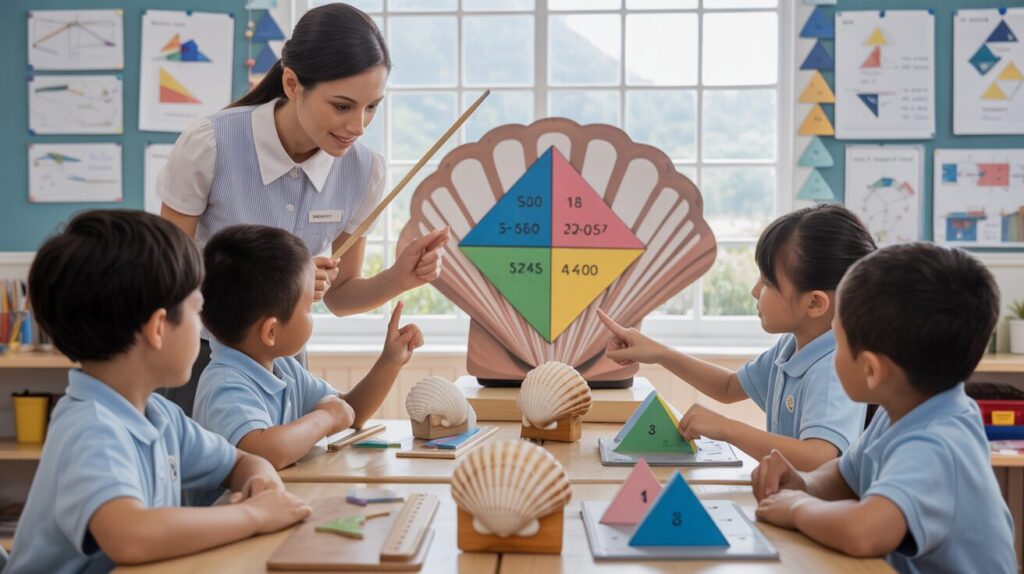
Table Of Contents
Geometry forms an essential foundation of mathematics, and understanding angles in shapes is a crucial skill for Primary school students. At Seashell Academy by Suntown Education Centre, we’ve observed that students who master these fundamental concepts early develop stronger spatial reasoning and problem-solving abilities that benefit them throughout their academic journey.
This quick guide focuses on angles in triangles and quadrilaterals – two of the most important shapes in geometry. Whether you’re preparing for PSLE Mathematics or simply building your mathematical knowledge, understanding how angles work within these shapes will give you valuable tools for tackling more complex geometry problems.
Using our signature Seashell Method that combines visual learning with practical applications, we’ll break down these concepts into clear, manageable segments that build upon each other. Let’s begin our exploration of the fascinating world of angles!
Understanding Angles in Triangles
Triangles are the simplest closed polygon, with just three sides and three angles. Their simple structure makes them incredibly important in mathematics and real-world applications like construction, engineering, and design. Let’s explore the key angle properties that make triangles special.
The Triangle Angle Sum Property
The most fundamental property of triangles is that the sum of all interior angles is always 180 degrees. This consistent property applies to every triangle regardless of its size or shape.
We can express this as a formula: ∠A + ∠B + ∠C = 180°
At Seashell Academy, we help students visualize this concept through paper-folding activities. By folding the three corners of a triangle to meet at a point, students can see how the three angles form a straight line – exactly 180 degrees!
This property gives us tremendous problem-solving power. If we know two angles in a triangle, we can always find the third angle by subtracting the sum of the known angles from 180 degrees:
∠C = 180° – (∠A + ∠B)
Triangle Types Based on Angles
Triangles are classified into three main types based on their internal angles:
Acute Triangle: All three angles measure less than 90 degrees. These triangles appear “pointy” at all corners.
Right Triangle: Contains exactly one right angle (90 degrees). The other two angles must sum to 90 degrees. Right triangles are crucial in many mathematical applications, including Pythagoras’ theorem.
Obtuse Triangle: Has one angle measuring more than 90 degrees. The other two angles must be acute (less than 90 degrees) and sum to less than 90 degrees.
Understanding these classifications helps students recognize patterns and solve problems more efficiently. In our Mathematics Programme, we guide students to identify triangle types quickly, which is particularly valuable in PSLE problem-solving scenarios.
Exterior Angles in Triangles
When we extend any side of a triangle, we form an exterior angle. A key property that Primary 6 students need to understand is that an exterior angle of a triangle equals the sum of the two interior opposite angles.
For example, if we extend side BC to form an exterior angle at C, this exterior angle equals the sum of angles A and B.
This can be written as: ∠Exterior = ∠A + ∠B
At Seashell Academy by Suntown Education Centre, we use interactive activities to demonstrate this property, helping students develop intuitive understanding rather than mere memorization. This approach reflects our Programme Philosophy of building deep conceptual understanding.
Understanding Angles in Quadrilaterals
Quadrilaterals are four-sided polygons that appear frequently in both mathematics and our daily environment. From picture frames to computer screens, quadrilaterals surround us. Understanding their angle properties is essential for Primary 5 and 6 students preparing for PSLE Mathematics.
The Quadrilateral Angle Sum Property
Similar to triangles, all quadrilaterals have a consistent angle sum property: the interior angles of any quadrilateral always add up to 360 degrees.
We can write this as: ∠A + ∠B + ∠C + ∠D = 360°
This property makes logical sense when we consider that any quadrilateral can be divided into two triangles. Since each triangle contains 180 degrees worth of angles, two triangles would contain 360 degrees in total.
Understanding this property helps students solve complex problems where some angles are known and others need to be calculated. At Seashell Academy, we teach students to approach such problems methodically, applying algebraic thinking to geometric scenarios.
Special Quadrilaterals and Their Angles
Certain quadrilaterals have additional angle properties that make them special. Primary students should be familiar with these types:
Square: All four angles are right angles (90°). This means each angle equals 90 degrees, and the sum is 360 degrees.
Rectangle: Like squares, all four angles are right angles (90°).
Rhombus: Opposite angles are equal. While a rhombus doesn’t necessarily have right angles, the angles opposite each other have the same measure.
Parallelogram: Opposite angles are equal. Additionally, adjacent angles are supplementary, meaning they add up to 180 degrees.
Trapezoid: Has one pair of parallel sides. In an isosceles trapezoid (where the non-parallel sides are equal), the angles along the same base are equal.
Kite: Has two pairs of adjacent sides that are equal. In a kite, the angles between the pairs of equal sides are equal.
Through our gamified interactive lessons at Seashell Academy, we help students understand and remember these properties by exploring real-world examples and solving problems that make these abstract concepts concrete and meaningful.
Practical Applications and Problem-Solving
Understanding angles in triangles and quadrilaterals isn’t just about passing exams—it’s about developing spatial reasoning that applies to many real-world situations. Our students at Seashell Academy learn to connect these geometric concepts to practical applications:
Architecture and Construction: Triangles are used extensively in construction because of their inherent strength and stability. The fixed angle sum ensures structural integrity in roof trusses and support systems.
Navigation and Mapping: Triangulation, based on triangle properties, is used to determine locations and distances in navigation and surveying.
Art and Design: Understanding how angles work in different shapes helps artists and designers create balanced, visually appealing compositions.
Computer Graphics: Game developers and animators use properties of triangles and quadrilaterals to create 3D models and environments.
When approaching angle problems in PSLE Mathematics, we teach students to follow these steps:
1. Identify the type of shape (triangle or quadrilateral) and any special properties it might have.
2. Recall the relevant angle sum property (180° for triangles, 360° for quadrilaterals).
3. Look for additional relationships (parallel lines, right angles, etc.) that provide more angle information.
4. Set up equations based on these relationships to solve for unknown angles.
5. Verify your answer by checking if all angle properties are satisfied.
This structured approach aligns with our Seashell Method, which emphasizes systematic problem-solving techniques that build confidence and reduce anxiety during examinations.
Example Problems
Let’s look at some typical angle problems that Primary 5 and 6 students might encounter:
Problem 1 (Triangle): In triangle ABC, angle A = 45° and angle B = 60°. What is the measure of angle C?
Solution: Using the triangle angle sum property: ∠A + ∠B + ∠C = 180°
45° + 60° + ∠C = 180°
105° + ∠C = 180°
∠C = 75°
Problem 2 (Quadrilateral): In quadrilateral PQRS, three angles measure 80°, 100°, and 90°. What is the measure of the fourth angle?
Solution: Using the quadrilateral angle sum property: ∠P + ∠Q + ∠R + ∠S = 360°
80° + 100° + 90° + ∠S = 360°
270° + ∠S = 360°
∠S = 90°
These examples demonstrate how understanding the fundamental angle properties enables students to solve problems efficiently. At Seashell Academy, we provide ample practice with varied problem types to build students’ confidence and skill.
Summary and Key Takeaways
In this quick guide, we’ve explored the essential concepts related to angles in triangles and quadrilaterals that Primary school students need to master. Let’s recap the key points:
For Triangles:
• The sum of interior angles always equals 180 degrees
• Triangles can be classified as acute, right, or obtuse based on their angles
• An exterior angle equals the sum of the two non-adjacent interior angles
For Quadrilaterals:
• The sum of interior angles always equals 360 degrees
• Special quadrilaterals (squares, rectangles, parallelograms, etc.) have additional angle properties
• Understanding these properties helps in solving complex geometric problems
At Seashell Academy by Suntown Education Centre, we believe that building strong foundations in these geometric concepts creates confident mathematics learners. Our approach emphasizes understanding over memorization, which is why our students develop genuine mathematical thinking that serves them well beyond PSLE.
Remember that geometry is all around us—the angles in triangles and quadrilaterals are not just abstract concepts but practical tools for understanding and interacting with our world. By mastering these fundamentals now, you’re developing spatial reasoning skills that will benefit you throughout your academic journey and beyond.
Ready to Master Mathematics with the Seashell Method?
If you’re looking to help your child build strong foundations in Mathematics through our unique approach that combines academic excellence with emotional well-being, we invite you to learn more about our specialized Mathematics Programme at Seashell Academy by Suntown Education Centre.
Our experienced MOE-trained educators work with small class sizes to ensure personalized attention and sustainable learning progress.
Contact Us Today to Learn More
Alternatively, explore our Mathematics Programme or discover our unique Programme Philosophy to see how we nurture confident, resilient learners.