Experience Day on 22-Nov | Exclusively for Frasers Members
November 25, 2025
Data Interpretation: Mastering Line Graphs and Tables for Primary School Students
November 26, 2025
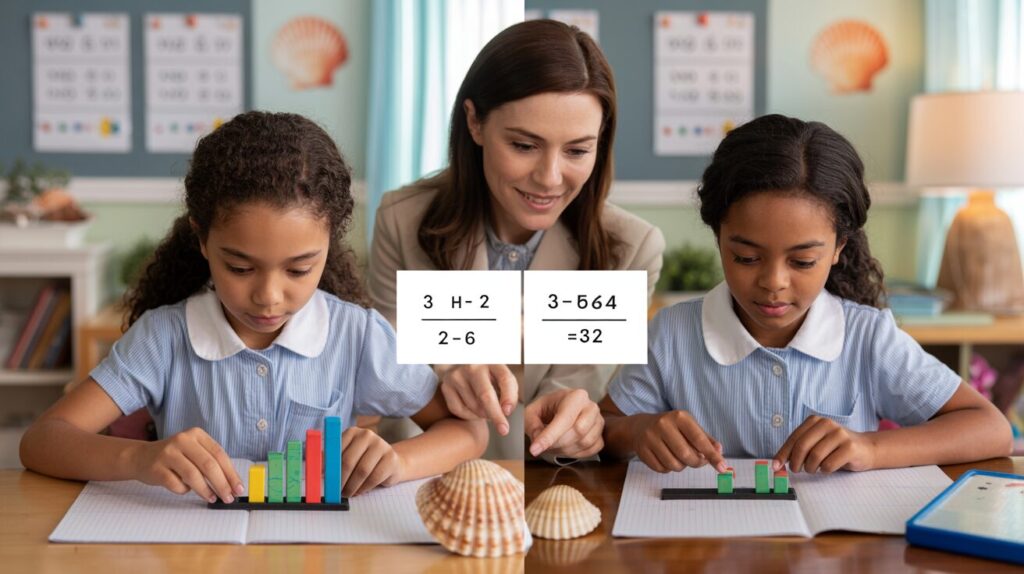
Table Of Contents
- Understanding P6 Math Challenges
- What is the Bar Model Method?
- What is the Algebraic Approach?
- Comparing Bar Model vs Algebra
- The Seashell Method: Integrating Both Approaches
- Helping Your Child Choose the Right Strategy
- PSLE Preparation Recommendations
- Conclusion
As Primary 6 students approach their PSLE Mathematics examination, many parents find themselves in a dilemma: should they encourage their children to use the Singapore Bar Model method, which has been taught since lower primary, or transition to algebraic techniques that will be essential in secondary school? This question isn’t just about academic preference—it’s about finding the right approach that aligns with your child’s learning style while preparing them for PSLE success.
At Seashell Academy by Suntown Education Centre, we’ve guided hundreds of students through this critical transition period, observing firsthand which strategies work best for different types of learners. While both the bar model and algebraic methods have their merits, understanding when and how to apply each approach can make the difference between confusion and confidence in your child’s mathematical journey.
In this comprehensive guide, we’ll explore the strengths and limitations of both bar modeling and algebra for P6 math problem-solving. You’ll discover how these approaches handle different question types, which method might better suit your child’s cognitive development, and how our unique Seashell Method integrates both strategies to maximize understanding and examination performance.
Understanding P6 Math Challenges
Primary 6 mathematics represents a significant leap in complexity from earlier years. Students face increasingly sophisticated word problems that test not just computational skills but conceptual understanding and problem-solving abilities. The challenges typically include:
Multi-step word problems requiring strategic thinking and careful planning are now the norm. Questions involving fractions, ratios, percentages, and rate become more intricate, often combining several concepts in a single problem. Most importantly, P6 students encounter complex relationship-based questions that demand strong visualization skills or systematic algebraic reasoning.
This heightened complexity creates a crossroads in mathematical approach. The bar model method that served students well in earlier years may become cumbersome for certain advanced problems, while algebraic techniques offer efficiency but require a conceptual shift in thinking.
The pressure of PSLE preparation adds another dimension to this challenge. Students need not only to solve problems correctly but to do so efficiently under time constraints. This makes the choice between visual modeling and algebraic methods particularly consequential.
What is the Bar Model Method?
The Singapore Bar Model method is a visual problem-solving approach that uses rectangular bars to represent quantities and their relationships. This pictorial technique bridges concrete and abstract thinking, helping students visualize mathematical relationships before attempting to solve them.
In a typical bar model approach, students read a word problem, identify the known and unknown values, and represent these as rectangular bars. The relative sizes of these bars illustrate relationships between quantities, making it easier to understand what operation is needed to solve the problem.
For example, in a problem where John has 24 marbles and Mary has 36 marbles, a bar model would show two bars with lengths proportional to 24 and 36. If the question asks how many more marbles Mary has, the visual representation immediately shows this as the difference between the two bars.
Advantages of Bar Modeling
The bar model method offers several distinct advantages for P6 students:
Visual representation makes abstract relationships concrete and accessible. This is particularly valuable for visual learners who process information better through pictures than through symbols. The method develops deep conceptual understanding by helping students see the “why” behind mathematical operations rather than just memorizing procedures.
Bar modeling provides a structured approach to problem-solving that guides students through the thinking process. It’s especially powerful for ratio, percentage, and fraction problems where visualizing proportional relationships clarifies concepts that might otherwise remain abstract.
Perhaps most importantly, the bar model method has strong continuity with earlier primary mathematics education. Students have been using this approach since P3 or P4, giving them a comfortable foundation to build upon.
Limitations of Bar Modeling
Despite its strengths, the bar model approach has several limitations for advanced P6 mathematics:
For complex multi-step problems with several variables or conditions, bar models can become unwieldy and difficult to draw accurately. The more variables involved, the more challenging it becomes to represent relationships clearly using bars.
Bar modeling can also be time-consuming during examinations, where students must work efficiently. Drawing precise bars and ensuring they accurately represent mathematical relationships requires care and attention that may consume valuable minutes.
Additionally, certain types of problems—particularly those involving simultaneous unknowns or algebraic relationships—are inherently more suitable for symbolic representation than for visual modeling. In these cases, insisting on bar models may actually increase cognitive load rather than reducing it.
What is the Algebraic Approach?
The algebraic approach uses symbols, typically letters like x and y, to represent unknown quantities. Students translate word problems into equations, then solve these equations using mathematical rules. This approach emphasizes symbolic representation and systematic manipulation of equations.
In algebra, students learn to express relationships using variables, coefficients, and operations. For instance, in the earlier example about marbles, an algebraic approach might use “m” to represent Mary’s marbles and write “m = 36” and “j = 24” for John’s marbles. The difference would be expressed as “m – j = 36 – 24 = 12”.
For more complex problems, students might need to define variables, write equations based on the conditions given, and then solve for the unknown quantities through algebraic manipulation. This process becomes particularly powerful when dealing with multiple unknowns or constraints.
Advantages of Algebra
The algebraic approach offers significant advantages for advanced problem-solving:
Algebra provides exceptional efficiency for complex problems. Once students master the technique, they can solve sophisticated problems with less working shown and in less time than visual methods would require. This efficiency becomes crucial during timed examinations.
The symbolic approach scales elegantly to handle multiple variables and relationships. Problems that would require complicated, multi-layered bar models can often be expressed concisely as systems of equations.
Perhaps most importantly, algebra creates a natural bridge to secondary school mathematics. By introducing algebraic thinking in P6, students develop skills that will be essential throughout their secondary education and beyond.
Algebraic methods also excel at handling certain problem types that appear in advanced P6 mathematics, such as before-after scenarios, mixture problems, and work-rate questions. For these problem types, algebra often provides the most direct solution path.
Limitations of Algebra
Despite its power, the algebraic approach presents certain challenges for P6 students:
The abstract nature of algebra represents a significant conceptual leap for many students. Using symbols to represent quantities requires a level of abstract thinking that some P6 students may not have fully developed. This can make algebra seem mysterious or disconnected from their understanding of mathematics.
Translating word problems into accurate equations is a complex skill that requires practice and precision. Students may understand the algebraic techniques but struggle with the critical first step of setting up the correct equation.
For students without adequate preparation, introducing algebra too suddenly can create anxiety and confusion. Without a gradual transition from concrete to pictorial to abstract representation, some students may memorize algebraic procedures without genuine understanding.
Comparing Bar Model vs Algebra
When directly comparing these approaches, several key differences emerge that influence their suitability for different students and problem types.
Problem Types and Suitability
Bar modeling excels at problems involving part-whole relationships, comparisons, and proportional reasoning. Questions about fractions, ratios, and percentages often become intuitive when represented visually. For example, problems asking “What fraction of the whole is this part?” align perfectly with the bar model’s visual representation of parts and wholes.
Algebra, on the other hand, shines when dealing with problems involving unknown quantities in multiple steps, especially when relationships can be expressed as equations. Work-rate problems (e.g., “How long would it take both workers together?”), age problems (“In how many years will the father be 3 times as old as the son?”), and mixture problems (“What is the concentration after mixing these solutions?”) all benefit from algebraic approaches.
At Seashell Academy’s Mathematics Programme, we’ve observed that certain challenging P6 problem types specifically benefit from one approach over the other:
For before-and-after scenarios, algebraic approaches typically provide cleaner solutions. When dealing with multiple variables that change under certain conditions, equations can track these changes more systematically than bar models.
Conversely, problems involving comparisons between quantities (“A is 3 times as much as B”) often remain more intuitive with bar models, as the visual representation directly shows these relationships.
Cognitive Development Considerations
The suitability of each approach also depends on your child’s cognitive development and learning preferences:
Visual-spatial learners typically gravitate toward bar modeling, finding that the pictorial representation aligns with their natural thinking process. For these students, bar models provide an intuitive entry point to problem-solving that builds confidence and conceptual understanding.
Logical-sequential thinkers may prefer the systematic nature of algebra, appreciating its clear rules and procedures. These students often find satisfaction in the step-by-step algebraic process and the elegance of symbolic representation.
Research in cognitive development suggests that most P6 students (ages 11-12) are in transition between concrete operational and formal operational thinking. This means they’re gradually developing the capacity for abstract reasoning needed for algebraic thinking, but this development happens at different rates for different children.
The Seashell Method: Integrating Both Approaches
At Seashell Academy by Suntown Education Centre, we’ve developed a unique approach that leverages the strengths of both methods while accommodating different learning styles. Our Programme Philosophy emphasizes building strong foundations while preparing students for future mathematical challenges.
The Seashell Method uses bar models as a bridge to algebraic thinking rather than treating these approaches as mutually exclusive. Students first visualize problems using bar models to develop conceptual understanding, then learn to translate these visual representations into algebraic equations.
This integrated approach offers several advantages:
It provides a gentler transition from concrete to abstract thinking, preventing the conceptual gaps that can occur when algebra is introduced too abruptly. Students see the connection between visual and symbolic representations, understanding how algebraic expressions relate to the quantities they represent.
The method also develops flexible problem-solving skills, encouraging students to select the most appropriate strategy based on the problem type rather than rigidly applying a single approach. This adaptability builds confidence and resilience when facing unfamiliar problem types.
Perhaps most importantly, our integrated approach supports diverse learning styles while preparing all students for the mathematical demands of secondary school. Visual learners aren’t left behind in the transition to algebra, while students ready for abstract thinking aren’t held back by exclusively visual methods.
Helping Your Child Choose the Right Strategy
As a parent, you can support your child in developing mathematical flexibility by encouraging strategic thinking about when to use each approach:
Observe your child’s natural problem-solving tendencies. Do they instinctively draw pictures to understand problems, or do they prefer working with numbers and symbols? Their natural inclination may indicate which approach will serve as their primary strategy.
Discuss the relative efficiency of different approaches for specific problems. Ask questions like, “Would it be easier to draw this problem or write an equation?” This helps develop metacognition—awareness of their own thinking processes.
Encourage your child to attempt problems using both methods initially, then compare the solutions. This builds confidence in both approaches while helping them recognize which method is more efficient for different problem types.
Remember that comfort and confidence are crucial for examination performance. While efficiency matters, your child will perform best using methods they truly understand and can apply with confidence under pressure.
PSLE Preparation Recommendations
As PSLE approaches, consider these strategic recommendations:
Focus on mastering the method your child finds most intuitive first, ensuring they have at least one reliable approach for tackling problems. Then gradually introduce alternative methods for problem types where their preferred approach is less efficient.
Practice time management with both approaches, helping your child recognize when a bar model might take too long or when setting up an algebraic equation might lead to confusion. The best approach in an examination context may differ from what works during learning.
Review past PSLE questions and identify patterns in problem types, noting which approach would be most efficient for each category. This creates a mental “decision tree” that helps your child quickly choose the appropriate method during the examination.
Remember that PSLE markers award marks for correct mathematical reasoning, regardless of whether it’s expressed through bar models or algebraic equations. The key is clarity, accuracy, and showing appropriate working.
At Seashell Academy, our experienced MOE-trained educators provide personalized guidance on strategy selection as part of our examination preparation. We believe that mathematical confidence comes not just from knowing how to solve problems, but from knowing which approach to apply and when.
Conclusion
The choice between bar modeling and algebra for P6 mathematics isn’t truly an either/or decision. Rather than viewing these as competing approaches, we encourage seeing them as complementary tools in your child’s mathematical toolkit.
Bar modeling builds strong conceptual foundations and visual reasoning skills that support mathematical understanding throughout life. Algebraic techniques develop abstract thinking and provide efficiency that becomes increasingly valuable as mathematical challenges grow more complex.
The most successful students are those who develop flexibility in their problem-solving approach—using bar models to understand relationships, then transitioning to algebraic methods when they offer greater efficiency. This balanced approach aligns with the Singapore mathematics curriculum’s emphasis on concrete-pictorial-abstract progression.
At Seashell Academy by Suntown Education Centre, our nurturing approach to mathematics education respects each child’s learning journey while preparing them for both immediate challenges and future growth. We believe that mathematical confidence comes from deep understanding, not just procedural fluency, and our integrated teaching methods reflect this philosophy.
Whether your child naturally gravitates toward visual or symbolic reasoning, our goal remains the same: to develop resilient, confident problem-solvers who approach mathematics with both understanding and enthusiasm.
Is your child struggling with P6 math problem-solving strategies? Seashell Academy by Suntown Education Centre offers personalized coaching that builds both competence and confidence through our unique integrated approach to mathematics education. Contact us today to learn more about our Mathematics Programme and how we can support your child’s PSLE preparation.