Circulatory System Model Using Straws & Balloons: A Complete STEM Guide for Primary Students
December 28, 2025
Tuition Centre vs Online Science Classes: Which Works Better for Your Child?
December 30, 2025
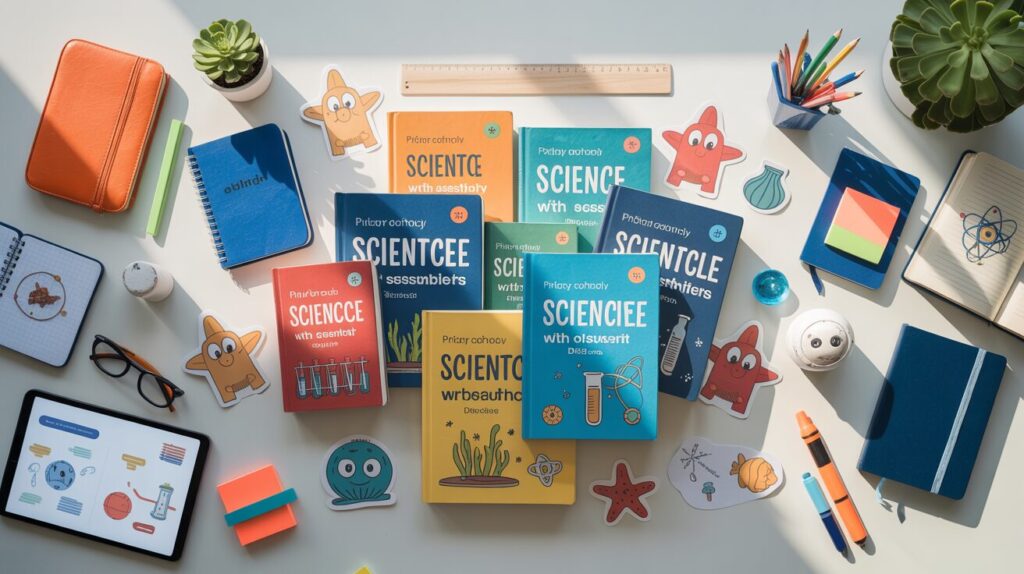
Table Of Contents
- Understanding Science Assessment Books: Beyond Practice Makes Perfect
- What Makes a Science Assessment Book Truly Effective?
- Best Science Assessment Books for Lower Primary (P3-P4)
- Best Science Assessment Books for Upper Primary (P5-P6)
- Assessment Books for Specialized Learning Needs
- How to Integrate Assessment Books Into Holistic Learning
- Common Mistakes Parents Make With Assessment Books
Walking into any Popular or Times bookstore in Singapore, parents are immediately confronted with towering shelves of assessment books, each promising exam success and better grades. For science specifically, the choices can feel overwhelming—different publishers, various difficulty levels, and conflicting advice from other parents about which books “guarantee” PSLE success.
But here’s what many parents don’t realize: the best assessment book isn’t necessarily the thickest one or the one with the most questions. The most effective science assessment books are those that align with how your child learns, reinforce conceptual understanding rather than mere memorization, and build confidence without causing burnout. At Seashell Academy by Suntown Education Centre, we’ve seen firsthand how the right assessment materials—used correctly—can complement structured learning and deepen scientific thinking, while the wrong approach can lead to frustration and disengagement.
This comprehensive guide reviews the best science assessment books available for Primary 3 to Primary 6 students in Singapore, evaluating each based on pedagogical effectiveness, alignment with MOE syllabus objectives, and their ability to support genuine understanding. Whether your child is building foundational science skills or preparing for the PSLE, you’ll find practical recommendations that prioritize sustainable learning over short-term cramming.
Understanding Science Assessment Books: Beyond Practice Makes Perfect
Before diving into specific recommendations, it’s important to understand that not all assessment books serve the same purpose. Many parents treat assessment books as the primary learning tool, but this approach fundamentally misunderstands their role in the learning ecosystem. Science assessment books should reinforce and test understanding that has already been built through classroom learning, hands-on experimentation, and conceptual exploration.
The science curriculum for Singapore primary students emphasizes three interconnected domains: Knowledge, Understanding and Application; Skills and Processes; and Ethics and Attitudes. Truly effective assessment books don’t just test recall—they challenge students to apply scientific concepts to novel situations, analyze experimental scenarios, and develop scientific reasoning. This mirrors the approach used in our Programme Philosophy at Seashell Academy, where we emphasize real-life application alongside foundational knowledge.
Research in educational psychology consistently shows that spaced repetition, varied practice contexts, and metacognitive reflection produce deeper learning than massed practice alone. The best assessment books incorporate these principles through carefully structured question progressions, diverse question formats, and opportunities for students to check their understanding and identify knowledge gaps.
What Makes a Science Assessment Book Truly Effective?
When evaluating science assessment books for this review, we applied rigorous criteria based on both educational research and practical classroom experience with hundreds of primary students. Understanding these criteria will help you make informed decisions beyond the specific recommendations in this guide.
Conceptual Clarity: The best assessment books include clear explanations and worked examples that illuminate the underlying scientific principles, not just the steps to get the right answer. Look for books that explain the “why” behind phenomena, not just the “what” to memorize.
Question Progression: Effective books structure questions from foundational recall to higher-order application, allowing students to build confidence before tackling complex scenarios. This scaffolded approach prevents discouragement while still providing appropriate challenge.
Alignment With MOE Syllabus: Science syllabi are regularly updated to reflect current pedagogical approaches. Assessment books should align with current syllabus emphases, question formats, and the balance between content domains (Diversity, Cycles, Systems, Interactions, Energy).
Quality of Explanations: When students make mistakes—and they will—the book’s answer key becomes a crucial learning tool. Detailed explanations that address common misconceptions are far more valuable than simple answer keys.
Visual Design and Accessibility: Science is inherently visual. Books with clear diagrams, well-organized layouts, and appropriate use of color coding help students process information more effectively and reduce cognitive load.
Best Science Assessment Books for Lower Primary (P3-P4)
The lower primary years mark students’ first formal introduction to science as a discrete subject. At this stage, building curiosity, establishing good thinking habits, and developing comfort with scientific vocabulary are just as important as content mastery. The assessment books we recommend for P3 and P4 balance skill-building with engagement.
Casco Educational Press Science Assessment Books
Best for: Building strong foundational understanding with comprehensive coverage
Casco’s assessment books for lower primary have earned their reputation through consistently well-structured content that mirrors the MOE teaching sequence. Each topic begins with a concise summary of key concepts, followed by a carefully graded progression of questions. What distinguishes Casco is their attention to conceptual connections—questions frequently require students to link different topics or apply learning to everyday contexts.
For P4 students who are also strengthening their language skills, particularly those enrolled in programmes like our P4 Chinese Programme, Casco’s clear language and well-defined scientific terminology help reinforce vocabulary across subjects. The books include helpful annotation features where key terms are highlighted and defined in context.
Strengths:
- Excellent topic summaries that serve as quick revision tools
- Questions that emphasize understanding over memorization
- Detailed answer explanations that address common errors
- Good balance between question types (MCQ, open-ended, structured)
Considerations: Some parents find the difficulty level slightly higher than other publishers, which can be challenging for students who struggle with reading comprehension. However, this higher bar often prepares students well for the increased rigour in upper primary.
SAP Science Assessment Books
Best for: Students who need confidence-building and accessible practice
SAP (Singapore Asia Publishers) takes a gentler, more encouraging approach to science assessment. Their lower primary books feature abundant diagrams, color-coded sections, and a slightly lower difficulty curve that helps build confidence. Each chapter includes a “Recall and Review” section that reinforces key points before moving to practice questions.
The question bank in SAP books is extensive, providing plenty of practice opportunities without overwhelming students. This makes them particularly suitable for children who are still developing stamina for independent study or who need more repetition to solidify concepts. The approach aligns well with the philosophy we use in our Mathematics Programme—building competence through appropriately challenging, success-oriented practice.
Strengths:
- Highly visual presentation that supports different learning styles
- Encouraging tone that reduces anxiety around assessment
- Extensive practice questions for thorough reinforcement
- Affordable pricing compared to other assessment books
Considerations: The easier difficulty level, while beneficial for confidence, may not sufficiently challenge students who are already strong in science. These students might benefit from supplementing with more rigorous materials.
Marshall Cavendish Topical Assessment Books
Best for: Targeted practice and filling specific knowledge gaps
Marshall Cavendish offers a topical approach rather than comprehensive term-by-term coverage. Each book focuses on specific themes from the syllabus (Diversity, Cycles, Systems, etc.), allowing for deep practice in particular areas. This format is especially valuable when students have mastered some topics but struggle with others.
The topical structure supports the kind of focused reinforcement that complements systematic learning programmes. When students identify specific weak areas—perhaps through school assessments or diagnostic testing—these books provide concentrated practice without requiring them to work through material they’ve already mastered.
Strengths:
- Focused, in-depth coverage of individual topics
- Flexibility to target specific areas of difficulty
- Questions designed to deepen understanding of particular concepts
- Useful for revision before topic-specific school assessments
Considerations: The topical approach requires more planning from parents to ensure comprehensive coverage. These work best as supplements to other assessment books rather than standalone resources.
Best Science Assessment Books for Upper Primary (P5-P6)
Upper primary science introduces significantly greater complexity, with more sophisticated concepts, multi-step reasoning, and the looming presence of PSLE. Assessment books for these levels need to build exam-ready skills while maintaining the conceptual depth that produces genuine understanding rather than superficial pattern recognition.
Casco Educational Press Advanced Series
Best for: Comprehensive PSLE preparation with rigorous practice
Casco’s upper primary series represents their flagship offering, with significantly expanded content that matches the increased demands of P5 and P6. The books are organized both topically and by question type, helping students develop versatility in their approach to different question formats. This dual organization is pedagogically sound—it allows for both concept-focused study and format-specific practice.
For P5 students, particularly those also managing demanding language programmes like our P5 Chinese Programme, the clear structure and comprehensive nature of Casco books reduce the need to juggle multiple resources. Everything required for thorough science preparation is consolidated in one well-organized package.
The P6 edition includes actual PSLE questions from previous years, carefully categorized by topic and difficulty. This exposure to authentic exam questions is invaluable for familiarizing students with PSLE expectations and question styles.
Strengths:
- Rigorous questions that prepare students for PSLE-level thinking
- Inclusion of authentic past-year PSLE questions
- Excellent answer keys with detailed explanations
- Systematic coverage of all syllabus requirements
Considerations: The difficulty level can be intimidating for students who lack strong foundations. These books work best when students have solid grasp of lower primary concepts and are ready for challenge.
SAP Complete Assessment Package
Best for: Balanced preparation with emphasis on building confidence
SAP’s upper primary offerings maintain their accessible approach while appropriately increasing difficulty for PSLE readiness. Their “Complete Assessment Package” includes both topical assessments and full-length practice papers, providing comprehensive coverage without overwhelming complexity.
What makes SAP particularly valuable for upper primary is their attention to exam techniques and common pitfalls. Sidebar notes throughout the books highlight frequent mistakes, time management strategies, and tips for interpreting question requirements—meta-cognitive skills that significantly impact exam performance.
Strengths:
- Gradual difficulty progression that builds confidence
- Integration of exam techniques and strategy guidance
- Full-length practice papers that simulate PSLE conditions
- Supporting materials like formula sheets and concept maps
Considerations: Students aiming for AL1 or AL2 may need additional challenging materials to push their thinking beyond the book’s scope.
Opti-Mark Science Assessment Books
Best for: Students seeking challenging, high-level practice
Opti-Mark has built its reputation on providing questions that extend beyond typical PSLE difficulty, challenging high-achieving students to think more deeply about scientific concepts. These books are not for everyone—they’re specifically designed for students who have mastered the standard curriculum and need intellectual stretching.
The questions in Opti-Mark books frequently require synthesis of multiple concepts, application to novel scenarios, and careful analysis of complex experimental setups. This level of cognitive demand helps prevent overconfident students from becoming complacent and pushes them toward genuine scientific reasoning.
For students in our P6 Chinese Programme who are managing multiple demanding subjects, Opti-Mark should be used selectively—perhaps one or two topics per week—rather than as a comprehensive workbook to complete in full.
Strengths:
- Highly challenging questions that develop advanced thinking skills
- Excellent preparation for competitive examinations
- Questions that reward deep understanding over memorization
- Helps distinguish students at the highest achievement levels
Considerations: The difficulty level can be demoralizing for average students. Use judiciously and only when foundations are absolutely solid. Not recommended as a primary assessment book.
Marshall Cavendish PSLE Preparation Series
Best for: Final-stage PSLE revision and practice
Marshall Cavendish’s PSLE-specific series is designed for the final months before the examination. These books focus heavily on exam strategy, time management, and pattern recognition for common PSLE question types. Each book includes multiple full-length practice papers with detailed marking schemes.
The value of this series lies not in teaching new content but in consolidating existing knowledge and building exam confidence. The practice papers are carefully calibrated to match actual PSLE difficulty and format, providing authentic preparation experiences.
Strengths:
- Authentic PSLE simulation papers
- Detailed marking schemes that clarify examiners’ expectations
- Strategic guidance on approaching different question types
- Useful for identifying remaining knowledge gaps before PSLE
Considerations: Best used in the months immediately before PSLE rather than throughout P5 and P6. Should supplement, not replace, topical understanding-focused practice.
Assessment Books for Specialized Learning Needs
Every child’s learning journey is unique, and sometimes standard assessment books don’t match specific needs. Students who are visual learners, those who need more scaffolding, or children who benefit from alternative explanations may require specialized materials.
For Visual and Kinesthetic Learners: The “My Pals Are Here!” Science Activity Books (Marshall Cavendish) incorporate more hands-on elements, experiments, and visual thinking tools. While not traditional assessment books, they provide valuable reinforcement for students who struggle with text-heavy materials.
For Students Needing Additional Support: The “Success Science” series focuses on core concepts with simplified language and more scaffolding. These books break down complex ideas into manageable steps, making them suitable for students who find standard assessment books overwhelming.
For Bilingual Learners: Some publishers offer assessment books with Chinese-English terminology support, which can be particularly helpful for students balancing both languages. This dual-language approach reinforces scientific vocabulary across languages, supporting the kind of integrated learning we emphasize at Seashell Academy.
How to Integrate Assessment Books Into Holistic Learning
Even the best assessment book becomes counterproductive if used incorrectly. At Seashell Academy, we’ve observed that the relationship between assessment practice and learning outcomes follows an inverted U-curve—moderate, strategic practice produces optimal results, while both too little and excessive practice undermine learning.
Timing Matters: Assessment books should reinforce recently taught concepts, not introduce new material. Use them after classroom teaching and initial understanding, not as primary learning tools. Spacing practice over time produces better retention than massed practice sessions.
Quality Over Quantity: It’s far more valuable for students to complete fewer questions with full understanding, including careful review of mistakes, than to rush through many questions without reflection. After completing each section, students should review incorrect answers, understand why they erred, and redo similar questions to confirm understanding.
Balance With Other Learning Activities: Assessment books should represent only one component of science learning. Hands-on experiments, nature observation, science documentaries, museum visits, and curiosity-driven exploration are equally important for developing genuine scientific thinking. The sustainable learning approach emphasized in our Programme Philosophy recognizes that varied learning experiences produce deeper, more lasting understanding than assessment practice alone.
Use Assessment Books Diagnostically: Rather than working through books sequentially from cover to cover, use them to identify knowledge gaps. If a student struggles with a particular topic, that signals a need for conceptual review and re-teaching, not just more practice questions.
Maintain Emotional Wellbeing: Watch for signs of stress, frustration, or declining enthusiasm. If assessment practice is causing anxiety or reducing curiosity about science, it’s time to scale back and refocus on building understanding and confidence. The pearl-forming process takes time and patience—forcing it only produces inferior results.
Common Mistakes Parents Make With Assessment Books
With the best intentions, many parents inadvertently undermine their children’s learning through how they approach assessment books. Understanding these common pitfalls helps you avoid them.
Mistake #1: Starting Too Many Books Simultaneously. Some parents purchase multiple assessment books and have children work on all of them concurrently. This scattered approach prevents completion of any single book, creates confusion about which material to prioritize, and overwhelms students. Choose one primary assessment book per level and complete it thoroughly before adding others.
Mistake #2: Using Assessment Books as Primary Teaching Tools. Assessment books are designed to test and reinforce understanding, not to build it initially. When students repeatedly encounter questions they cannot answer because concepts haven’t been properly taught, they develop learned helplessness and anxiety around the subject. Ensure proper teaching precedes assessment practice.
Mistake #3: Focusing Only on Completion Rather Than Understanding. The goal is not to finish the book but to master the concepts. Rushing through material to complete chapters creates an illusion of progress without actual learning. Better to complete 60% of a book with full understanding than 100% with superficial engagement.
Mistake #4: Neglecting to Review Mistakes Properly. When students get questions wrong, simply showing them the correct answer provides minimal learning benefit. Effective mistake review involves understanding the underlying misconception, reviewing the relevant concept, and practicing similar questions until the thinking pattern is corrected.
Mistake #5: Using Only Difficult Books to “Challenge” Students. While challenging materials can benefit strong students, using books that are too difficult causes frustration, erodes confidence, and can create negative associations with science. Assessment materials should be appropriately challenging—difficult enough to require thought but accessible enough to build mastery.
Mistake #6: Treating All Subjects Identically. The approach that works for mathematics assessment books may not work for science. Science requires more emphasis on conceptual understanding, vocabulary development, and real-world application, while mathematics emphasizes procedural fluency and problem-solving patterns. Adjust your approach based on subject characteristics.
Choosing the right science assessment books for your child involves more than finding the most popular title or the one with the most questions. The best assessment book is the one that matches your child’s current understanding level, supports their learning style, and integrates into a balanced, holistic approach to education.
For most lower primary students (P3-P4), SAP or Casco provide excellent foundations—SAP for confidence-building and Casco for those ready for moderate challenge. Upper primary students (P5-P6) generally benefit from Casco’s comprehensive coverage, supplemented with Marshall Cavendish practice papers in the months before PSLE. High-achieving students seeking additional challenge can selectively incorporate Opti-Mark materials.
Remember that assessment books are tools, not magic solutions. They work best when integrated into a comprehensive learning approach that includes quality teaching, hands-on exploration, conceptual discussion, and emotional support. At Seashell Academy by Suntown Education Centre, we’ve seen countless students excel not because they completed the most assessment books, but because they developed genuine understanding, built confidence through appropriately scaffolded challenge, and maintained their curiosity and love for learning.
The journey toward PSLE success and lifelong learning isn’t a sprint through endless assessment books—it’s a carefully nurtured process of growth, much like a pearl forming within its protective shell. Choose your materials wisely, use them strategically, and always prioritize your child’s holistic development over short-term test scores. The investment in thoughtful, balanced preparation pays dividends far beyond any single examination.
Looking for More Than Just Assessment Books?
At Seashell Academy by Suntown Education Centre, we combine the best assessment materials with our proven Seashell Method—integrating academic excellence with emotional wellbeing through personalized coaching, mind-mapping approaches, and gamified learning. Our experienced MOE-trained educators don’t just help students complete workbooks; we nurture confident, resilient learners who genuinely love science.
Discover how our holistic approach to Primary Science, Math, and Chinese creates sustainable success without burnout.