Adaptations in Mangrove Plants: Comprehensive Illustrated Guide for Primary Students
December 15, 2025
DIY Lung Model: A Hands-On Activity to Understand the Respiratory System
December 17, 2025
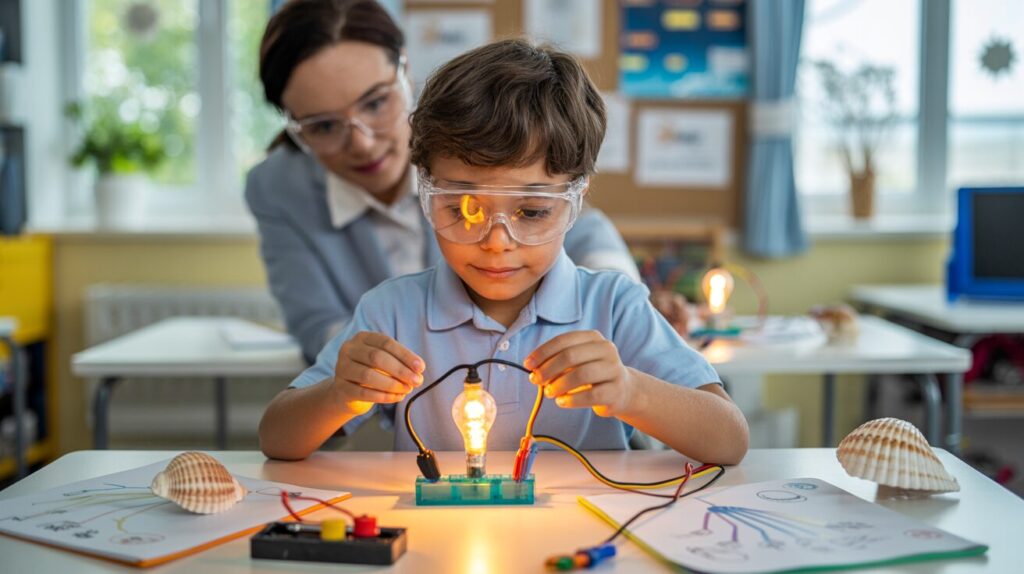
Table Of Contents
- Introduction
- Understanding Electricity Basics
- Components Needed for a Simple Circuit
- Safety First: Essential Guidelines
- Step-by-Step: Building Your First Circuit
- Troubleshooting Common Problems
- Extension Activities and Experiments
- Connecting to Real-World Applications
- Conclusion
Building a Simple Electric Circuit: A Complete Guide with Safety Tips for Primary Students
Electricity powers our modern world, from the lights in our homes to the devices in our pockets. For primary school students, understanding how electricity works isn’t just fascinating—it’s foundational knowledge that builds critical thinking skills and scientific curiosity. At Seashell Academy by Suntown Education Centre, we believe that science concepts come alive through hands-on exploration, which is why building a simple electric circuit is one of the most exciting and educational activities for young learners.
Just as a seashell protects the pearl growing within, safety measures protect young scientists during their electrical explorations. This comprehensive guide will walk you through creating a basic circuit while emphasizing important safety precautions every step of the way. Whether you’re a Primary 3 student just beginning to learn about electricity or a Primary 6 student preparing for PSLE Science, these activities will illuminate electrical concepts in a memorable, engaging way that aligns perfectly with the MOE science syllabus.
Let’s embark on an electrifying journey of discovery that will spark your child’s interest in science and build confidence through safe, hands-on learning!
Understanding Electricity Basics
Before we begin building our circuit, it’s important to understand what electricity actually is. Electricity is a form of energy resulting from charged particles, particularly electrons. Think of electricity as a flow of tiny particles traveling along a path, similar to water flowing through pipes in your home.
In a circuit, electricity needs a complete pathway to flow from a power source (like a battery), through components (like a light bulb), and back to the power source. This circular journey is why we call it a “circuit” – from the word “circle.” If this path is broken at any point, the electricity stops flowing, and the circuit is considered “open.” When the path is complete, we call it a “closed circuit.”
At Seashell Academy by Suntown Education Centre, we use mind-mapping approaches to help students visualize these concepts. Imagine a tiny car traveling on a circular road (the wire), powered by a service station (the battery), and visiting destinations (the components like bulbs or motors) along the way. If the road breaks anywhere, the car can’t complete its journey!
Key Terms to Know
Let’s familiarize ourselves with some important vocabulary that will help us discuss circuits clearly:
- Conductor: Materials that allow electricity to flow through them easily (like metals)
- Insulator: Materials that do not allow electricity to flow through them easily (like rubber, plastic)
- Current: The flow of electric charge through a conductor
- Voltage: The electric pressure that pushes current through a circuit
- Resistance: How much a material opposes the flow of electric current
Understanding these terms will help your child build a stronger foundation in science, aligning with our approach at Seashell Academy where we emphasize building academic mastery through conceptual understanding rather than mere memorization.
Components Needed for a Simple Circuit
One of the beauties of learning about electric circuits is that the basic components are relatively inexpensive and easy to find. For your child’s first circuit-building experience, you’ll need:
Essential Components:
- 1.5V battery (AA or AAA batteries work well for beginners)
- Battery holder (makes handling safer and more convenient)
- Insulated copper wire (at least 30cm)
- Small light bulb (1.5V bulb matches the battery voltage)
- Bulb holder (makes connections easier and safer)
- Electrical tape (for securing connections)
- Scissors with plastic handles (for cutting wire)
- Wire strippers (if available, otherwise scissors can work carefully)
Optional Additional Components:
- Switch (to easily turn the circuit on and off)
- Buzzer (as an alternative output to the light bulb)
- Small electric motor (to demonstrate mechanical energy conversion)
- Additional batteries (to experiment with different power levels)
- Alligator clips (for easier connections)
At Seashell Academy, we emphasize preparation as part of the scientific process. Having all materials ready before beginning creates a smoother, more enjoyable learning experience that allows your child to focus on the concepts rather than searching for supplies mid-activity.
Safety First: Essential Guidelines
Just as we nurture our students like pearls within a protective shell at Seashell Academy by Suntown Education Centre, safety precautions create a protective environment for electrical exploration. Before building any circuit, review these essential safety guidelines with your child:
Basic Electrical Safety Rules
Electricity can be dangerous if not handled properly. Here are important safety guidelines to follow:
- Use low voltage batteries only. For primary students, stick to 1.5V or 3V (using two 1.5V batteries) power sources. Never experiment with wall outlets or higher voltage batteries.
- Adult supervision is required. Even with low-voltage circuits, an adult should always be present to guide and monitor the activity.
- Keep circuits away from water. Electricity and water are a dangerous combination, so ensure the work area is dry and away from sinks or drinks.
- Inspect components before use. Check for damaged wires, battery leakage, or broken parts before starting.
- Never put electrical components in your mouth. Batteries contain harmful chemicals, and small parts present choking hazards.
- Use proper tools. Wire strippers or scissors with insulated handles should be used for cutting and stripping wires.
- Disconnect power when not in use. Always remove batteries or open the circuit when you’ve finished experimenting or if you need to make changes.
At Seashell Academy, we believe that teaching safety alongside science concepts helps children develop responsibility and good judgment. These skills extend beyond the classroom and prepare them for safe, independent learning throughout their lives.
Setting Up a Safe Workspace
Creating the right environment is just as important as following safety rules:
- Choose a clean, dry, well-lit area with a flat surface
- Keep the workspace clear of clutter and unnecessary items
- Have a container ready for organizing small components
- Place a non-conductive mat (like a rubber or plastic mat) on the work surface
- Keep a basic first aid kit nearby, just in case
This preparation aligns with our Programme Philosophy at Seashell Academy, where we create structured learning environments that support both academic excellence and student well-being.
Step-by-Step: Building Your First Circuit
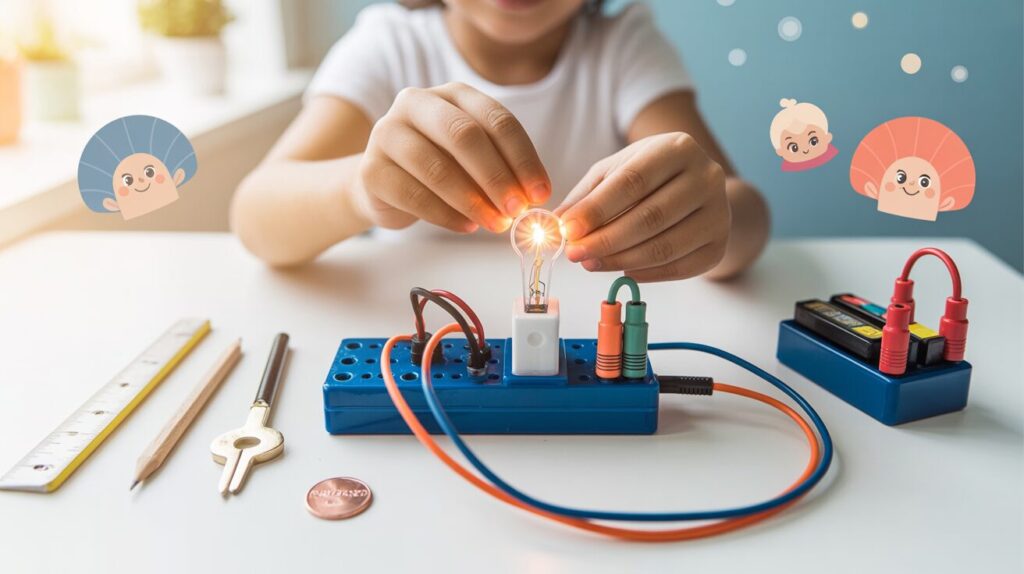
Now that we understand the basics and have our safety measures in place, let’s build a simple circuit that will light up a bulb. This hands-on activity is perfect for making abstract electrical concepts concrete and memorable.
Preparation Steps
- Gather all materials and place them on your workspace.
- Inspect your battery to ensure it’s fresh and not leaking.
- Place the battery in the holder if you’re using one.
- Examine the light bulb to make sure the filament inside is intact.
- Insert the bulb into the holder if you’re using one.
Building the Circuit
- Prepare two pieces of wire: Cut two pieces of insulated wire, each about 15cm long.
- Strip the ends: Using wire strippers or scissors (carefully), remove about 1cm of insulation from each end of both wires, exposing the copper inside.
- Connect the first wire: Attach one end of the first wire to the positive terminal (+) of the battery or battery holder.
- Connect to the bulb: Attach the other end of the first wire to one terminal of the bulb holder.
- Complete the circuit: Take the second wire and connect one end to the other terminal of the bulb holder.
- Close the loop: Connect the remaining end of the second wire to the negative terminal (-) of the battery.
If everything is connected correctly, the bulb should light up immediately! If not, don’t worry—we’ll cover troubleshooting in the next section.
Adding a Switch (Optional)
To make your circuit more interactive, you can add a simple switch:
- Cut one of your existing wires in the middle.
- Strip the newly cut ends to expose about 1cm of copper on each.
- Connect each of these exposed ends to the terminals of your switch.
- Now you can turn the light on and off by operating the switch!
This activity exemplifies our teaching approach at Seashell Academy, where we use gamified, interactive lessons to make learning engaging and memorable for our Mathematics Programme and Science students alike.
Troubleshooting Common Problems
Sometimes circuits don’t work as expected on the first try. Learning to troubleshoot is an important part of the scientific process that builds problem-solving skills and resilience—qualities we actively foster at Seashell Academy by Suntown Education Centre.
If Your Bulb Doesn’t Light Up
Check these common issues one by one:
- Loose connections: Make sure all wires are firmly connected to the battery and bulb terminals.
- Battery power: Test the battery with a battery tester or try a fresh battery.
- Bulb functionality: Try a different bulb to ensure the original isn’t burned out.
- Wire continuity: Check for breaks in your wires, especially near the stripped ends.
- Correct terminals: Verify you’ve connected to the proper positive and negative terminals.
- Complete circuit: Ensure you have a complete loop with no gaps in the circuit path.
Troubleshooting is an excellent opportunity to apply the scientific method: observe what’s happening, form a hypothesis about what might be wrong, test your hypothesis by making a change, and observe the results.
Extension Activities and Experiments
Once your basic circuit is working, there are many ways to extend the learning and make it even more engaging. These activities align with our philosophy at Seashell Academy, where we encourage students to apply knowledge creatively and connect concepts across different areas.
Experiment: Conductors vs. Insulators
This experiment helps children understand which materials allow electricity to flow and which don’t:
- Modify your circuit by cutting one wire and leaving a small gap.
- Collect various household items: metal paper clips, rubber bands, plastic rulers, aluminum foil, wooden sticks, fabric, etc.
- One by one, place these items in the gap to complete the circuit.
- Record which materials allow the bulb to light up (conductors) and which don’t (insulators).
- Discuss patterns: What do all the conductors have in common? What about the insulators?
Challenge: Create a Series Circuit
Take your circuit-building skills to the next level:
- Gather two bulbs and holders instead of one.
- Connect them one after another in a single loop with the battery.
- Observe how the brightness compares to your single-bulb circuit.
- Try removing one bulb and observe what happens to the other.
Activity: Create a Parallel Circuit
For more advanced learners:
- Use two bulbs again, but this time, arrange them so each has its own path from the battery.
- Notice how the brightness compares to your series circuit.
- Try removing one bulb and observe what happens to the other—it’s different from the series circuit!
These extension activities help children develop critical thinking skills and deepen their understanding of electrical concepts, much like our Mathematics Programme activities build conceptual understanding through hands-on exploration.
Connecting to Real-World Applications
At Seashell Academy by Suntown Education Centre, we emphasize the real-life application of knowledge. Helping children see how circuit concepts connect to the world around them makes learning more meaningful and lasting.
Everyday Examples of Circuits
After building circuits, discuss these everyday applications with your child:
- Home lighting: Explain how light switches at home work similarly to the switch in their circuit.
- Battery-operated toys: Discuss how their favorite electronic toys contain circuits similar to what they’ve built.
- Flashlights: Examine a flashlight together and identify the circuit components.
- Appliances: Talk about how household appliances use electricity and contain more complex versions of the circuits they’ve built.
Understanding these connections helps children appreciate the relevance of what they’re learning, which is a key aspect of our teaching approach at Seashell Academy.
Future Learning Paths
Building simple circuits opens doors to many exciting areas of further study:
- Electronics and programming with tools like micro:bit or Arduino
- Renewable energy sources like solar panels and how they generate electricity
- Energy efficiency and conservation in everyday life
- Careers in electrical engineering, renewable energy, and electronics design
At Seashell Academy, we believe in nurturing not just present understanding but future potential, guiding students like our P4 Chinese Programme, P5 Chinese Programme, and P6 Chinese Programme students toward lifelong learning and growth.
Conclusion
Building a simple electric circuit is more than just a fun science activity—it’s an opportunity for children to develop hands-on understanding of fundamental physical concepts, practice safety awareness, and connect classroom learning to the real world. Through the process of designing, constructing, testing, and troubleshooting circuits, children build not only scientific knowledge but also critical thinking skills, resilience, and confidence.
At Seashell Academy by Suntown Education Centre, we believe that this kind of experiential learning forms the foundation of true academic excellence. Just as a pearl grows layer by layer within a protective shell, knowledge grows most effectively when nurtured in an environment that balances challenge with support, exploration with guidance, and theory with practical application.
We encourage parents to engage in these activities alongside their children, asking open-ended questions, encouraging predictions, and celebrating both successes and the valuable learning that comes from mistakes. The skills developed through these circuit-building activities—careful observation, logical thinking, persistence, and creative problem-solving—extend far beyond science and support success across all academic subjects.
Remember to always prioritize safety while fostering curiosity, and watch as your child’s understanding and enthusiasm for science illuminate brightly—just like the bulb in their very first circuit!
Experience Our Holistic Approach to Learning
At Seashell Academy by Suntown Education Centre, we bring science, mathematics, and language concepts to life through our unique Seashell Method. Our experienced MOE-trained educators create engaging, interactive lessons that build both academic excellence and emotional well-being.
Interested in learning more about our approach to primary school education? We invite you to explore our Mathematics Programme and discover how we can nurture your child’s potential in a supportive, enriching environment.
Contact us today to schedule a consultation or visit our centre!