Real-Life Money Math: The Grocery Budget Challenge for Primary School Students
December 4, 2025
Expert Analysis: Mock PSLE Math Paper Walk-Through For Complete Preparation
December 6, 2025
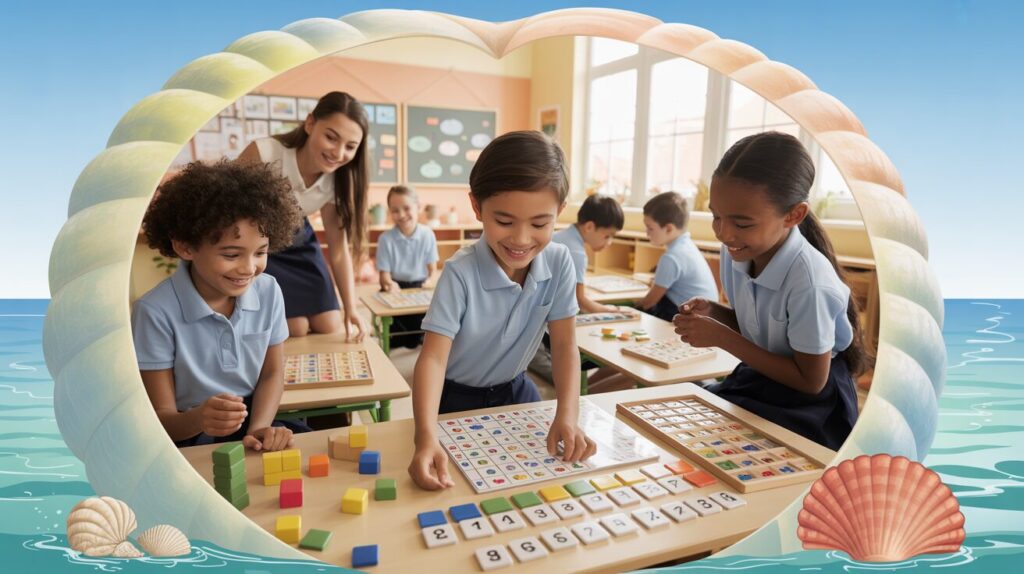
Table Of Contents
- Understanding Algebraic Thinking in Primary Education
- Why Introduce Algebraic Thinking Early?
- Symbol-Free Approaches to Algebraic Thinking
- Classroom Strategies at Seashell Academy
- Home Activities to Reinforce Algebraic Thinking
- Building a Strong Foundation for Future Mathematics
- Conclusion: The Seashell Approach to Mathematical Thinking
When most parents hear the term “algebra,” they often picture complex equations filled with letters and symbols that gave them challenges during their own school days. However, at Seashell Academy by Suntown Education Centre, we understand that algebraic thinking begins long before students encounter formal algebraic notation. In fact, developing algebraic thinking skills in primary students—without using intimidating algebraic symbols—creates a natural pathway to mathematical fluency and confidence.
Algebraic thinking is essentially about recognizing patterns, understanding relationships, and developing generalizations—all crucial skills that form the foundation of mathematical reasoning. For Primary 1-6 students, introducing these concepts without formal notation allows them to grasp the underlying principles in an intuitive, engaging way that aligns perfectly with their developmental stage.
In this comprehensive guide, we’ll explore how algebraic thinking can be nurtured in young learners through creative, symbol-free approaches that make mathematics both accessible and enjoyable. We’ll share insights from our Seashell Method and provide practical strategies that build mathematical confidence while preparing students for future success.
Understanding Algebraic Thinking in Primary Education
Algebraic thinking in primary education isn’t about solving for x or manipulating equations. Rather, it’s about developing fundamental cognitive skills that allow students to reason mathematically. At its core, algebraic thinking encompasses:
Looking for and recognizing patterns in numbers and shapes; understanding that mathematical operations have certain properties and relationships; representing mathematical situations in multiple ways; and reasoning about quantities that may change or remain unknown. These skills form the building blocks for all higher mathematics—not just algebra.
In Singapore’s primary mathematics curriculum, algebraic thinking is embedded throughout, even though formal algebra isn’t introduced until upper primary or secondary levels. This approach allows students to develop conceptual understanding before encountering abstract symbols, which significantly reduces math anxiety and builds confidence.
At Seashell Academy by Suntown Education Centre, we embrace this philosophy wholeheartedly. Our experienced MOE-trained educators recognize that mathematical concepts should be introduced in developmentally appropriate ways that nurture understanding rather than memorization of procedures.
Why Introduce Algebraic Thinking Early?
Introducing algebraic thinking during the primary years offers numerous benefits that extend far beyond preparation for formal algebra. Research has consistently shown that early exposure to algebraic concepts:
Develops critical thinking skills as students learn to analyze patterns and relationships. Children naturally look for patterns in their environment; algebraic thinking builds on this innate tendency in a structured way. Early introduction also prevents the “algebra shock” many students experience when suddenly faced with abstract symbols in higher grades.
Furthermore, algebraic thinking helps students see mathematics as a coherent, interconnected subject rather than a collection of isolated skills and procedures. This holistic view aligns perfectly with our Seashell Method, which emphasizes connections between concepts and real-world applications.
Perhaps most importantly, developing algebraic thinking without formal notation allows students to focus on the reasoning process rather than getting caught up in symbolic manipulation. This builds mathematical confidence and curiosity—qualities we value deeply at Seashell Academy by Suntown Education Centre.
Symbol-Free Approaches to Algebraic Thinking
Our Mathematics Programme incorporates several effective approaches to develop algebraic thinking without relying on formal algebraic notation. These strategies make abstract concepts tangible and accessible for primary students:
Pattern Recognition and Extension
Pattern work forms the foundation of algebraic thinking. At Seashell Academy, we guide students to identify, describe, and extend patterns in various contexts. For example, students might analyze a sequence like 2, 5, 8, 11… and determine both the pattern rule (add 3) and predict future terms.
We use visual patterns as well as numeric ones. Students might examine growing patterns of dots or blocks and describe how they change from one step to the next. This activity develops their ability to generalize—a key algebraic skill—without requiring algebraic notation.
Through our gamified interactive lessons, students eagerly engage with pattern challenges. They might be tasked with creating their own patterns for classmates to decipher, which deepens understanding while making learning enjoyable and collaborative.
Balance Models and Equality Concepts
The concept of equality is fundamental to algebra, yet many students misunderstand the equals sign as simply indicating “the answer comes next” rather than representing a balance between two expressions. To address this, we use physical and visual balance models.
In our small-group classes, students work with actual balance scales to explore equations concretely. For example, if 3 identical blocks on one side balance with 12 individual units on the other, what must each block be worth? This hands-on experience helps students grasp the concept of unknowns without using letters or symbols.
We also use diagrams of balance scales in our mind-mapping approaches, allowing students to visualize equality relationships. These activities build intuition about equations long before formal equation-solving is introduced.
Strategic Word Problems
Carefully crafted word problems provide an excellent context for algebraic thinking without formal notation. At Seashell Academy, we design problems that encourage students to reason about unknowns and relationships.
For example, instead of writing “x + 5 = 12,” we might present: “Maya has some stickers. After she gets 5 more stickers from her teacher, she has 12 stickers altogether. How many stickers did Maya have at the beginning?” Students solve this by thinking algebraically without using algebraic symbols.
As students progress, we introduce more complex scenarios that involve multiple unknowns or relationships. Our educators guide students to use strategies like working backward, looking for patterns, and making tables—all approaches that develop algebraic reasoning.
Through our Programme Philosophy, we ensure these word problems connect to students’ lives and interests, making mathematical reasoning relevant and meaningful.
Visualization Techniques
Visual representations bridge the gap between concrete understanding and abstract algebraic thinking. Our Seashell Method incorporates various visualization techniques to help students reason algebraically:
Singapore bar models serve as a powerful tool for representing relationships between quantities. These visual representations allow students to “see” algebraic relationships without using symbols. For instance, when solving a problem about two children with a combined age of 15, where one is 3 years older than the other, students can draw bars to represent each child’s age and work out the solution visually.
Function machines provide another visualization tool. Students imagine a machine that performs operations on input numbers to produce output numbers. By analyzing the inputs and outputs, they can determine the “rule” of the machine—essentially discovering the function without algebraic notation.
Our educators also use number lines to help students visualize operations and relationships, particularly when exploring concepts like equality and inequality.
Classroom Strategies at Seashell Academy
At Seashell Academy by Suntown Education Centre, we implement several specific strategies to develop algebraic thinking in our mathematics classes:
Our structured learning plans incorporate regular “number talks” where students discuss different ways to solve problems. This develops flexibility in thinking—a crucial algebraic skill. For example, students might share multiple approaches to calculating 4 × 15, with some decomposing it as 4 × (10 + 5) and others as (2 × 2) × 15.
We emphasize precise mathematical language from an early age. Terms like “unknown quantity,” “relationship,” and “what changes/what stays the same” become part of students’ mathematical vocabulary, preparing them for more formal algebraic concepts later.
Our educators deliberately pose open-ended questions that encourage algebraic thinking: “What do you notice?” “How does this pattern grow?” “What would happen if…?” These questions stimulate deeper mathematical reasoning than closed questions with single correct answers.
Most importantly, we create a supportive environment where students feel comfortable exploring mathematical ideas and making mistakes. This emotional safety is essential for developing the confidence to tackle unfamiliar problems—a skill that will serve students well when they encounter formal algebra.
Home Activities to Reinforce Algebraic Thinking
Parents often ask how they can support mathematical development at home. We recommend several enjoyable activities that reinforce algebraic thinking without formal notation:
Pattern games are simple yet effective. Create patterns with household objects (spoons, blocks, coins) and ask your child to continue the pattern or find the missing element. Cooking together provides natural opportunities to explore proportional relationships: “If this recipe serves 4 people but we’re cooking for 6, how should we adjust the ingredients?”
Board games like Monopoly involve strategic thinking about unknown quantities (money) and relationships. Even simple card games can develop algebraic thinking—games where players need to figure out a mystery number based on clues are particularly valuable.
For older primary students, introduce logic puzzles that require reasoning about relationships without using equations. These puzzles are entertaining while developing the exact kind of thinking that formal algebra will require later.
Remember that the goal isn’t to accelerate children into formal algebra but to develop the foundational thinking skills that will make algebra accessible and meaningful when they encounter it in the curriculum.
Building a Strong Foundation for Future Mathematics
The symbol-free algebraic thinking skills developed in primary school create a robust foundation for future mathematical learning. Students who have strong algebraic thinking skills:
Transition more easily to formal algebra in secondary school because the concepts are already familiar—only the notation is new. They demonstrate greater flexibility in problem-solving across all areas of mathematics, not just algebra. Their mathematical confidence remains high even when facing challenging new concepts.
At Seashell Academy by Suntown Education Centre, we’ve observed that students from our Mathematics Programme consistently demonstrate these advantages when they progress to higher levels of education. Their strong foundation in algebraic thinking supports not only their academic achievement but also develops critical thinking skills that benefit them across subjects.
This approach aligns perfectly with our philosophy of sustainable growth rather than burnout. By building conceptual understanding progressively and appropriately, we prevent the overwhelm that can occur when students encounter abstract mathematical ideas without adequate preparation.
For Primary 4-6 students preparing for PSLE, this foundation in algebraic thinking proves especially valuable. The problem-solving questions in PSLE Mathematics often require the very reasoning skills that algebraic thinking develops—identifying relationships, working with unknowns, and generalizing patterns.
Conclusion: The Seashell Approach to Mathematical Thinking
Developing algebraic thinking without formal notation represents a perfect example of our Seashell Method in action. By introducing mathematical concepts in developmentally appropriate ways, we build both competence and confidence in our students.
Through pattern work, balance models, strategic word problems, and visualization techniques, primary students at Seashell Academy by Suntown Education Centre develop robust algebraic thinking skills that serve as building blocks for future mathematical success. These approaches make mathematics accessible and enjoyable while preparing students for the more abstract concepts they’ll encounter in later years.
Most importantly, our approach nurtures a genuine love for mathematical thinking. Students learn to see mathematics not as a collection of rules and procedures to memorize, but as an exciting field of patterns and relationships to discover. This perspective creates resilient, confident learners who are well-prepared for whatever mathematical challenges lie ahead.
Just as a pearl forms gradually within the protective environment of a seashell, mathematical thinking develops progressively within our supportive learning environment. By the time Seashell Academy students complete their primary education, they possess not just the knowledge needed for examinations, but the thinking skills and confidence that will benefit them throughout their educational journey.
Would you like to learn more about how Seashell Academy by Suntown Education Centre nurtures algebraic thinking and other essential mathematical skills in primary students? Our experienced educators would be happy to discuss your child’s specific learning needs and how our unique Seashell Method can support their mathematical development.
Contact us today to schedule a consultation or learn more about our Mathematics Programme for Primary 1-6 students.