Key Science Keywords & Definitions Cheat Sheet for Primary School Students
December 21, 2025
Primary Science Process Skills: Understanding the TRACCER Framework for PSLE Success
December 22, 2025
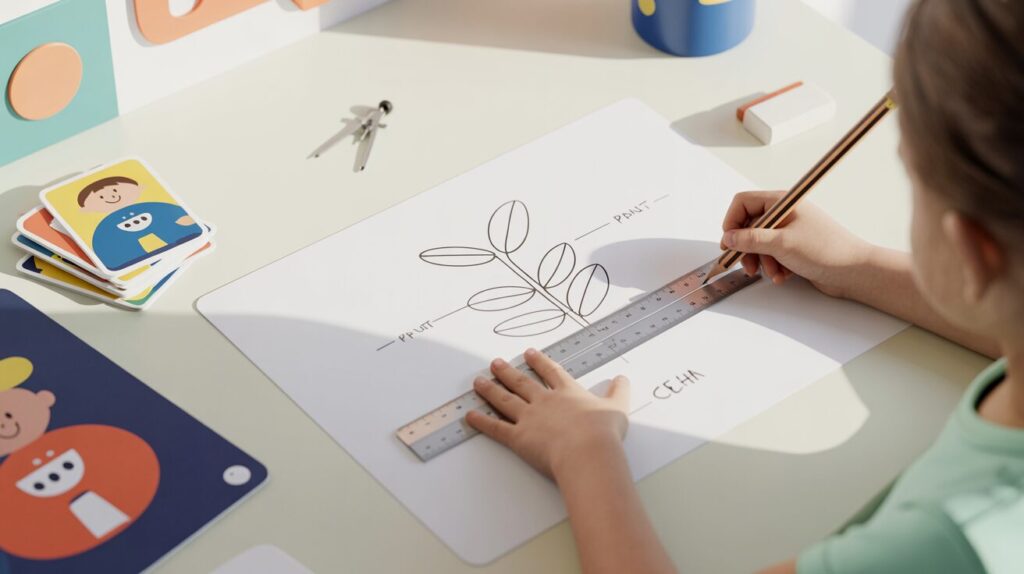
Table Of Contents
- Why Scientific Diagrams Matter in Primary School Science
- Essential Materials: What You’ll Need
- The Golden Pencil Rules for Scientific Diagrams
- Ruler Rules: Drawing Straight, Professional Lines
- Proper Labeling Techniques That Score Marks
- Common Mistakes to Avoid
- Practice Tips for Building Confidence
- How Seashell Academy Supports Science Mastery
When your child sits down for their Primary School Science exam and encounters a question asking them to “draw and label” a diagram, do they feel confident or anxious? The ability to create clear, accurate scientific diagrams isn’t just an artistic skill—it’s a fundamental component of science education that directly impacts exam performance and deeper understanding of scientific concepts.
At Seashell Academy by Suntown Education Centre, we’ve observed that many Primary 3 to Primary 6 students struggle not because they don’t understand the science, but because they haven’t mastered the technical skills of diagram drawing. A well-executed scientific diagram demonstrates precision, attention to detail, and genuine understanding of what’s being observed or studied. More importantly, it’s a skill that can be systematically learned and perfected with the right guidance.
In this comprehensive guide, we’ll walk you through the essential ruler and pencil rules that transform ordinary drawings into examination-worthy scientific diagrams. Whether your child is preparing for their first science practical assessment or fine-tuning their skills for PSLE, these techniques will build both competence and confidence. Let’s explore how proper tools, correct techniques, and consistent practice can turn diagram drawing from a source of stress into an opportunity to shine.
Why Scientific Diagrams Matter in Primary School Science
Scientific diagrams serve a purpose far beyond filling space on an exam paper. They are visual representations of understanding, allowing students to communicate what they’ve observed, learned, or investigated. In the Singapore Primary School Science curriculum, diagram drawing appears across multiple topics—from plant and animal structures to electrical circuits and the human body systems. Each diagram is an opportunity for your child to demonstrate precision, observation skills, and scientific literacy.
What makes scientific diagrams different from regular drawings is their emphasis on accuracy over artistry. Unlike art class, where creativity and personal expression are celebrated, science diagrams prioritize clear communication of factual information. The lines must be clean, the proportions reasonably accurate, and the labels precise. Examiners look for diagrams that could help someone who has never seen the object understand its structure and components. This is why mastering the technical rules of pencil and ruler use becomes so critical—they’re the foundation upon which accurate scientific communication is built.
Beyond examinations, these diagramming skills develop important cognitive abilities. Drawing what you observe forces careful attention to detail, spatial reasoning, and the translation of three-dimensional reality into two-dimensional representation. At Seashell Academy, we recognize that when students master these technical skills early, they approach science with greater confidence, knowing they can accurately capture and communicate their observations. This confidence translates into deeper engagement with scientific concepts and better overall performance.
Essential Materials: What You’ll Need
Before diving into techniques, let’s ensure your child has the right tools. Using appropriate materials makes a significant difference in the quality of scientific diagrams and reduces frustration during the drawing process.
The Pencil
- HB pencil: This is the standard pencil for scientific diagrams. It produces clean, dark lines that are easily visible but can be erased if needed. Avoid using 2B pencils as they’re too soft and may smudge.
- Sharp pencil tip: Always ensure the pencil is properly sharpened before starting. A sharp point allows for precise lines and accurate details.
- Quality eraser: A clean, soft eraser helps correct mistakes without damaging the paper or leaving smudge marks.
The Ruler
- Transparent ruler (30cm): A see-through ruler allows students to see what’s underneath while drawing straight lines. The 30cm length provides flexibility for different diagram sizes.
- Clear markings: Ensure the ruler has clear millimeter and centimeter markings for accurate measurements when needed.
- Straight edge: Check that the ruler’s edge is truly straight—worn or damaged rulers can produce wavy lines.
Additional Tools
- Plain white paper: For practice sessions, though exams will provide answer booklets
- Pencil case organizer: Keeping materials organized prevents last-minute scrambling during exams
Having the right materials is just the starting point. The real transformation happens when students learn to use these simple tools with proper technique, turning them into instruments of scientific precision.
The Golden Pencil Rules for Scientific Diagrams
The pencil is your child’s primary tool for creating scientific diagrams, and how they use it determines the clarity and professionalism of their work. These rules might seem simple, but consistent application makes the difference between a diagram that loses marks and one that earns full credit.
Rule 1: Use Single, Clean Lines
Single continuous lines are the hallmark of professional scientific diagrams. Many students fall into the habit of sketching with multiple short, overlapping strokes—a technique that works in art but appears messy and uncertain in science. Instead, teach your child to draw each line in one smooth, deliberate motion. If the first attempt isn’t quite right, erase it completely and try again rather than drawing over it multiple times. This approach communicates confidence and precision, showing the examiner that the student knows exactly what they’re representing.
Rule 2: Draw Firmly but Not Too Dark
The pressure applied to the pencil matters more than students realize. Lines should be dark enough to be clearly visible when the examiner reviews the paper, but not so heavy that they can’t be erased if corrections are needed. Practice finding the sweet spot—firm, confident strokes that produce visible lines without indenting the paper. This balance becomes especially important when diagrams need to show different structures that might overlap or sit close together. If lines are too faint, important details disappear; if too dark, the diagram looks cluttered and corrections become difficult.
Rule 3: No Shading or Coloring
This is perhaps the most frequently broken rule among primary school students. Unlike art drawings, scientific diagrams should never include shading, coloring, or artistic embellishments. Every mark on the paper should serve a communicative purpose—showing structure, boundaries, or connections. Shading can obscure details and make labels harder to read. If the exam question specifically requires differentiation between parts, students should use clear labels or, if explicitly instructed, simple hatching patterns. Otherwise, clean line drawings are always the correct approach.
Rule 4: Maintain Proportional Accuracy
While scientific diagrams don’t need to be perfectly to scale, they must show reasonable proportions. If drawing a flower, the petals shouldn’t be larger than the leaves if that’s not how the actual plant appears. If illustrating a circuit, the bulb shouldn’t dwarf the battery. Students should train their observational skills to capture the relative sizes of different components. This doesn’t require artistic talent—just careful looking and thoughtful representation. At Seashell Academy, our programme philosophy emphasizes real-life application, which includes accurately representing what students observe in the world around them.
Rule 5: Keep It Simple and Clear
Scientific diagrams prioritize clarity over complexity. If a leaf has small hairs or textures, students don’t need to draw every single one unless that’s the specific focus of the diagram. Instead, they should capture the essential structures that matter for understanding. This principle of simplification is actually a higher-order thinking skill—deciding what’s important enough to include and what can be omitted without losing scientific accuracy. Encourage your child to think about what the diagram is meant to teach or demonstrate, and include only the features that serve that purpose.
Ruler Rules: Drawing Straight, Professional Lines
The ruler transforms sketches into scientific diagrams by bringing precision and professionalism to the work. Many students underutilize their rulers, pulling them out only for drawing margins or borders. In reality, rulers should be used extensively throughout scientific diagram work—particularly for label lines and certain structural elements.
When to Use a Ruler
Understanding when rulers are required versus optional is crucial. Always use a ruler for:
- Label lines: Every single line connecting a label to the part it identifies must be drawn with a ruler. This is non-negotiable in scientific diagram conventions.
- Straight structural elements: Items like stems, electrical wires, light rays, or any naturally straight component of what you’re drawing.
- Diagram borders or frames: If the question requires a specific size or boxed diagram.
- Measurement indicators: Any lines showing scale or measurements.
Rulers are not needed for: Curved structures like leaves, petals, circular objects, irregular shapes found in nature, or organic forms. Attempting to approximate curves with multiple straight ruler segments creates an artificial, segmented appearance that actually reduces diagram quality.
Proper Ruler Technique
Using a ruler correctly requires technique that should be practiced until it becomes automatic. Here’s the step-by-step approach we teach at Seashell Academy:
1. Position the ruler firmly: Place the ruler exactly where the line needs to be drawn, ensuring it won’t slip. Many students rush this step and end up with crooked lines because the ruler shifted mid-draw.
2. Hold it steady with your non-drawing hand: Press down firmly but not so hard that the ruler bends. The pressure should be distributed across multiple fingers, creating stable contact with the paper.
3. Draw along the ruler’s edge: Keep the pencil point touching the ruler’s edge throughout the entire stroke. The pencil should be angled slightly toward the ruler to prevent it from sliding under the edge and creating a gap between where you intended the line and where it actually appears.
4. Draw in one smooth motion: Start just before where the line needs to begin and end just after where it should finish. This ensures the line extends fully to its intended endpoints without falling short.
5. Lift the ruler straight up: After completing the line, lift the ruler straight upward rather than sliding it away. Sliding can smudge fresh pencil marks, especially if the student is using slightly softer lead or pressed firmly.
Common Ruler Mistakes
Watch out for these frequent errors that can undermine otherwise good diagrams:
- Drawing freehand label lines: This is the most common mistake. Wavy or imprecise label lines immediately signal carelessness, even if the rest of the diagram is excellent.
- Using rulers for curved objects: Attempting to draw a round leaf or circular cell with a ruler creates unnatural angles and straight edges where curves should be.
- Not checking alignment before drawing: Students sometimes place the ruler approximately where they want it and start drawing without double-checking the positioning.
- Rushing: Drawing with a ruler requires a moment of stillness and focus. Hurrying leads to slips, crooked lines, and wasted time on corrections.
Proper Labeling Techniques That Score Marks
Even the most beautifully drawn diagram earns zero marks if the labeling is incorrect or unclear. Labels are how students demonstrate their knowledge of what they’ve drawn, identifying structures and showing they understand the subject matter. The technical requirements for labeling are specific and must be followed precisely.
The Anatomy of a Perfect Label Line
Every label consists of two essential components: the label line (drawn with a ruler) and the label text (written clearly). The label line must touch the exact part being identified and extend outward to where the text is written. This line should be straight, clean, and drawn with a ruler—never freehand. The line should point precisely to the structure, not approximately near it or toward a general area. Precision here demonstrates that the student knows exactly what they’re identifying.
Critical Labeling Rules
No arrowheads: This surprises many students and parents, but in scientific diagrams for Singapore primary school science, label lines should be simple straight lines without arrowheads. The line itself, touching the structure and extending to the label, is sufficient to show what’s being identified.
Horizontal label text: All label text should be written horizontally, never at angles or vertically along the side of the page. This makes the labels easy to read when the examiner reviews the work. Even if the label line itself must angle to reach a particular structure, the text should still be horizontal.
Label lines should not cross: Plan label placement carefully so that lines don’t intersect each other. Crossing lines create visual confusion and make it difficult to see which label corresponds to which structure. If the diagram is complex, arrange labels on different sides or at different heights to avoid crossings.
Neat, legible handwriting: Scientific accuracy means nothing if the examiner can’t read what you’ve written. Students should write label text in their clearest handwriting, using proper capitalization (typically lowercase unless it’s a proper noun or abbreviation) and correct spelling of scientific terms.
Position labels around the diagram: Distribute labels around the outside of the diagram rather than clustering them all on one side. This creates a balanced, professional appearance and makes each label easier to trace to its corresponding structure.
Practical Labeling Strategy
Teach your child this systematic approach to labeling: First, complete the entire diagram. Second, identify all structures that need labels. Third, plan where each label will be positioned, ensuring lines won’t cross. Fourth, draw all label lines with the ruler. Finally, write in all the label text. This sequential process prevents the common mistake of adding labels haphazardly as the drawing progresses, which often results in crowding, crossed lines, and poor organization.
Common Mistakes to Avoid
Understanding what not to do can be just as valuable as knowing the correct techniques. These are the most frequent diagram errors we observe at Seashell Academy, along with simple strategies to avoid them.
Technical Mistakes
- Sketchy, multi-stroke lines: Building up lines with multiple short strokes creates a rough, uncertain appearance. Practice drawing confident single-stroke lines instead.
- Freehand label lines: Bears repeating—always use a ruler for every label line without exception.
- Arrowheads on label lines: Remember that Singapore primary science conventions don’t require arrowheads on labels.
- Inconsistent line weight: All outline lines should have similar darkness. Avoid having some parts very dark and others barely visible.
- Labels placed inside the diagram: Unless space absolutely requires it, labels should be positioned outside the diagram structure with lines pointing inward.
Content Mistakes
- Including unnecessary details: Drawing every tiny vein, texture, or minor feature clutters the diagram. Focus on structures relevant to the question.
- Incorrect proportions: A leaf shouldn’t be larger than the entire flower, or a battery smaller than a wire. Check proportions against reality.
- Misspelled labels: Scientific terms must be spelled correctly. “Stammen” instead of “stamen” or “clhorophyll” instead of “chlorophyll” may cost marks.
- Vague label lines: Lines that point to general areas rather than specific structures show lack of precision. Each line should touch exactly what it’s identifying.
Mindset Mistakes
Beyond technical errors, certain approaches to diagram drawing undermine success. Rushing is the most damaging—scientific diagrams require patience and deliberate work. Students who race through diagrams inevitably make careless errors. Assuming “close enough” is acceptable leads to imprecise work. In science, precision matters. Finally, being afraid to erase and correct results in students accepting flawed work rather than taking a few extra seconds to fix mistakes. Encourage your child to view their eraser as a tool for achieving excellence, not a symbol of failure.
Practice Tips for Building Confidence
Like any skill, diagram drawing improves dramatically with deliberate practice. The key is making practice purposeful rather than simply repetitive. Here are strategies that help students internalize these techniques until they become second nature.
Start with Simple Objects
Don’t begin practice with complex multi-part diagrams. Instead, start with simple structures—a single leaf, a bar magnet, a light bulb. Master the techniques of clean lines, proper proportions, and correct labeling on straightforward objects before progressing to more intricate diagrams like complete plant structures or electrical circuits. This builds confidence and allows students to focus on technique without being overwhelmed by complexity.
Practice Ruler Work Separately
Dedicate some practice time specifically to drawing straight lines with a ruler. Create exercises where your child draws lines between specific points, or copies simple geometric patterns. This isolated practice develops muscle memory for proper ruler positioning and pencil control, making it automatic when they’re working on actual science diagrams. The goal is for ruler use to become effortless background skill rather than something requiring conscious thought and effort.
Use Real Objects as References
Whenever possible, have your child draw from observation rather than copying diagrams from textbooks. Observing a real leaf, flower, or object and translating it into a simplified scientific diagram develops crucial observation and abstraction skills. This connects to Seashell Academy’s emphasis on real-life application, where conceptual understanding links directly to tangible reality. Students learn to see the essential structures beneath surface details, a skill that serves them throughout their science education.
Create a Diagram Checklist
Develop a simple checklist your child can mentally run through before submitting any diagram:
- Are all lines clean and single-stroke?
- Were label lines drawn with a ruler?
- Do label lines touch the exact structures they identify?
- Are all labels spelled correctly?
- Is the diagram reasonably proportional?
- Is everything clearly visible and legible?
- Have I avoided shading or coloring?
This systematic review catches common oversights and reinforces good habits. Over time, the checklist becomes internalized, and students automatically produce higher-quality work without conscious checking.
Time Your Practice
While initial practice should focus on accuracy without time pressure, eventually students need to work on speed. Exam conditions require completing diagrams efficiently without sacrificing quality. Once techniques are solid, introduce timed practice sessions. This helps students find the right balance between thoroughness and efficiency—working carefully but not obsessively, checking their work but not second-guessing every line. Our Mathematics Programme similarly emphasizes building both accuracy and appropriate speed for exam success.
How Seashell Academy Supports Science Mastery
At Seashell Academy by Suntown Education Centre, we recognize that mastering scientific diagrams is just one component of comprehensive science education—but it’s an important one that directly impacts exam performance and scientific communication skills. Our approach to teaching diagram techniques exemplifies our broader educational philosophy: breaking down complex skills into manageable components, providing structured practice, and building genuine confidence alongside technical competence.
Through our specialized Primary School Science programme, students don’t just memorize diagram rules—they understand why these conventions exist and how they serve scientific communication. This deeper understanding, combined with systematic skill development, transforms diagram drawing from a source of anxiety into an opportunity to demonstrate knowledge clearly and confidently. Our MOE-trained educators provide personalized feedback on diagram work, catching developing bad habits early and reinforcing good techniques until they become automatic.
The Seashell Method applies to diagram skills just as it does to content mastery. We use mind-mapping approaches to help students organize their understanding of different diagram types and their requirements. Our gamified interactive lessons make practicing diagram techniques engaging rather than tedious—students might compete to draw the cleanest label lines or work in pairs to evaluate each other’s diagrams against criteria. This approach maintains motivation while building essential skills.
Perhaps most importantly, we emphasize sustainable growth rather than burnout. Perfect diagrams don’t appear overnight. Like any worthwhile skill, diagram proficiency develops through patient, consistent practice with supportive guidance. We celebrate progress, identify specific areas for improvement, and ensure students feel capable and confident as their skills develop. Whether your child is in P3 just beginning to work with scientific diagrams or in P6 polishing their technique for PSLE, we provide the structured support that nurtures continuous improvement.
Our science teaching extends beyond diagram techniques to comprehensive content understanding, practical skills, and exam strategies. Students learn to see connections between different topics, apply knowledge to novel situations, and approach science questions with systematic thinking. This holistic development creates students who don’t just perform well on exams—they develop genuine scientific literacy and curiosity that serves them well into secondary school and beyond.
Mastering the ruler and pencil rules for scientific diagrams is an achievable goal for every Primary School student, regardless of their artistic ability or initial skill level. These techniques aren’t about talent—they’re about understanding conventions, practicing proper methods, and developing careful habits. When students know that label lines must be drawn with rulers, that single clean lines beat sketchy strokes, and that proportions matter more than photorealism, they approach diagram questions with confidence instead of dread.
The investment in developing these skills pays dividends throughout your child’s science education journey. Well-executed diagrams earn marks, certainly, but more importantly, they develop observation skills, attention to detail, and the ability to communicate scientific understanding visually. These capabilities extend far beyond primary school science exams, serving students in secondary school science subjects, practical assessments, and even future careers in STEM fields.
Remember that improvement happens through practice, not perfection. Encourage your child to view each diagram as an opportunity to refine their technique slightly, to notice one more detail accurately, to create one cleaner line than before. With patient, consistent effort and the right guidance, scientific diagram drawing transforms from an intimidating requirement into a skill your child wields with pride and precision.
At Seashell Academy, we’re committed to nurturing not just academic skills but confident, capable learners who approach challenges with resilience and curiosity. Whether it’s mastering scientific diagrams, understanding complex mathematical concepts through our Mathematics Programme, or developing language proficiency through our specialized P4, P5, and P6 Chinese Programmes, our goal remains constant: building students who don’t just succeed in exams but develop a genuine love for learning that extends far beyond the classroom.
Help Your Child Master Science with Confidence
At Seashell Academy by Suntown Education Centre, we provide the structured guidance, personalized support, and proven techniques that transform science challenges into opportunities for growth. Our experienced MOE-trained educators help Primary School students build both skills and confidence across all aspects of science education—from diagram techniques to content mastery.