5 Common Mis-read Keywords in PSLE Math Problems That Cause Careless Mistakes
December 8, 2025
Exploring Heat Transfer Experiments With Kitchen Utensils: Science Learning Made Fun
December 13, 2025
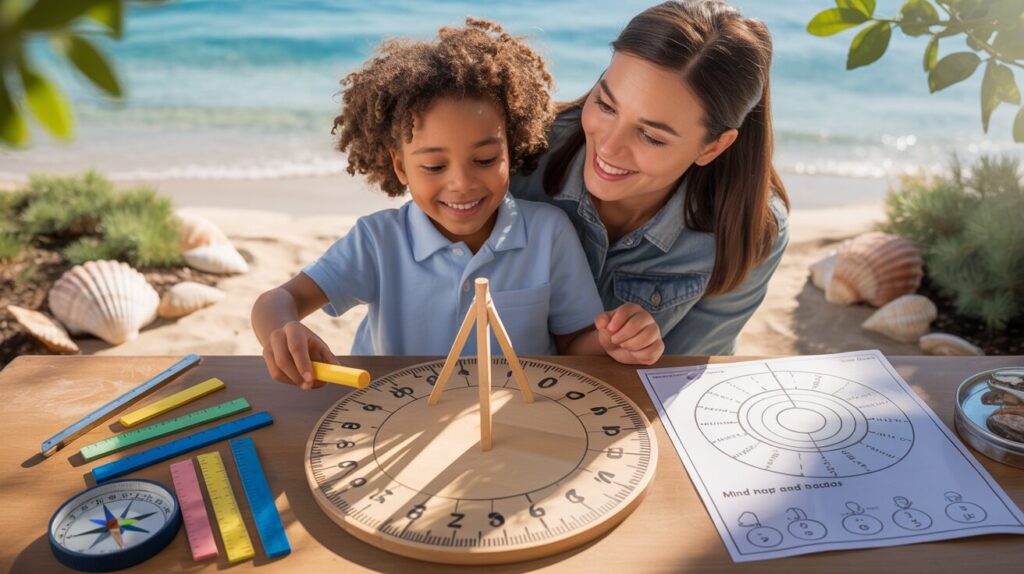
Table Of Contents
- Introduction to Light & Shadow Investigations
- Understanding Sundials: Ancient Timekeeping
- Science Concepts Behind Sundials
- Materials Needed for Your DIY Sundial
- Step-by-Step Guide to Creating Your Sundial
- Investigation Activities Using Your Sundial
- Learning Outcomes and PSLE Connections
- Troubleshooting Common Sundial Issues
- Conclusion
Have you ever wondered how people told time before watches and clocks were invented? The answer lies in one of humanity’s oldest scientific instruments: the sundial. At Seashell Academy by Suntown Education Centre, we believe that hands-on learning creates the deepest understanding of scientific concepts. Light and shadows form an essential part of the Primary Science curriculum, and what better way to explore these fascinating phenomena than by creating your very own sundial?
This DIY sundial project offers the perfect blend of history, science, and creativity that will engage your child’s curiosity while reinforcing important scientific principles. As they construct and use their sundial, students will develop a tangible understanding of Earth’s rotation, the sun’s apparent movement across the sky, and how shadows form and change throughout the day.
In line with our Seashell Method, this activity transforms abstract concepts into concrete experiences, helping children build connections between classroom learning and real-world applications. So gather a few simple materials, head outdoors, and prepare for a scientific adventure that bridges ancient wisdom with modern understanding!
DIY Sundial: Exploring Light & Shadow
A hands-on science investigation for primary school students
What You’ll Learn
- How Earth’s rotation creates day & night
- Properties of light & shadow formation
- Ancient timekeeping methods
- Science process skills for PSLE
Materials Needed
- Paper plate
- Pencil or wooden skewer
- Marker & scissors
- Ruler & compass
- Modeling clay
Creating Your Sundial in 5 Steps
Find center of plate & insert gnomon
Secure with clay underneath
Place in sunny spot, pointing north
Mark shadow position hourly
Connect marks to create your clock face
Shadow Science Facts
Morning & Afternoon
Shadows are longest when the sun is low in the sky (morning & late afternoon)
Midday
Shadows are shortest at noon when the sun is highest in the sky
Direction
Morning shadows point west; afternoon shadows point east
Extend Your Learning: Investigation Ideas
Shadow Length Tracking
Measure shadow length at 9am, noon, and 3pm. Graph your results to see the pattern.
Monthly Observations
Measure shadow at the same time each month to observe seasonal changes.
Primary Science Curriculum Connections
Primary 3
Light travels in straight lines
Primary 4
Earth’s rotation & day/night cycle
PSLE Skills
Observing, measuring & analyzing data
Understanding Sundials: Ancient Timekeeping
Sundials represent one of humanity’s earliest technological innovations, dating back over 3,500 years to ancient Egyptian and Babylonian civilizations. These ingenious devices use the position of the sun and the shadows it casts to track the passage of time throughout the day. Before the invention of mechanical clocks, sundials were the most reliable way to tell time.
The basic principle of a sundial is beautifully simple: as the Earth rotates on its axis, the sun appears to move across the sky from east to west. This movement causes shadows to change position and length throughout the day. By placing a vertical object (called a gnomon) on a flat surface marked with hour lines, ancient timekeepers could read the time based on where the shadow fell.
Interestingly, sundials were so important in human history that they influenced how we divide our day into hours. The 12-hour division we still use today can be traced back to these ancient timekeeping devices! By creating their own sundial, your child isn’t just doing a science experiment – they’re connecting with thousands of years of human ingenuity and astronomical observation.
Science Concepts Behind Sundials
At Seashell Academy, we believe that understanding the “why” behind scientific phenomena helps students develop deeper appreciation and retention of knowledge. Before diving into the construction of our DIY sundial, let’s explore the key scientific concepts that make sundials work.
Earth’s Rotation and Shadows
Our planet Earth completes one full rotation on its axis every 24 hours. This rotation is what gives us day and night. From our perspective on Earth, it appears that the sun moves across the sky, but it’s actually our planet that’s moving! This concept is fundamental to understanding how sundials work.
As the Earth rotates eastward, the sun appears to travel westward across our sky. This apparent movement causes the shadows cast by objects to change direction throughout the day. In the morning, shadows point westward; at noon, they’re at their shortest pointing north (in the Northern Hemisphere); and in the afternoon, they stretch eastward.
When Primary 3 and 4 students learn about the Earth’s movements in their Science curriculum, the sundial provides a tangible demonstration of these abstract concepts. By observing how shadows move in a predictable pattern throughout the day, students can literally see Earth’s rotation in action!
Properties of Light
Another crucial scientific principle at work in our sundial investigation involves the properties of light. Light travels in straight lines – a concept that Primary 3 students learn in their unit on light. When an opaque object (like our sundial’s gnomon) blocks the sun’s rays, it creates a shadow on the opposite side from the light source.
The size and shape of a shadow depend on:
- The position of the light source (in this case, the sun)
- The size and shape of the object blocking the light
- The distance between the light source, the object, and the surface where the shadow appears
Our DIY sundial investigation allows students to observe firsthand how these properties of light create predictable shadow patterns that can be used to measure time. Through this hands-on experience, abstract concepts from the Primary Science syllabus become concrete and memorable, exemplifying the Seashell Academy learning approach of making knowledge applicable to real life.
Materials Needed for Your DIY Sundial
One of the wonderful aspects of this light and shadow investigation is that it requires only simple, everyday materials. Before starting this project with your child, gather the following supplies:
- Paper plate (the sturdier, the better)
- Pencil or wooden skewer (this will serve as the gnomon)
- Marker or permanent pen
- Scissors
- Ruler
- Compass (the mathematical kind for drawing circles)
- Modeling clay or playdough (to hold the gnomon in place)
- Small rocks (optional, to prevent the plate from blowing away outdoors)
- Notebook and pencil for recording observations
This project aligns perfectly with our belief at Seashell Academy by Suntown Education Centre that learning materials should be accessible and straightforward, allowing the focus to remain on concept mastery rather than complicated equipment. The simplicity of these materials also makes this an ideal weekend project for reinforcing school lessons at home.
Step-by-Step Guide to Creating Your Sundial
Now that we understand the science behind sundials and have gathered our materials, it’s time to build our own working timepiece! Follow these steps with your child, using each stage as an opportunity to discuss the scientific concepts involved:
- Find the center of your paper plate: Use your compass or ruler to find and mark the exact center of the plate. This precision matters because your gnomon needs to be centered for the sundial to work correctly.
- Create the gnomon: Take your pencil or wooden skewer and push it through the center of the plate. The pointed end should go through the top side and extend about 10-12 cm above the plate. This vertical stick is the gnomon that will cast our shadow.
- Secure the gnomon: On the underside of the plate, use a small ball of modeling clay or playdough to hold the pencil firmly in place. The gnomon must be perfectly vertical (perpendicular to the plate) for accurate shadow casting.
- Position your sundial: Choose a flat, open area that receives sunlight throughout the day. Ideally, this spot should remain undisturbed, as you’ll need to return to it several times. If using your sundial at school, ask permission to place it in a designated area of the playground or courtyard.
- Align your sundial: Position the plate so that the gnomon points directly north. You can use a compass app on a smartphone to help find north. This alignment is crucial for your sundial to work properly.
- Mark the hours: Beginning early in the morning (around 7 or 8 AM), mark where the shadow falls on the edge of the plate. Write down the current time next to this mark. Return every hour until late afternoon, making a new mark and noting the time with each visit.
- Connect the dots: At the end of your observation day, you can draw lines from the center of the plate (where the gnomon is) to each of your hour marks, creating a clock face that’s calibrated to your specific location on Earth.
Through this construction process, students apply mathematical skills (measuring, using a compass), develop fine motor control, and gain a practical understanding of Earth’s movement in relation to the sun. This multidisciplinary approach mirrors how we teach at Seashell Academy’s Mathematics Programme, where we emphasize connections between different subject areas.
Investigation Activities Using Your Sundial
Now that you have a working sundial, it’s time to use it for some fascinating scientific investigations! These activities will deepen your child’s understanding of light, shadows, and Earth’s movements while developing crucial scientific skills like observation, data collection, and analysis.
Shadow Tracking Experiment
This investigation focuses on how shadows change throughout a single day:
- Morning observation (9 AM): Note the length and direction of the gnomon’s shadow. Use a ruler to measure the shadow’s length in centimeters and record it in a table.
- Midday observation (12 noon): Return to your sundial and repeat your measurements. You’ll notice the shadow is much shorter now. Why do you think this happens? (This is a great discussion point about the sun’s position in the sky.)
- Afternoon observation (3 PM): Take your final measurement. The shadow will now be pointing in a different direction and will have grown longer again.
- Data analysis: Create a simple graph showing shadow length versus time of day. What pattern do you notice? The U-shaped curve that results demonstrates how the sun’s angle in the sky changes throughout the day.
This activity teaches students to collect and record data systematically, a key skill in the Primary Science syllabus. It also reinforces the concept that shadows are shortest when the sun is highest in the sky (around noon) and longest when the sun is low (morning and afternoon).
Observing Seasonal Changes
For a more extended investigation that demonstrates how Earth’s position relative to the sun changes throughout the year, try this activity:
- Monthly shadow tracking: Choose a specific time of day (noon works well) and measure the gnomon’s shadow length on the same date each month for several months.
- Record your findings: Create a table or chart showing how the shadow length changes month by month.
- Analyze patterns: Even in Singapore where seasons aren’t as pronounced as in temperate regions, you’ll still notice subtle differences in shadow lengths throughout the year due to Earth’s tilt and its orbit around the sun.
This longer-term investigation helps students understand that Earth’s relationship with the sun changes not just daily but seasonally as well. It introduces the concept that Singapore’s position near the equator means our day length remains fairly consistent year-round, unlike countries farther north or south where days become significantly longer or shorter depending on the season.
These investigations align perfectly with Seashell Academy’s emphasis on sustainable learning growth rather than short-term memorization. By engaging in these extended observations, students develop patience and scientific rigor while building a deeper understanding of astronomical concepts that will serve them well in upper primary and beyond.
Learning Outcomes and PSLE Connections
At Seashell Academy by Suntown Education Centre, we ensure all our learning activities connect directly to the MOE curriculum and PSLE requirements. This DIY sundial project supports several key learning outcomes from the Primary Science syllabus:
- Primary 3 Science: Understanding that light travels in straight lines and that shadows form when light is blocked by an opaque object. The sundial activity provides concrete evidence of these abstract concepts.
- Primary 4 Science: Learning about the Earth’s rotation and its effect on day and night. The sundial demonstrates this rotation through the changing position of shadows throughout the day.
- Primary 5 Science: Exploring the relationship between the Earth and the sun. The seasonal shadow tracking activity introduces concepts about Earth’s orbit that will be further developed in the upper primary curriculum.
- Process Skills Development: Throughout this investigation, students practice essential scientific skills that are assessed in the PSLE Science examination, including:
- Observing and comparing (shadow lengths and positions)
- Measuring accurately (using rulers to track shadow dimensions)
- Recording data systematically (in tables and charts)
- Analyzing patterns (in daily and seasonal shadow movements)
- Drawing conclusions based on evidence (about Earth’s movements)
Beyond science, this project integrates other subject areas in the way that Seashell Academy’s P4 Chinese Programme, P5 Chinese Programme, and P6 Chinese Programme often do with cross-curricular connections. Students apply mathematical skills when measuring and graphing, historical knowledge when learning about ancient timekeeping, and language skills when recording their observations and conclusions.
This holistic approach to learning mirrors our Seashell Method, where we view knowledge not as isolated subjects but as interconnected concepts that build upon each other to create a comprehensive understanding of our world.
Troubleshooting Common Sundial Issues
Even the best scientists encounter challenges during their experiments! Here are some common issues your child might face with their DIY sundial and how to solve them:
- Problem: The sundial shows incorrect time.
Solution: Check that your gnomon is pointing due north and is perfectly vertical. Also remember that sundials show “sun time,” which can differ slightly from clock time due to standardized time zones and other factors. - Problem: The shadow is too faint to read accurately.
Solution: Try using a taller or thicker gnomon to cast a more distinct shadow. Alternatively, place your sundial on a lighter-colored surface for better contrast. - Problem: The sundial gets moved between observations.
Solution: Use small rocks around the edges of your plate to keep it in place, or mark its position with chalk so you can return it to exactly the same spot if it gets disturbed. - Problem: It’s a cloudy day with no shadows.
Solution: This is a perfect teachable moment about how weather affects our ability to use sundials! Discuss why clouds prevent shadows and how this might have been a problem for people in the past who relied on sundials.
At Seashell Academy, we believe that working through challenges is an essential part of the learning process. When students troubleshoot problems with their sundial, they’re developing resilience, critical thinking, and problem-solving skills that extend far beyond this particular activity.
Conclusion
Our journey through light and shadow with this DIY sundial investigation showcases exactly what we value at Seashell Academy by Suntown Education Centre: learning that bridges theoretical understanding with hands-on application. Through this simple yet profound activity, your child has explored fundamental scientific concepts like Earth’s rotation, the properties of light, and the predictable patterns of shadow formation.
More importantly, they’ve connected with a technological innovation that has shaped human history for thousands of years. The humble sundial represents humanity’s enduring curiosity about the natural world and our ingenuity in developing tools to understand it – the very same qualities we nurture in our students every day.
This project exemplifies our Seashell Method in action: providing structured learning experiences that engage multiple senses, incorporate real-world applications, and build confidence through achievement. Your child hasn’t just learned about shadows – they’ve created a functional scientific instrument and used it to make discoveries of their own.
We encourage you to extend this learning by discussing how modern timekeeping technologies have evolved from these ancient beginnings, or by researching other cultures’ sundial designs throughout history. By connecting this activity to broader themes, you’ll reinforce our philosophy that genuine learning is never isolated but always part of a larger tapestry of knowledge.
Remember, true education isn’t just about preparing for examinations – it’s about nurturing a lifelong love of learning and discovery. Each time your child glances at their handmade sundial and reads the time from the sun’s position, they’re experiencing the joy of science in action!
Nurture Your Child’s Scientific Curiosity at Seashell Academy
Has this sundial investigation sparked your child’s interest in science? At Seashell Academy by Suntown Education Centre, we incorporate hands-on learning experiences like this into our curriculum to make complex concepts accessible and engaging.
Our experienced MOE-trained educators specialize in developing customized learning plans that balance academic excellence with emotional well-being, ensuring your child builds confidence alongside knowledge.
Contact us today to learn more about our Primary Science, Mathematics, and Chinese programmes, and discover how our unique Seashell Method can help your child develop a genuine love for learning that extends far beyond examinations.