Mastering Chinese Character Stroke Order: Common Errors and Expert Fixes
November 18, 2025
Tuition Centre vs Self-Study: Which Path Leads to PSLE Chinese Success?
November 20, 2025
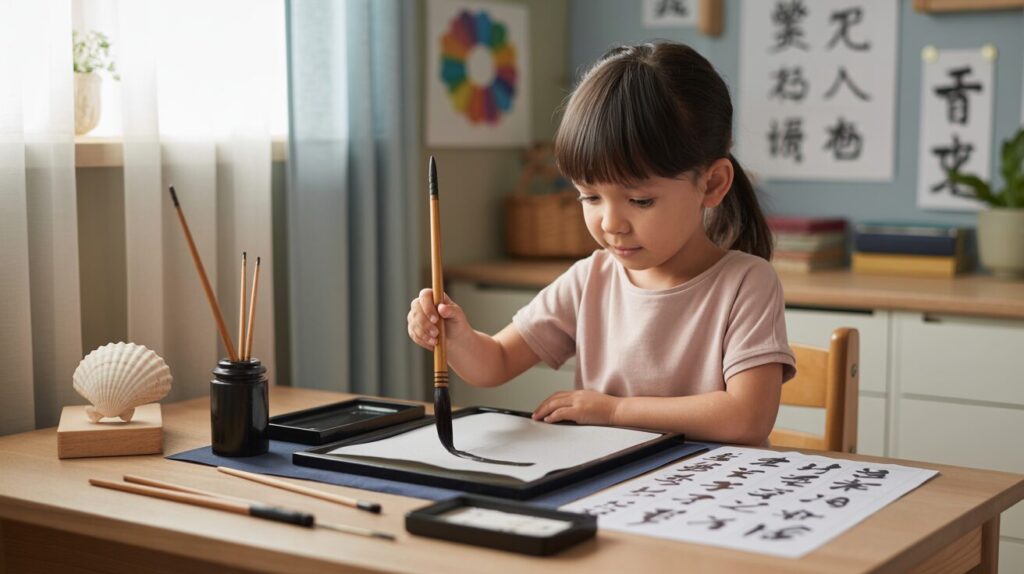
Table Of Contents
- Introduction to Chinese Calligraphy for Children
- Educational Benefits of Chinese Calligraphy
- Essential Tools for a Chinese Calligraphy Starter Kit
- How to Choose the Right Starter Kit for Primary Students
- Basic Calligraphy Techniques for Beginners
- First Characters to Practice: A Progressive Approach
- Fun Calligraphy Activities to Try at Home
- Common Challenges and How to Overcome Them
- Supporting Your Child’s Calligraphy Journey
- Conclusion: Nurturing a Lifelong Appreciation
The gentle brush stroke against paper, the flowing rhythm of movement, and the quiet concentration that comes with practicing Chinese calligraphy offer a unique blend of artistic expression and language learning that primary school students can deeply benefit from. As parents seeking to support your child’s Chinese language education, introducing calligraphy at home provides a hands-on complement to their formal studies that engages multiple senses and creates a deeper connection to Chinese characters.
At Seashell Academy by Suntown Education Centre, we’ve observed how children who engage with Chinese characters through calligraphy develop not only better handwriting and character recognition but also improved focus, patience, and a deeper appreciation for Chinese language and culture. This ancient art form, when adapted for young learners, becomes a journey of discovery rather than just another academic exercise.
This guide will walk you through everything you need to know to set up a calligraphy practice space at home, select the right starter kit for primary school students, introduce basic techniques in a child-friendly way, and create fun, memorable learning experiences. Whether your child is just beginning their Chinese language journey or looking to enhance their existing skills, calligraphy offers a beautiful bridge between artistic expression and language mastery.
Educational Benefits of Chinese Calligraphy
Chinese calligraphy offers far more than beautiful handwriting—it develops crucial skills that support your child’s overall development and specifically enhances their Chinese language learning journey. Understanding these benefits helps parents appreciate why calligraphy deserves a place in your child’s learning routine.
Strengthening Character Recognition and Retention
When children practice writing Chinese characters through calligraphy, they engage multiple learning pathways simultaneously. The physical act of tracing and forming characters creates muscle memory that reinforces visual recognition. At Seashell Academy, we’ve observed that students who regularly practice calligraphy demonstrate improved character recall and recognition during their P4 Chinese, P5 Chinese, and P6 Chinese lessons.
The deliberate stroke-by-stroke approach required in calligraphy helps children understand character composition and structure in a way that typing or casual handwriting cannot achieve. This deeper understanding of how characters are built creates stronger neural pathways for long-term retention.
Developing Focus and Patience
In our fast-paced digital world, calligraphy offers a refreshing counterbalance by requiring children to slow down and focus on each deliberate movement. This mindful practice naturally cultivates concentration and patience—skills that transfer to all academic subjects, including Mathematics and other demanding cognitive tasks.
The meditative quality of calligraphy practice aligns perfectly with Seashell Academy’s Programme Philosophy, which emphasizes sustainable learning rather than burnout. Children learn to value the process of careful work rather than rushing toward completion.
Enhancing Fine Motor Skills and Hand-Eye Coordination
The precision required for controlling a calligraphy brush provides excellent exercise for developing fine motor skills. Children must learn to regulate pressure, speed, and angle—all while coordinating what they see with how they move the brush. These refined movements strengthen the neural connections between brain and hand, supporting development that benefits handwriting across all subjects.
For primary school students, whose fine motor skills are still developing, calligraphy offers a scaffold that progressively challenges their abilities in an engaging way that doesn’t feel like work.
Cultivating Cultural Appreciation
Beyond language learning, calligraphy opens a window to Chinese cultural heritage. As children learn about different calligraphy styles and their historical significance, they develop a deeper connection to Chinese culture. This cultural context gives meaning to their language studies and fosters pride in learning Chinese, especially for students in Singapore’s multicultural environment.
Essential Tools for a Chinese Calligraphy Starter Kit
Assembling the right tools makes a significant difference in your child’s calligraphy experience. A well-chosen starter kit creates the proper foundation while being accessible for young learners. Here are the essential components every primary school calligraphy kit should include:
Child-Friendly Brushes
While traditional calligraphy brushes are made from animal hair, many child-friendly options use synthetic materials that are more durable and easier to maintain. For beginners, look for:
- Small to medium-sized brushes that fit comfortably in a child’s hand
- Brushes with a good balance of softness and springiness
- A set with at least two brushes of different sizes (one for larger characters and one for details)
Children’s starter brushes often feature colorful handles and slightly stiffer bristles that make control easier as they develop their technique. Some even come with ergonomic grips designed specifically for small hands.
Suitable Paper Options
The right paper can make the difference between frustration and enjoyable practice. For beginners, consider:
- Rice paper (Xuan paper): Traditional but can be challenging for beginners
- Practice grid paper: Printed with character squares and guidelines
- Magic water-writing paper: Shows strokes when wet then disappears as it dries, perfect for repeated practice
- Calligraphy copybooks (Tian Zi Ge): Provide models and grids for proper character proportions
We recommend starting with magic water-writing paper, as it’s economical and environmentally friendly for daily practice. Standard practice grid paper can be used for creating finished pieces once your child gains confidence.
Ink and Inkstone Alternatives
Traditional solid ink sticks require grinding on an inkstone with water—a process that can be cumbersome for young beginners. More practical alternatives include:
For beginners (P1-P3):
- Bottled liquid ink with a spill-resistant design
- Ink cartridges that fit into special practice brushes
- Water-only practice (used with special paper that shows strokes when wet)
For advancing students (P4-P6):
- Beginner-friendly inkstones with pre-carved wells
- Student-grade ink sticks that grind easily
- Small ink dishes with lids for convenient storage
The traditional process of grinding ink can become a meditative part of the practice as children grow more advanced, but it’s not essential for beginners.
Workspace Protection and Organization
Calligraphy can be messy, especially for enthusiastic young artists. A complete starter kit should include:
- A desk pad or mat to protect surfaces
- A brush rest to keep brush tips clean between use
- A small water container for rinsing brushes
- A weight or clips to hold paper in place
Having these organizational elements teaches children proper care for materials while making setup and cleanup manageable for parents.
How to Choose the Right Starter Kit for Primary Students
With numerous calligraphy sets available in Singapore, selecting the right one for your child requires consideration of several factors. Here’s how to make a choice that will set your child up for success:
Age-Appropriate Considerations
Different age groups have distinct needs when it comes to calligraphy tools:
Lower Primary (P1-P3): Choose kits with larger, sturdier brushes, water-writing practice sheets, and minimal components. Focus on materials that provide immediate success experiences to build confidence. Many kits designed for this age feature color-coded guides and simplified character practice.
Upper Primary (P4-P6): Students can graduate to more traditional materials, including smaller brushes for detail work and actual ink. Kits for this age group might include a broader range of brush sizes and character practice materials at varying difficulty levels.
At Seashell Academy, we’ve found that matching materials to developmental readiness prevents frustration and maintains enthusiasm for the practice.
Quality vs. Budget Considerations
Calligraphy kits range from basic budget sets under $20 to premium collections costing over $100. For beginners, we recommend a middle path:
- Invest in one or two quality brushes rather than many inferior ones
- Choose a kit with good paper that accepts ink properly without excessive bleeding
- Look for sets with durable cases or storage solutions that protect materials
A quality starter set priced between $30-$60 typically offers the right balance of durability and performance without overwhelming a beginner. As your child’s interest and skill develop, you can gradually add higher-quality individual pieces.
Complete Kits vs. Building Your Own
Pre-assembled kits offer convenience, while building your own provides customization. Consider these approaches:
Pre-assembled beginner kits: Ideal for parents unfamiliar with calligraphy who want a complete solution. Look for kits that include instructional materials, especially those with child-friendly demonstrations.
Building your own kit: Better for families who may already have some materials or who want to select specific components. This approach allows you to prioritize quality for the most important items (like brushes) while economizing on others.
For most families new to calligraphy, a quality beginner set provides the easiest entry point, with the option to upgrade individual components as needed.
Basic Calligraphy Techniques for Beginners
Before attempting characters, children need to develop fundamental brush control. These basic techniques form the building blocks for all Chinese characters and help develop the necessary motor skills and brush sensitivity.
Proper Brush Holding Position
The brush grip is fundamental to successful calligraphy and differs from holding a pencil. Teach your child these key points:
- Hold the brush vertically or at a slight angle, not horizontally like a pencil
- Position fingers approximately one-third of the way up from the brush tip
- Use the thumb, index, and middle fingers to grip, with the ring finger providing support
- Keep the wrist slightly raised, not resting on the table
- Maintain a relaxed grip—tension creates shaky lines
For young children who struggle with the traditional grip, it’s acceptable to begin with a modified hold and gradually transition to the proper position as their dexterity improves.
The Eight Basic Strokes
All Chinese characters are composed of variations of eight basic strokes. Starting with these fundamental movements builds confidence and proper technique:
- Horizontal stroke (横, héng): Left to right, slightly higher on the left
- Vertical stroke (竖, shù): Top to bottom, with a slight thickening at the bottom
- Left-falling stroke (撇, piě): A diagonal stroke falling to the left
- Right-falling stroke (捺, nà): A diagonal stroke falling to the right, often with a slight curve
- Rising stroke (提, tí): A short upward flick, usually after a horizontal stroke
- Dot (点, diǎn): A brief press and lift of the brush
- Hook (钩, gōu): A stroke with a sharp change in direction at the end
- Turning stroke (折, zhé): A stroke that changes direction, combining horizontal and vertical elements
Practice each stroke individually before attempting to combine them into characters. This builds muscle memory and teaches the distinctive qualities of each stroke type.
Pressure and Speed Control
The expressiveness of calligraphy comes from variations in pressure and speed. Help your child develop these skills through targeted exercises:
- Pressure variations: Practice transitions from thin to thick lines by varying pressure
- Speed control: Experiment with stroke speed to achieve different effects—quick for energetic lines, slow for deliberate ones
- Consistent rhythm: Develop a steady, breathing-like rhythm that creates harmony across strokes
A useful exercise is practicing horizontal lines with varying pressure patterns—beginning light, pressing in the middle, and ending light. This teaches the subtle control that gives calligraphy its dynamic quality.
First Characters to Practice: A Progressive Approach
After mastering basic strokes, children are ready to attempt complete characters. Beginning with the right characters in a logical progression builds confidence and skill methodically.
Simple One and Two-Stroke Characters
Start with the simplest characters that reinforce basic stroke techniques:
- 一 (yī, one): A single horizontal stroke
- 二 (èr, two): Two horizontal strokes
- 三 (sān, three): Three horizontal strokes
- 十 (shí, ten): A vertical stroke crossing a horizontal one
- 人 (rén, person): Two angled strokes supporting each other
- 八 (bā, eight): Two strokes falling away from each other
- 口 (kǒu, mouth): A square formed of three turning strokes
These characters allow children to practice fundamental strokes while experiencing the satisfaction of creating complete, meaningful characters. They also form components of many more complex characters they’ll learn later.
Building to Familiar Vocabulary
Once comfortable with simple characters, progress to those that have personal relevance and appear in your child’s Chinese curriculum:
- 日 (rì, day/sun): A slightly more complex square character
- 月 (yuè, month/moon): Builds upon the skill of creating 日
- 水 (shuǐ, water): Introduces the dot stroke in combination with others
- 火 (huǒ, fire): Practices varying stroke lengths and positioning
- 木 (mù, tree/wood): Combines horizontal, vertical, and angled strokes
Following this, consider characters from your child’s name or common characters from their textbooks. This connection to their daily learning reinforces vocabulary while practicing calligraphy.
Character Composition Principles
As your child progresses, introduce basic principles of character composition:
- Balance: Characters should appear stable, with visual weight distributed appropriately
- Proportion: Maintaining proper size relationships between components
- Spacing: Creating appropriate density within the character square
- Structure awareness: Understanding whether characters follow left-right, top-bottom, or enclosure patterns
These principles help children develop an aesthetic sensibility along with technical skill. At Seashell Academy, we emphasize these composition aspects as they align with our holistic approach to Chinese language learning, where understanding structural patterns aids both writing and comprehension.
Fun Calligraphy Activities to Try at Home
Maintaining enthusiasm for calligraphy means balancing structured practice with creative, playful applications. These engaging activities transform practice sessions from homework into artistic adventures while reinforcing skills.
Seasonal Greeting Cards
Creating personalized greeting cards for Chinese festivals and family celebrations gives purpose to calligraphy practice:
- Chinese New Year cards with characters like 福 (fú, good fortune) or 春 (chūn, spring)
- Birthday cards with 生日快乐 (shēngrì kuàilè, happy birthday)
- Thank you notes with 谢谢 (xièxie, thank you)
Guide children to write a central character or phrase, then decorate around it with drawings or watercolors. This activity connects calligraphy to personal expression and cultural traditions, reinforcing the practical value of their developing skills.
Character Story Creation
This creative activity helps children understand character evolution and meaning:
- Select pictographic characters like 山 (shān, mountain), 火 (huǒ, fire), or 鸟 (niǎo, bird)
- Research how these characters evolved from ancient pictographs to modern forms
- Create a visual story showing this evolution
- Practice writing both the modern character and its ancient versions
This exploration helps children understand the logic behind character formation and creates memorable associations that aid retention. It also introduces historical and cultural aspects of Chinese writing in an accessible way.
Calligraphy Games and Challenges
Transforming practice into games keeps children engaged while building skills:
- Character Charades: One person writes a character while others guess its meaning
- Speed Challenges: Set a timer and see how many quality characters can be written in one minute
- Stroke Order Races: Have siblings or friends compete to correctly write a character with proper stroke order
- Progressive Story: Each family member adds one character to create a sentence or story
These activities incorporate friendly competition and collaborative creation, making calligraphy a social activity rather than solitary practice. At Seashell Academy, we’ve found that gamification significantly increases student engagement and retention, which is why we incorporate similar approaches in our Programme Philosophy.
Common Challenges and How to Overcome Them
Every young calligrapher faces obstacles on their learning journey. Understanding common challenges and having strategies to address them helps parents provide effective support.
Maintaining Proper Posture and Grip
Children often revert to familiar pencil grips and hunched positions, which can impede progress and cause fatigue.
Solutions:
- Create a visual reminder card showing proper posture and grip positioned near the practice area
- Use gentle physical guidance to adjust hand position until muscle memory develops
- Practice in short sessions (10-15 minutes) to prevent fatigue that leads to poor form
- Try brush holders or training brushes designed for beginners that encourage proper grip
Consistent gentle correction works better than criticism. Praise efforts at maintaining proper form rather than focusing only on the finished character.
Managing Ink Flow and Consistency
Controlling ink can be frustrating for beginners, leading to blots, dry brush strokes, or uneven lines.
Solutions:
- Demonstrate proper ink loading—not too wet or too dry
- Practice the “test stroke” habit (making a small test mark on scrap paper before beginning)
- Use beginner-friendly ink that’s less likely to bleed or run
- Start with water-writing practice paper until brush control improves
Understanding that ink management is a skill in itself helps children separate this technical challenge from their overall progress with stroke formation.
Maintaining Interest Through Plateaus
Like any skill development, calligraphy progress isn’t linear. Children may experience plateaus where improvement seems to stall, potentially diminishing motivation.
Solutions:
- Alternate between skill-building exercises and fun creative applications
- Document progress by saving dated samples to demonstrate improvement over time
- Introduce new materials or techniques when motivation wanes
- Connect calligraphy practice to school success, showing how it supports character recognition
At Seashell Academy, we emphasize that learning plateaus are normal and temporary. Our educators remind students that the brain continues processing and integrating skills even when visible progress slows. This patient, sustainable approach aligns with our commitment to preventing burnout while nurturing genuine love for Chinese language learning.
Supporting Your Child’s Calligraphy Journey
Parents play a crucial role in nurturing a child’s calligraphy practice through thoughtful support and creating the right environment. These strategies help integrate calligraphy into your family routine in a sustainable way.
Creating a Dedicated Practice Space
A designated calligraphy area signals the importance of the practice and provides practical benefits:
- Choose a well-lit location with stable, flat surface at appropriate height
- Store materials in accessible, organized containers that protect brushes and paper
- Display exemplary characters or inspiring calligraphy works nearby
- Position the practice space away from high-traffic areas to minimize disturbance
This dedicated space doesn’t require an entire room—even a small corner with proper organization can become a special creative zone that invites regular practice.
Establishing a Sustainable Practice Routine
Consistency matters more than duration when developing calligraphy skills:
- Schedule regular 15-20 minute sessions 2-3 times weekly rather than lengthy, infrequent practices
- Link practice to existing routines (e.g., before dinner or after homework)
- Alternate between structured practice of specific strokes/characters and free exploration
- Create a simple practice log to track progress and celebrate consistency
This approach aligns with Seashell Academy’s philosophy of sustainable learning that prevents burnout while building skills incrementally over time.
Connecting Calligraphy to School Learning
Help your child see the relationship between calligraphy practice and academic success:
- Practice characters from current school vocabulary lists through calligraphy
- Use calligraphy to create study aids like character flashcards or vocabulary posters
- Encourage using calligraphy skills for Chinese assignments when appropriate
- Share calligraphy progress with Chinese language teachers for encouragement
Students at Seashell Academy who incorporate calligraphy into their study routines often report deeper character understanding and improved retention. The multi-sensory engagement helps solidify learning in ways that conventional writing practice alone cannot achieve.
Finding Additional Learning Resources
Expand your child’s calligraphy experience with these supplementary resources:
- Age-appropriate instructional videos that demonstrate techniques
- Chinese calligraphy exhibitions at local museums and cultural centers
- Community classes for children interested in advancing their skills
- Digital resources that provide stroke order animations and practice sheets
These additional touchpoints reinforce the importance and cultural significance of calligraphy while providing expert guidance beyond what parents may be able to offer directly.
Conclusion: Nurturing a Lifelong Appreciation
Chinese calligraphy offers primary school students so much more than an artistic hobby—it provides a gateway to deeper Chinese language mastery, cultural understanding, and the development of focus and patience that benefit all areas of learning. By introducing calligraphy at home with the right tools, techniques, and supportive approach, you’re giving your child a gift that enhances their immediate academic journey while potentially sparking a lifelong appreciation.
The journey of learning calligraphy mirrors the philosophy we embrace at Seashell Academy by Suntown Education Centre—that meaningful learning happens through engagement, patience, and a holistic approach that values process as much as outcome. Just as a pearl forms layer by layer within a protective shell, calligraphy skills develop gradually through consistent, nurturing practice.
As your child progresses from basic strokes to complete characters and creative expression, celebrate each step of their development. Remember that the ultimate goal extends beyond beautiful handwriting to fostering a genuine connection with Chinese language and culture—a connection that will serve them well throughout their educational journey and beyond.
Chinese calligraphy represents one of the most beautiful bridges between artistic expression and language mastery available to primary school students. By providing your child with a thoughtfully selected starter kit and regular opportunities to practice in a supportive environment, you’re offering them a multi-faceted learning experience that enhances their Chinese language studies while developing patience, focus, and cultural appreciation.
Remember that calligraphy, like all meaningful learning, is about the journey rather than immediate perfection. Each stroke your child practices contributes to their growing mastery, whether or not every character turns out as expected. This patient, process-oriented approach aligns perfectly with how we nurture students at Seashell Academy—with an understanding that sustainable growth comes through engagement, enjoyment, and consistent practice.
As your family embarks on this calligraphy journey together, you’re not just supporting your child’s Chinese language learning—you’re creating opportunities for mindfulness, cultural connection, and the special joy that comes from creating something beautiful with your own hands.
Support Your Child’s Chinese Language Journey with Seashell Academy
Would you like to learn more about how Seashell Academy’s holistic approach can help your child excel in Chinese language and develop a genuine love for learning? Our experienced MOE-trained educators specialize in making Chinese accessible, engaging, and enjoyable through our unique Seashell Method.
Contact us today to discuss how our P4 Chinese, P5 Chinese, and P6 Chinese programmes can complement your child’s calligraphy practice and build comprehensive language skills.