Primary Science Syllabus Updates for 2025: Comprehensive Guide for Parents and Students
October 30, 2025
Comprehensive Checklist for Choosing the Best Science Tuition Centre in Singapore
October 31, 2025

Table Of Contents
- Introduction
- Mistake #1: Misinterpreting Question Requirements
- Mistake #2: Poor Time Management During Exams
- Mistake #3: Weak Concept Linkages Across Topics
- Mistake #4: Neglecting Scientific Keywords in Answers
- Mistake #5: Inadequate Practical Knowledge Application
- Mistake #6: Overlooking Diagram-Based Questions
- Mistake #7: Insufficient Practice with Open-Ended Questions
- Mistake #8: Exam Anxiety and Low Confidence
- Conclusion
Top 8 Critical Mistakes in PSLE Science & Expert Strategies to Avoid Them
PSLE Science often represents a significant hurdle for many primary school students in Singapore. Unlike subjects that primarily test memorization, Science demands critical thinking, application skills, and the ability to connect concepts across different topics. At Seashell Academy by Suntown Education Centre, we’ve guided hundreds of students through their PSLE Science journey, and we’ve identified patterns in where students commonly stumble.
Understanding these pitfalls isn’t just about avoiding mistakes—it’s about transforming your child’s approach to Science learning. The difference between students who excel in PSLE Science and those who struggle often comes down to a few critical factors that go beyond simply studying harder. Through our experience with the Seashell Method, we’ve developed strategies that address not just the academic aspects of Science preparation but also the cognitive and emotional elements that impact performance.
In this comprehensive guide, we’ll explore the top 8 mistakes students make when preparing for and taking the PSLE Science examination, and provide actionable strategies to overcome them. These insights are drawn from our educators’ extensive classroom experience and are aligned with our philosophy of nurturing confident, resilient learners who develop genuine understanding rather than short-term memorization skills.
8 Critical PSLE Science Mistakes
And Expert Strategies to Overcome Them
Misinterpreting Question Requirements
Students rush to answer without understanding what the question is asking for.
Strategy:
Use the POWER technique: Pause and read, Outline key instructions, Wonder about concepts, Evaluate principles, Review answer.
Poor Time Management
Spending too much time on low-mark questions and rushing through high-value ones.
Strategy:
Allocate approximately 1 minute per mark. Practice the “flag and move on” technique for difficult questions.
Weak Concept Linkages
Studying topics in isolation instead of understanding how concepts connect across different areas.
Strategy:
Create concept maps that visually connect related topics. Identify concepts that appear across multiple topics (e.g., energy transformation).
Neglecting Scientific Keywords
Using everyday language instead of precise scientific terminology in answers.
Strategy:
Maintain a Science keyword journal for each topic. Replace general terms (“get,” “move”) with precise terms (“absorb,” “transfer”).
Inadequate Practical Knowledge
Struggling with questions about experimental design, variables, and interpreting results.
Strategy:
Apply the “Think Like a Scientist” framework: identify questions, recognize variables, analyze procedures, interpret data objectively, and draw evidence-based conclusions.
Overlooking Diagram Questions
Missing crucial details in diagrams or making errors when drawing/completing them.
Strategy:
Observe the entire diagram before reading questions. Identify what the diagram represents and note all labels, arrows, and measurements.
Insufficient Open-Ended Practice
Focusing too heavily on MCQs while neglecting structured practice for open-ended questions.
Strategy:
Apply the CLEAR framework: Concept identification, Logical sequencing, Evidence provision, Application of terms, Review for completeness.
Exam Anxiety & Low Confidence
Psychological barriers that lead to underperformance despite adequate preparation.
Strategy:
Practice with low-stakes assessments that mirror exam formats. Learn breathing techniques and positive self-talk to manage anxiety during exams.
Key Takeaways
- Success in PSLE Science requires both content mastery and effective exam strategies.
- Structured approaches like POWER and CLEAR frameworks help students tackle different question types systematically.
- Building connections between science topics is more effective than studying topics in isolation.
- Addressing both academic preparation and psychological readiness creates confident, resilient learners.
Overcome PSLE Science Challenges with Expert Guidance
Experienced educators can help your child build both knowledge and confidence for science success.
Mistake #1: Misinterpreting Question Requirements
One of the most common mistakes we observe at Seashell Academy is students’ tendency to misinterpret what PSLE Science questions are actually asking. This often leads to technically correct answers that don’t address the specific requirements of the question.
Many students rush into answering without carefully analyzing the question’s demands. For instance, when a question asks to “explain” a phenomenon, simply stating what happens isn’t sufficient—students need to provide the underlying scientific principles. Similarly, when asked to “compare,” many students describe just one element instead of highlighting similarities and differences between multiple items.
Another common misinterpretation occurs with questions containing words like “predict,” “suggest,” or “infer.” These require students to apply their knowledge to new situations rather than simply recalling facts. We’ve seen countless cases where students with excellent content knowledge lose marks simply because they didn’t understand what the question was asking.
How to Avoid This Mistake:
At Seashell Academy by Suntown Education Centre, we teach students to use the “POWER” technique when approaching Science questions:
P – Pause and read the entire question twice
O – Outline the key instruction words (explain, describe, predict, etc.)
W – Wonder about which concepts are being tested
E – Evaluate what evidence or scientific principles should be included
R – Review your answer against the question requirements
This structured approach helps students avoid the knee-jerk reaction of writing down everything they know about a topic without addressing the specific question. Through our Programme Philosophy, we emphasize understanding question patterns and requirements as a fundamental skill, not just an exam technique.
Mistake #2: Poor Time Management During Exams
PSLE Science examinations are designed to test not just knowledge but also a student’s ability to manage time effectively. Many students struggle with allocating appropriate time to different sections of the paper, particularly between Multiple Choice Questions (MCQs) and Open-Ended Questions (OEQs).
A pattern we’ve observed is that students often spend too much time deliberating over MCQs, leaving insufficient time for the OEQs which typically carry more marks per question. Some students spend up to 5 minutes on a single MCQ worth only 1 mark, while rushing through 4-mark open-ended questions in the same amount of time.
Another time management issue occurs when students encounter challenging questions. Rather than moving on and returning later, they get fixated on difficult questions, creating a domino effect that impacts their performance throughout the entire paper.
How to Avoid This Mistake:
Time management is a skill that must be practiced regularly, not just during the examination itself. At Seashell Academy, we incorporate timed practice sessions into our Science curriculum, gradually building students’ awareness of time constraints and helping them develop internal pacing mechanisms.
We recommend allocating time based on marks: approximately 1 minute per mark is a good starting point. This means spending about 1 minute on a 1-mark MCQ and about 4 minutes on a 4-mark open-ended question. We also teach students to do a quick time check after every 10 questions to ensure they’re on track.
For students who struggle with leaving difficult questions, we introduce the “flag and move on” strategy during practice sessions. This psychological technique helps break the attachment to problematic questions and builds the confidence to return to them later with a fresh perspective.
Mistake #3: Weak Concept Linkages Across Topics
PSLE Science increasingly tests students’ ability to make connections across different Science topics—a skill many students find challenging. While most students study individual topics thoroughly, they often struggle when questions require applying concepts from multiple areas simultaneously.
For example, a question might combine elements of both the energy and plant systems topics, asking how light energy is converted and stored in plants. Students who have compartmentalized their knowledge often find such integrated questions difficult to tackle.
This siloed approach to learning Science is particularly problematic because the PSLE Science syllabus is designed to test integrated understanding. The examination often features questions that deliberately cross topic boundaries to assess students’ holistic grasp of scientific principles.
How to Avoid This Mistake:
At Seashell Academy by Suntown Education Centre, we place special emphasis on concept mapping as part of our Seashell Method. Our students learn to create visual connections between different Science topics, helping them see Science as an interconnected body of knowledge rather than isolated facts.
We use specialized exercises that require students to identify concepts that span multiple topics. For instance, the concept of energy transformation appears in mechanical systems, electrical systems, plant processes, and human bodily functions. By highlighting these common threads, students develop a more cohesive understanding of Science.
Our Mathematics Programme also complements this approach by strengthening students’ analytical thinking—a skill that transfers well to Science concept integration. The cross-disciplinary thinking fostered in our Mathematics classes helps students better recognize patterns and relationships in Science topics.
Mistake #4: Neglecting Scientific Keywords in Answers
A critical mistake that costs many students precious marks in PSLE Science is failing to use scientific keywords in their answers. Science exams at the primary level require precision in language—using everyday terms instead of scientific vocabulary often results in partial or no credit, even when the conceptual understanding is present.
For example, writing that “heat moves from the hot object to the cold one” instead of “heat transfers from the higher temperature object to the lower temperature object through conduction” demonstrates understanding but lacks the scientific precision examiners look for.
Students frequently use general terms like “get,” “move,” or “change” instead of precise scientific terminology such as “absorb,” “transfer,” or “transform.” This imprecision suggests to examiners a superficial rather than deep understanding of scientific concepts.
How to Avoid This Mistake:
At Seashell Academy, we emphasize scientific vocabulary development through our structured learning plans. Students maintain a Science keyword journal where they record essential scientific terms for each topic, along with their definitions and example usage in answers.
Our educators model proper scientific communication, consistently using precise terminology during lessons and providing immediate feedback when students use everyday language instead of scientific terms. We also provide examples of model answers that highlight the critical keywords examiners look for.
We’ve developed topic-specific keyword lists that students review regularly, ensuring they internalize the vocabulary necessary for accurate scientific expression. This approach aligns with our philosophy that mastery of scientific language is fundamental to demonstrating true scientific understanding.
Mistake #5: Inadequate Practical Knowledge Application
PSLE Science places significant emphasis on students’ ability to apply theoretical knowledge to practical situations and experiments. Many students who perform well on knowledge-based questions struggle when faced with questions about experimental design, variables, or interpreting experimental results.
A common issue we observe is students’ inability to identify independent, dependent, and controlled variables in experiments. When asked to suggest improvements to experimental setups or explain why certain experimental designs are flawed, many students provide generic answers instead of specific, scientifically-sound explanations.
Another practical application challenge involves data interpretation. Students often have difficulty drawing valid conclusions from graphs, tables, or experimental observations, particularly when the data doesn’t perfectly align with textbook examples.
How to Avoid This Mistake:
Our approach at Seashell Academy emphasizes the real-world application of scientific concepts. While hands-on experiments aren’t always possible in every lesson, we utilize virtual labs, demonstration videos, and detailed experimental scenarios to build students’ practical understanding.
We’ve developed a framework called “Think Like a Scientist” that guides students through analyzing experimental scenarios:
1. Identify the question or problem being investigated
2. Recognize the variables (independent, dependent, and controlled)
3. Analyze the experimental procedure for fairness and reliability
4. Interpret data objectively rather than based on preconceived ideas
5. Draw conclusions supported by evidence
6. Suggest improvements or extensions to the investigation
This systematic approach helps students develop the critical thinking skills necessary for tackling practical application questions in the PSLE Science examination.
Mistake #6: Overlooking Diagram-Based Questions
Diagram-based questions form a substantial component of the PSLE Science examination, yet many students underestimate their importance or lack strategies for approaching them effectively. These questions may require students to interpret diagrams, complete missing parts, identify components, or explain processes depicted visually.
A recurring issue we see is students failing to extract all available information from diagrams before attempting to answer questions. They often miss crucial details like arrows indicating direction, labels providing context, or the relationship between different components shown in the diagram.
When required to draw or complete diagrams themselves, many students make careless errors such as omitting labels, drawing inaccurate proportions, or failing to use proper scientific conventions (like arrow direction in food chains or energy flow diagrams).
How to Avoid This Mistake:
At Seashell Academy by Suntown Education Centre, our gamified interactive lessons incorporate extensive visual learning elements to help students become comfortable with scientific diagrams. We teach specific strategies for diagram interpretation, such as:
First, take a moment to observe the entire diagram before reading the question. Identify the scientific concept being illustrated and note any labels, arrows, or measurements provided. Next, relate the diagram to known scientific principles and terminology from that topic. Finally, when answering, refer specifically to elements in the diagram using their correct labels or positions.
For diagram completion questions, we coach students to first understand what the diagram is representing before adding their contributions. We emphasize the importance of neat, clear drawing with proper labels and conventions. Through regular practice with various diagram types, students develop the visual literacy essential for this question format.
Mistake #7: Insufficient Practice with Open-Ended Questions
Open-ended questions (OEQs) constitute a significant portion of the PSLE Science paper and often distinguish high-performing students from average ones. Many students focus their preparation heavily on Multiple Choice Questions (MCQs) while neglecting structured practice for OEQs.
The challenges with OEQs are multifaceted. Students frequently provide answers that are too brief, missing key explanations or scientific principles. Alternatively, some write excessively long answers that include irrelevant information while still missing critical points. Both approaches result in unnecessary mark loss.
Another common issue is not organizing answers logically. Science OEQs often require multi-step explanations that follow a cause-and-effect sequence or demonstrate a clear understanding of processes. Disorganized answers suggest confusion about the underlying concepts, even when the correct elements are mentioned.
How to Avoid This Mistake:
Our structured learning plans at Seashell Academy include dedicated OEQ practice sessions with immediate feedback. We teach students the “CLEAR” framework for structuring open-ended responses:
C – Concept identification (identify the key scientific principle)
L – Logical sequencing (organize the answer in a step-by-step manner)
E – Evidence and examples (provide specific scientific evidence)
A – Application of scientific terms (use proper terminology)
R – Review for completeness (ensure all parts of the question are addressed)
We also provide students with model answers that demonstrate effective responses at different mark levels. This helps them understand what distinguishes a 1-mark answer from a 4-mark answer, for example. Regular practice with peer review and teacher feedback helps students internalize these standards.
Through our Programme Philosophy, we emphasize that the ability to articulate scientific understanding clearly is as important as the understanding itself—a skill that serves students well beyond their PSLE examinations.
Mistake #8: Exam Anxiety and Low Confidence
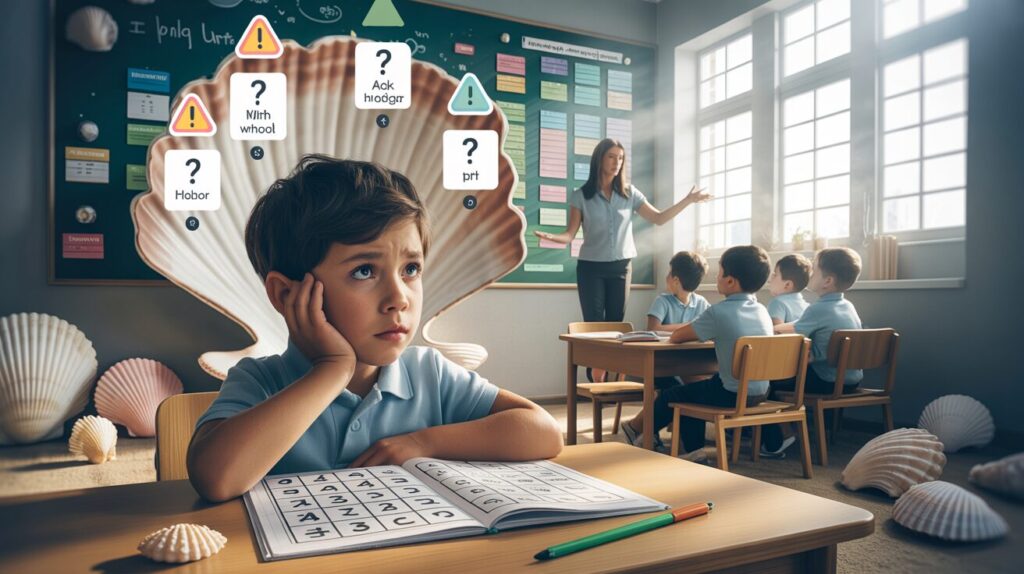
While not strictly an academic issue, exam anxiety and low confidence significantly impact many students’ PSLE Science performance. The pressure associated with this high-stakes examination often causes even well-prepared students to underperform.
Common manifestations of exam anxiety include mental blocks during the examination, second-guessing correct answers, overthinking straightforward questions, and physical symptoms like increased heart rate or nausea that interfere with concentration.
For many students, previous negative experiences with Science assessments create a self-fulfilling prophecy of poor performance. They approach the subject with the belief that it’s “too difficult” or that they’re “not good at Science,” creating psychological barriers to effective learning and examination performance.
How to Avoid This Mistake:
At Seashell Academy by Suntown Education Centre, we recognize that academic excellence must be paired with emotional well-being and confidence. Our approach addresses the psychological aspects of exam preparation through several strategies:
We incorporate regular, low-stakes assessments that mirror the PSLE format, helping students become comfortable with the examination environment without the pressure. These practice sessions gradually build confidence as students see their improvement over time.
Our experienced MOE-trained educators provide not just academic guidance but also emotional support. They help students develop positive self-talk and visualization techniques that combat negative thought patterns about Science examinations.
Through our small class sizes, we ensure personalized attention that addresses each student’s specific anxieties and learning needs. This supportive environment allows students to ask questions without fear of judgment and receive immediate reinforcement for their progress.
We also teach specific exam-day strategies like structured breathing techniques, progressive muscle relaxation, and mental focusing exercises that students can use if they feel anxiety mounting during the actual examination.
Unlike approaches that focus solely on content knowledge, our P6 Chinese Programme philosophy of nurturing resilient learners applies across subjects, helping students develop emotional regulation skills that benefit them in Science and beyond.
Conclusion: Building Science Mastery Beyond PSLE
Avoiding these 8 critical mistakes can significantly improve your child’s PSLE Science performance. At Seashell Academy by Suntown Education Centre, we believe that true Science education goes beyond merely avoiding errors—it’s about fostering genuine understanding, curiosity, and confidence in scientific thinking.
Our Seashell Method addresses both the academic and psychological aspects of Science learning. By combining structured content mastery with mind-mapping approaches and emotional support, we prepare students not just for examination success but for lifelong learning in Science.
Unlike conventional tuition approaches that focus on drilling and memorization, our holistic methodology develops students who can think critically, apply concepts flexibly, and approach new scientific problems with confidence. These skills extend far beyond the PSLE examination room, preparing students for secondary school Science and beyond.
The journey to Science mastery is unique for each child. Some may struggle with concept application while others face challenges with time management or exam anxiety. Our personalized coaching approach in small classes ensures that each student receives the specific support they need to overcome their particular obstacles.
Remember that PSLE Science success isn’t built overnight. It requires consistent practice, guidance from experienced educators, and a supportive environment that nurtures both academic excellence and emotional well-being. At Seashell Academy, we’re committed to providing this balanced approach to help every student achieve their full potential in Science.
Ready to help your child overcome these common PSLE Science mistakes? Seashell Academy by Suntown Education Centre offers specialized Science programs designed to build both knowledge and confidence. Our experienced MOE-trained educators use the proven Seashell Method to nurture resilient, capable young scientists who excel not just in examinations but in their understanding of the world around them.