Master Multiple-Choice Comprehension Questions: Essential Strategies for Primary School Students
November 14, 2025
10 Essential Chinese Proverbs That Help Children Navigate Life’s Challenges
November 16, 2025
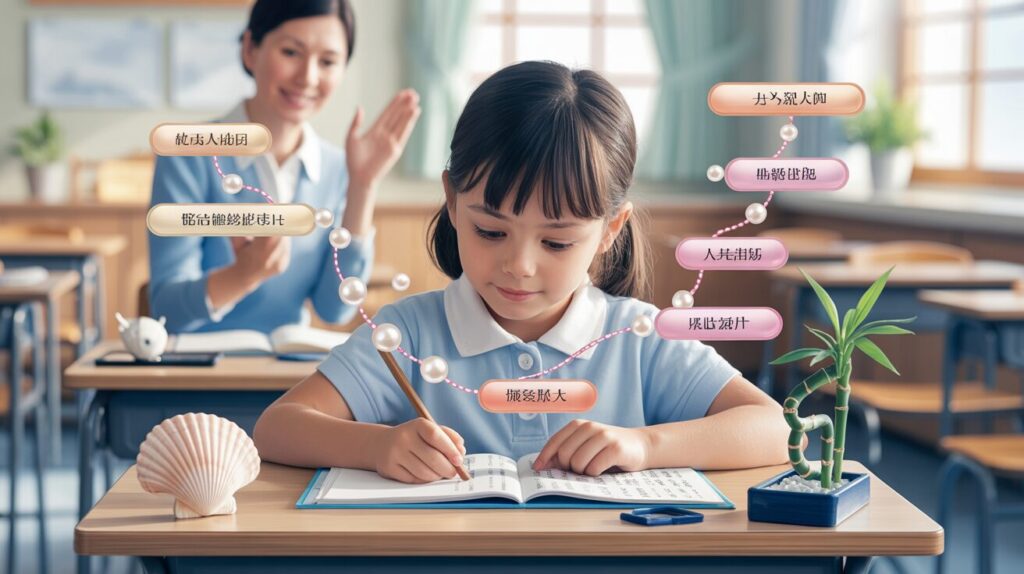
Table Of Contents
- Introduction to Chinese Transition Words
- Why Transition Words Matter in Chinese Compositions
- Sequential Transition Words (顺序过渡词)
- Cause and Effect Transition Words (因果过渡词)
- Comparison and Contrast Transition Words (比较过渡词)
- Addition and Emphasis Transition Words (补充过渡词)
- Summary and Conclusion Transition Words (总结过渡词)
- Practical Application in Compositions
- Common Mistakes to Avoid
- Practice Exercises
- Conclusion
Imagine reading a story that jumps abruptly from one idea to another, leaving you confused about how the events connect. In Chinese composition writing, transition words (过渡词) serve as the invisible bridges that link sentences and paragraphs, creating a smooth flow of ideas that guides readers through your narrative. For primary school students preparing for PSLE Chinese examinations, mastering these connecting phrases is not just about improving writing style—it’s about effectively communicating ideas in a coherent and persuasive manner.
At Seashell Academy by Suntown Education Centre, we understand that many students struggle with connecting their thoughts logically in Chinese essays. The challenge often lies not in lacking ideas but in presenting them in a way that feels natural and connected. This comprehensive guide breaks down Chinese transition words by category, provides clear examples, and offers practical guidance on incorporating them into compositions to enhance clarity, coherence, and overall writing quality.
Whether you’re a Primary 4 student just beginning to write complex compositions or a Primary 6 student refining your skills for the PSLE, this complete list of Chinese transition words will become an invaluable resource in your Chinese language learning journey.
Why Transition Words Matter in Chinese Compositions
Transition words in Chinese compositions are not mere decorative elements; they are essential components that determine how effectively your ideas connect and flow. Here’s why they deserve special attention in your Chinese writing practice:
Enhanced Readability: Transition words guide your readers through the logical progression of your ideas, making your composition easier to follow and understand. They act as signposts that indicate where your narrative is heading.
Improved Coherence: A coherent essay demonstrates clear thinking. By using appropriate transition words, you show examiners that you can organize your thoughts systematically and present arguments logically.
Higher Marks in Examinations: PSLE Chinese composition marking schemes specifically evaluate language use and organization. Appropriate use of transition words demonstrates language proficiency and can significantly impact your composition scores.
Natural Expression: Native Chinese speakers naturally incorporate transition words in their speech and writing. Mastering these words helps you sound more natural and fluent in your Chinese expression.
In our P4 Chinese Programme, P5 Chinese Programme, and P6 Chinese Programme at Seashell Academy, we emphasize the practical application of transition words through our unique Seashell Method. Rather than memorizing lists, students learn to use these words in context through structured composition exercises that gradually build confidence and proficiency.
Sequential Transition Words (顺序过渡词)
Sequential transition words help establish the chronological order of events or the logical sequence of ideas. They are particularly useful in narrative compositions where you need to describe a series of events clearly.
Time Sequence Words
These words indicate when events happen in relation to each other:
- 首先 (shǒu xiān) – First, firstly
- 其次 (qí cì) – Second, secondly, next
- 然后 (rán hòu) – Then, afterward
- 接着 (jiē zhe) – Subsequently, following that
- 最后 (zuì hòu) – Finally, lastly
- 从前 (cóng qián) – Before, previously
- 以前 (yǐ qián) – Previously, before
- 以后 (yǐ hòu) – After, afterwards
- 同时 (tóng shí) – Meanwhile, at the same time
- 此时 (cǐ shí) – At this moment
Process Sequence Words
These transitions help explain steps in a process or procedure:
- 起初 (qǐ chū) – Initially, at the beginning
- 开始 (kāi shǐ) – To begin with
- 接下来 (jiē xià lái) – Next, following
- 随后 (suí hòu) – Subsequently
- 紧接着 (jǐn jiē zhe) – Immediately after
- 终于 (zhōng yú) – Finally, at last
Example sentence using sequential transitions:
首先,我们要准备材料。其次,我们需要按照说明书组装。然后,进行测试。最后,记录结果。
(First, we need to prepare the materials. Second, we need to assemble according to instructions. Then, conduct testing. Finally, record the results.)
Cause and Effect Transition Words (因果过渡词)
Cause and effect transition words establish logical relationships between ideas, showing how one event or situation leads to another. These are particularly important in explanatory and argumentative writing.
Cause Transitions
These words introduce reasons or causes:
- 因为 (yīn wèi) – Because, since
- 由于 (yóu yú) – Due to, owing to
- 基于 (jī yú) – Based on, because of
- 之所以 (zhī suǒ yǐ) – The reason why
- 既然 (jì rán) – Since, given that
Effect Transitions
These words introduce results or consequences:
- 所以 (suǒ yǐ) – Therefore, so
- 因此 (yīn cǐ) – Thus, as a result
- 于是 (yú shì) – Consequently, hence
- 结果 (jié guǒ) – As a result
- 为此 (wèi cǐ) – For this reason
- 导致 (dǎo zhì) – Lead to, result in
Example sentence using cause-effect transitions:
由于下雨,所以我们取消了野餐计划。
(Due to the rain, we canceled our picnic plans.)
Comparison and Contrast Transition Words (比较过渡词)
These transition words help you highlight similarities and differences between ideas, concepts, or situations. They are essential for comparing and contrasting in argumentative or descriptive compositions.
Similarity Transitions
Words that show similarities:
- 同样 (tóng yàng) – Similarly, likewise
- 相似 (xiāng sì) – Similarly
- 也 (yě) – Also, too
- 不但…而且… (bù dàn… ér qiě…) – Not only… but also…
- 与此相似 (yǔ cǐ xiāng sì) – Similar to this
Contrast Transitions
Words that show differences or unexpected outcomes:
- 但是 (dàn shì) – But, however
- 可是 (kě shì) – But, yet
- 然而 (rán ér) – However, nevertheless
- 相反 (xiāng fǎn) – On the contrary, conversely
- 尽管 (jǐn guǎn) – Although, despite
- 虽然…但是… (suī rán… dàn shì…) – Although… however…
- 与…不同 (yǔ… bù tóng) – Unlike, different from
- 反而 (fǎn ér) – Instead, on the contrary
Example sentence using comparison transitions:
哥哥喜欢踢足球,相反,弟弟更喜欢游泳。
(Big brother likes to play soccer; in contrast, little brother prefers swimming.)
Addition and Emphasis Transition Words (补充过渡词)
Addition and emphasis transition words help you introduce additional information, elaborate on ideas, or emphasize important points. These transitions enrich your compositions by allowing you to provide supporting details and reinforce key arguments.
Addition Transitions
Words that introduce additional information:
- 此外 (cǐ wài) – In addition, moreover
- 另外 (lìng wài) – Additionally, furthermore
- 而且 (ér qiě) – Moreover, and also
- 还有 (hái yǒu) – Also, there is also
- 除此之外 (chú cǐ zhī wài) – Besides this, apart from this
- 不仅如此 (bù jǐn rú cǐ) – Not only this
Emphasis Transitions
Words that highlight or emphasize important points:
- 尤其 (yóu qí) – Especially, particularly
- 特别是 (tè bié shì) – Especially, particularly
- 更重要的是 (gèng zhòng yào de shì) – More importantly
- 值得注意的是 (zhí dé zhù yì de shì) – It is worth noting that
- 事实上 (shì shí shàng) – In fact, actually
- 确实 (què shí) – Indeed, truly
Example sentence using addition transitions:
这所学校的设施非常好,此外,老师们也很有耐心。
(This school has excellent facilities; moreover, the teachers are very patient.)
Summary and Conclusion Transition Words (总结过渡词)
Summary and conclusion transition words help you wrap up your ideas and bring your composition to a satisfying close. They signal to the reader that you are reaching the end of your argument or narrative.
Summary Transitions
Words that indicate you are summarizing information:
- 总之 (zǒng zhī) – In summary, in short
- 简言之 (jiǎn yán zhī) – In brief, to put it simply
- 综上所述 (zōng shàng suǒ shù) – To sum up the above
- 概括来说 (gài kuò lái shuō) – To summarize
Conclusion Transitions
Words that indicate you are concluding your essay:
- 最终 (zuì zhōng) – Eventually, ultimately
- 总而言之 (zǒng ér yán zhī) – All in all, in conclusion
- 归根结底 (guī gēn jié dǐ) – Fundamentally, in the final analysis
- 最后 (zuì hòu) – Finally, in the end
- 总结来说 (zǒng jié lái shuō) – In conclusion
Example sentence using summary transitions:
综上所述,保护环境是每个人的责任。
(To summarize the above, protecting the environment is everyone’s responsibility.)
Practical Application in Compositions
Understanding transition words is only the first step; applying them effectively in your compositions is where true mastery happens. At Seashell Academy by Suntown Education Centre, we guide students through a practical, step-by-step approach to incorporating transition words naturally in their writing.
Planning Your Composition Structure
Before writing, take a few minutes to plan your composition structure. Identify the main points you want to make and consider which transition words would best connect these ideas. This pre-writing organization helps you select appropriate transitions that create a logical flow throughout your composition.
In our Programme Philosophy, we emphasize mind-mapping techniques that help students visualize connections between ideas. This visual approach makes it easier to identify where transition words are needed to create smooth connections.
Varying Your Transition Words
One common mistake students make is using the same transition words repeatedly. Challenge yourself to use a variety of transitions appropriate to different contexts. Instead of always using “然后” (then) to sequence events, try alternating with “接着” (next), “随后” (subsequently), or “紧接着” (immediately after) for greater variety and precision.
Keep in mind that different types of compositions may require different transitions. Narrative compositions often rely heavily on sequential transitions, while argumentative essays may use more cause-effect and comparison transitions.
Creating Paragraph Transitions
Transition words are particularly important at the beginning of paragraphs, where they help connect the new paragraph to the previous one. Consider how each paragraph relates to the one before it:
– If adding a similar idea, use addition transitions like “此外” (moreover) or “另外” (furthermore).
– If introducing a contrasting viewpoint, use contrast transitions like “然而” (however) or “相反” (on the contrary).
– If explaining consequences, use effect transitions like “因此” (therefore) or “结果” (as a result).
This intentional selection of paragraph transitions creates a cohesive essay where ideas flow naturally from one to the next.
Common Mistakes to Avoid
Even students with good knowledge of transition words can make mistakes in their application. Here are some common pitfalls to avoid:
Overusing Transition Words
Using too many transition words can make your writing feel mechanical and disrupt the natural flow. Aim for balance—use transitions where they clarify relationships between ideas, but don’t force them into every sentence.
Example of overuse:
首先,我去了超市。然后,我买了水果。接着,我付了钱。随后,我回家了。最后,我吃了水果。
Improved version:
我去了超市买水果,付完钱后就回家了,然后享用了新鲜的水果。
Misusing Transition Words
Using transitions that don’t accurately reflect the relationship between ideas can confuse readers. Make sure you understand the precise meaning and usage of each transition word.
Incorrect usage:
我很喜欢这部电影,但是我朋友也很喜欢。 (I really like this movie, but my friend also likes it.)
Correct usage:
我很喜欢这部电影,而且我朋友也很喜欢。 (I really like this movie, and my friend also likes it.)
Forced Transitions
Sometimes the best connection between ideas is implicit and doesn’t require an explicit transition word. Forcing transitions where they’re not needed can make your writing sound unnatural.
Instead of focusing on using a certain number of transition words, concentrate on clarifying the logical relationships between your ideas. If the relationship is already clear, an additional transition word may be unnecessary.
Practice Exercises
At Seashell Academy by Suntown Education Centre, we believe in learning through practice. Here are some exercises that can help you become more comfortable with using transition words in your Chinese compositions:
Fill-in-the-Blank Exercise
Complete the following sentences with appropriate transition words:
1. 天气预报说今天会下雨,_______,我带了雨伞。
2. 小明很努力学习,_______,他的成绩还是不理想。
3. _______,我们要收集材料;_______,我们要分析数据;_______,我们要写报告。
4. 这家餐厅的食物很好吃,_______,价格也很合理。
5. _______他生病了,他还是来上学了。
(Possible answers: 1. 因此/所以 2. 然而/但是 3. 首先,其次,最后 4. 而且/此外 5. 尽管/虽然)
Paragraph Connection Exercise
Practice connecting the following paragraphs with appropriate transition words:
Paragraph 1: 现代科技给我们的生活带来了很多便利。智能手机让我们可以随时随地与他人联系。电脑帮助我们快速获取信息。
Paragraph 2: 科技也带来了一些问题。很多人沉迷于电子设备,减少了面对面交流。有些人因为长时间使用电子产品而影响健康。
(Possible transition: 然而/可是/另一方面)
Through regular practice with exercises like these, students at Seashell Academy develop a natural instinct for when and how to use transition words effectively. Our Mathematics Programme similarly emphasizes logical connections between concepts, reinforcing the same cognitive skills needed for effective composition writing.
Conclusion
Mastering transition words in Chinese compositions is a journey that takes time and practice, but the impact on your writing quality is substantial. These seemingly small connecting phrases have the power to transform a disconnected series of sentences into a flowing, coherent narrative that engages readers and clearly communicates your ideas.
At Seashell Academy by Suntown Education Centre, we recognize that truly effective use of transition words goes beyond memorization. Through our structured learning plans and interactive lessons, students learn to identify the logical relationships between ideas and select the most appropriate transitions to express these relationships clearly.
Remember that the goal of using transition words is not to impress examiners with sophisticated vocabulary but to enhance the clarity and coherence of your writing. As you practice incorporating these words into your compositions, you’ll find your writing becoming more fluid, your arguments more persuasive, and your narratives more engaging.
With consistent practice and guidance, you’ll develop an intuitive sense for when and how to use transition words effectively, an essential skill not just for PSLE Chinese compositions but for all future Chinese writing endeavors.
Mastering transition words is a critical step in becoming proficient in Chinese composition writing. These connecting phrases do more than just link sentences—they reveal the logical thinking behind your writing and demonstrate your ability to organize and express ideas coherently.
At Seashell Academy by Suntown Education Centre, we encourage students to view transition words as valuable tools that enhance communication rather than as mere requirements to fulfill. Through our student-centered approach, we help primary school students build confidence in their Chinese writing abilities, developing skills that extend far beyond examination success.
As you continue to practice and refine your use of transition words, you’ll find your Chinese compositions becoming more sophisticated, your expression more precise, and your overall command of the language stronger. This comprehensive list serves as your reference guide, but true mastery comes through consistent application in your regular writing practice.
Want to help your child master Chinese composition writing and excel in their PSLE Chinese examinations? Seashell Academy by Suntown Education Centre offers specialized Chinese language programs designed specifically for Primary 1-6 students. Our experienced MOE-trained educators use the unique Seashell Method to nurture both academic excellence and a genuine love for the Chinese language.
Small class sizes ensure personalized attention, while our structured learning plans and interactive lessons make Chinese composition writing engaging and accessible. Don’t let language barriers hold your child back from achieving their full potential.
Contact us today at Seashell Academy to learn more about our Chinese language programs or to schedule an assessment session.